



2,000-year-old love note and gladiator fight scene discovered on Pompeii wall
By
Emily Mae Czachor
news editor
Emily Mae Czachor is a reporter and news editor at News. Typically covers breaking news, extreme weather, and social justice issues. Emily Mae previously wrote for outlets including the Los Angeles Times, BuzzFeed, and Newsweek.
Read full biography
/News themezone
Add News themezone on Google
A 2,000-year-old love note and an illustrated gladiator fight scene are among ancient inscriptions recently discovered on a wall in Pompeii, the archaeological park announced this week.
Considered the graffiti of their time, the inscriptions also included stories about daily life, sporting events, passions and insults, carved in a passage connecting Pompeii’s theater district with one of its main streets. The wall was excavated more than 230 years ago, but some 300 inscriptions engraved on it remained hidden until new technologies allowed researchers to identify them.
Efforts to expose the writings were part of a project called Corridor Rumors, led by Louis Autin and Éloïse Letellier-Taillefer of the Sorbonne University in Paris, and Marie-Adeline Le Guennec of the University of Quebec in Montreal, who collaborated with the Pompeii Archaeological Park. In two waves conducted in 2022 and again in 2025, researchers used various archaeological and computer imaging techniques to resurface the lost messages.
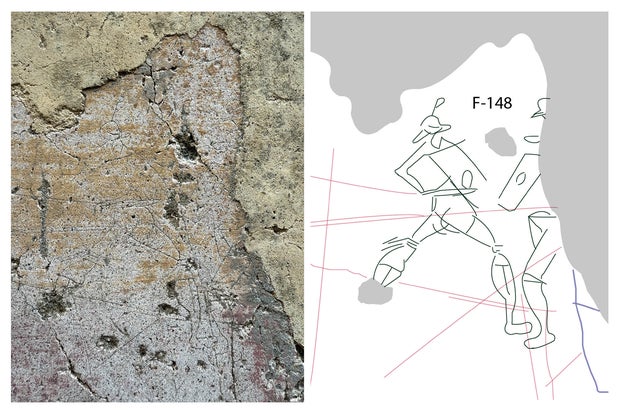
“I’m in a hurry; take care, my Sava, be sure to love me!” reads in an inscription that has resurfaced on the wall, according to the archaeological park, which says the writings “bear witness to the vitality, the multiplicity of interactions and forms of sociability, that developed in a public space so frequented by the inhabitants of ancient Pompeii.”
Once a bustling Roman city in what is now southern Italy, Pompeii was buried under piles of volcanic ash and pumice following the eruption of Mount Vesuvius in AD 79. The catastrophic incident left the area frozen in time. Now a UNESCO World Heritage Site, Pompeii has become a popular tourist attraction as well as a source of ongoing archaeological exploration.
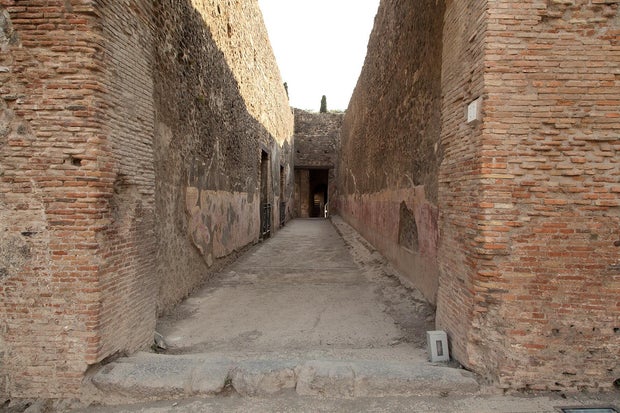
“Technology is the key that unlocks new rooms of the ancient world, and we must also share those rooms with the public,” archaeological park director Gabriel Zuchtriegel said in a statement about the latest discoveries. “We are working on a project to protect and value the writings, which number more than 10,000 throughout Pompeii, an immense heritage. Only the use of technology can guarantee a future for all this memory of the life lived in Pompeii.”
In:
- Pompeii
- Italy