



Trump cuts tariffs on China after
/News themezone
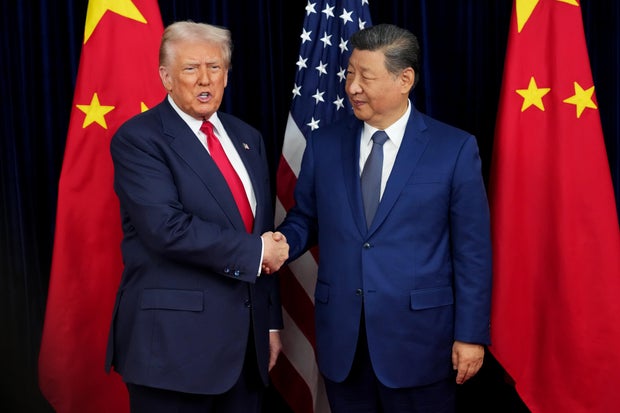
Washington — President Trump said Thursday he will reduce U.S. tariffs on Chinese goods after meeting Chinese President Xi Jinping for a high-stakes summit in South Korea amid a months-long trade war between the world’s two largest economies.
“On the scale of zero to 10, with 10 being the best, I would say the meeting was a 12,” Trump told reporters on Air Force One as he flew back to Washington from the South Korean city of Busan. He called his more than 90-minute session with Xi an “incredible meeting” and a “great success.”
Trump told reporters that “we have a deal” on trade and said he hopes to sign it “very soon,” although he is likely to renegotiate it in the coming years. “We finalized many things” during Thursday’s discussions, the president added, calling Xi a “tremendous leader of a very powerful country.”
Trump said he decided to reduce his overall tariff rate on imports of Chinese goods from 57% to 47%, following Xi’s promises to reduce shipments of fentanyl ingredients to the United States. 47% levies It would still leave China with one of the highest tariff rates imposed by the United States.
He also told reporters that China will resume purchasing American soybeans “immediately” after a boycott by China left American farmers reeling, and said a conflict over Chinese restrictions on rare earth exports was “resolved.” Details about those agreements remain scarce.
He told reporters that he would go to China in April for new talks and that Xi “will come here at some point later, either to Florida, Palm Beach or Washington, DC.”
The two leaders met at a South Korean military base at the end of Trump’s nearly week-long trip to Asia.
Before the meeting, Trump said he has a good relationship with Xi “but he’s a very tough negotiator. That’s not good.”
Xi said trade negotiators from both sides have made progress in addressing “major concerns” and believes the United States and China should be “partners and friends.”
“Given our different national conditions, we do not always agree, and it is normal for the world’s two major economies to have friction from time to time,” Xi said through an interpreter, although he noted that relations have been “generally stable.”
China is the United States’ third largest trading partner, only behind Mexico and Canada. The United States bought $438.9 billion in Chinese goods last year, while China bought $143.5 billion in U.S. goods.
The two sides briefly imposed massive retaliatory tariffs on each other in April, before delaying them to buy time for negotiations. In August, Trump signed an executive action delaying the reinstatement of higher tariffs on Chinese goods for another 90 days, extending the pause until mid-November.
U.S. and Chinese officials have been holding trade talks for months ahead of Thursday’s Trump-Xi meeting.
Earlier this month, Trump threatened to impose an additional 100% tariff rate on Chinese products starting Nov. 1 in retaliation for China’s increased export controls on rare earth minerals and magnets, which would raise total tariffs on Chinese imports to 155%. China has the vast majority of the world’s supply of those raw materials, critical for manufacturing in key technology areas such as semiconductors and missiles. Those additional 100% tariffs are “effectively off the table” for now, Treasury Secretary Scott Bessent said Sunday on “Face the Nation with Margaret Brennan.”
Bessent said he also hopes that Trump and Xi sign a deal On Thursday it placed TikTok under majority American ownership, although Chinese-owned ByteDance could still have a minority stake of less than 20%.
Defense is another point of tension between China and the US.
Trump’s first secretary of state, Mike Pompeo, said he should commit to Taiwan independence.
“Xi Jinping is expected to press President Trump to clarify the US stance toward Taiwan at their meeting this week,” Pompeo wrote on social media. “The United States should honor and affirm our unequivocal commitment to Taiwan’s sovereignty and independence from Beijing.”
But on the trip home, Trump told reporters that he and Xi did not talk about Taiwan.
Furthermore, moments before the meeting with Xi began, Trump wrote in Truth Social that he had ordered the Pentagon to restart nuclear weapons testing. and the president he said early Wednesday that will allow South Korea, China’s rival, to develop a nuclear-powered submarine.
The last time Trump and Xi met in person was on the sidelines of the Group of 20 summit in Japan in 2019, during Trump’s first term, although the two leaders spoke by phone. The last conversation the White House revealed between the two men was on September 19.
Busan, known as an educational and cultural center along Korea’s southeastern coast, is South Korea’s second most populous city behind its capital, Seoul. The meeting with Xi is the last item on Trump’s agenda for his five-day tour of Asia, concluding a trip aimed primarily at strengthening economic ties and cementing trade deals in the South Pacific region.
In:
- South Korea
- Porcelain