



Ohio panel, Virginia lawmakers move forward with congressional redistricting plans
An Ohio panel on Friday adopted new districts in the U.S. House of Representatives that could boost the Republican Party’s chances of gaining two additional seats in next year’s elections and help President Donald Trump’s efforts to maintain a slim majority in Congress.
The action by the Ohio Redistricting Commission came as Virginia’s Democrat-led General Assembly introduced a proposed constitutional amendment that could pave the way for redistricting in the state before the 2026 congressional elections. That measure needs another round of legislative approval early next year before it can reach voters.
Trump has been urging Republican-led states to redraw their districts in the US House of Representatives in a bid to gain more seats. But unlike other states, redistricting in Ohio was required by the state constitution because the current districts were adopted after the 2020 census without bipartisan support.
Ohio joins Texas, Missouri and North Carolina, where Republican lawmakers have already revised congressional districts.
Democrats have been responding. California voters will decide Tuesday on a redistricting plan approved by the Democratic-led Legislature.

Kim Kyung-Hoon/Pool photo via AP
Political parties are in an intense battle, because Democrats need to gain just three seats in next year’s elections to gain control of the House and gain the power to thwart Trump’s agenda.
In a rare episode of bipartisanship, Ohio’s new map won support from all five Republicans and two Democrats on the redistricting panel. The Democratic Congressional Campaign Committee praised Ohio Democrats “for negotiating to avoid even more egregious gerrymandering” to benefit Republicans.
Republicans hold 10 of Ohio’s 15 congressional seats. The new map could boost his chances in already competitive districts currently held by Democratic Reps. Greg Landsman in Cincinnati and Marcy Kaptur near Toledo. Kaptur won a 22nd term last year by about 2,400 votes, or less than 1 percentage point, in a district dominated by Trump. Landsman won re-election with more than 54% of the vote.
National Democrats said they hope to keep both districts drawn and compete to flip three more Republican seats.
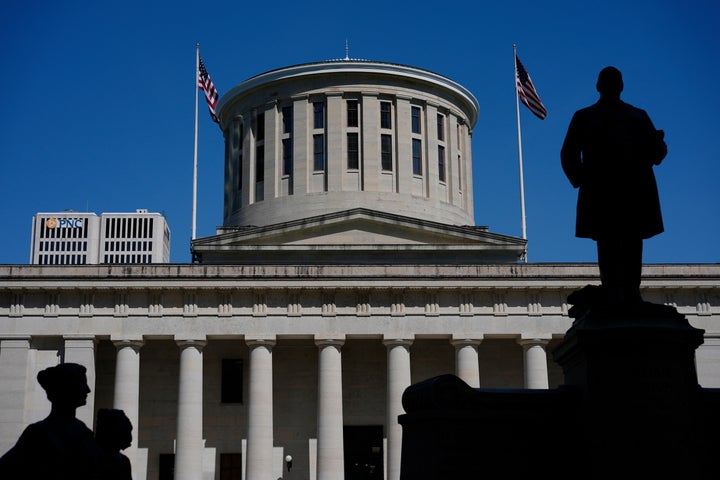
Carolyn Kaster via AP
Ohio residents criticize new map
The Ohio commission had a Friday deadline to adopt a new map, or the task would have fallen to the GOP-led Legislature, which could have created even more Republican-friendly districts. Any redistricting bill passed by the Legislature could have been subject to an initiative petition campaign by opponents forcing a public referendum on the new map.
That uncertainty gave commissioners of both parties some incentive to reach an agreement. House Minority Leader Dani Isaacsohn, a Democratic commissioner, said the deal “averts the disaster that was coming” with a potential 13-2 map that would favor Republicans. And Republican Secretary of State Frank LaRose, another commissioner, said he avoided a costly referendum battle that could have delayed the state’s primary.
But Ohioans who testified before commissioners Friday decried the new districts. Julia Cattaneo, whose T-shirt proclaimed “gerrymandering is cheating,” said the new map is more rigged for Republicans than the one it is replacing and is not the kind of compromise needed.
“Yes, you are compromising your integrity, your honor, your duty and that of representing Ohioans,” he said.
Resident Scott Sibley added: “This map is an affront to democracy, and all of you, every single one of you, should be ashamed.”
Republican Auditor Keith Farber, a member of the commission, defended the map during a testy exchange with an opponent. Because many Democrats live in cities and many Republicans live in rural areas, he said there was no way to draw eight Republican and seven Democratic districts — as some had urged — without dividing cities, counties and townships.
Virginia Democrats point to Trump to defend redistricting
Virginia is represented in the United States House of Representatives by six Democrats and five Republicans. Democratic lawmakers have not revealed what new map they are planning or how many seats they will try to gain, but they said their moves are necessary to respond to Trump-inspired gerrymandering in Republican-led states.
“Our voters are asking to have that voice. They are asking that we protect democracy, that we not allow gerrymandering to happen across the country, and we sit down,” said Democratic Senator Barbara Favola.
The proposed constitutional amendment would allow lawmakers to temporarily bypass a bipartisan commission and redraw congressional districts to their advantage. Senate approval on Friday followed House approval on Wednesday.
The developments come as Virginia holds elections on Tuesday, where all 100 state House seats are on the ballot. Democrats would need to maintain their slim majority to advance the constitutional amendment again next year. A statewide referendum would then be held.
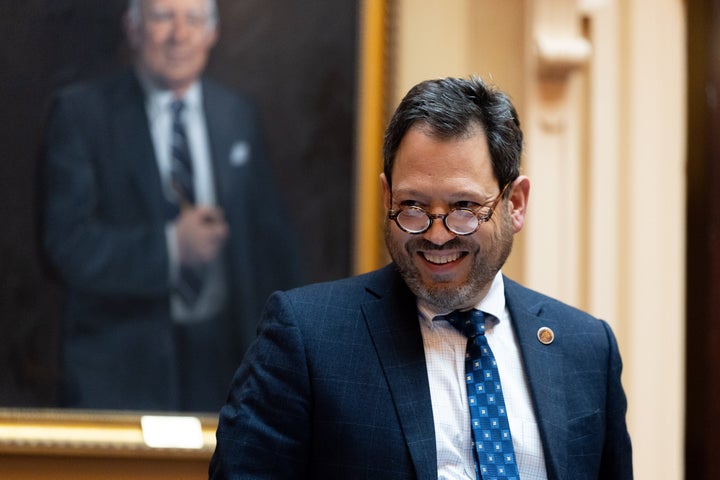
Mike Kropf via AP
Republican Sen. Mark Obenshain said Democrats were ignoring the will of voters who overwhelmingly approved the bipartisan redistricting commission.
“God forbid we actually join arms and work together on something,” Obenshain said. “What Virginia voters said is, ‘We hope that redistricting is an issue that we work on across both parties, that we are united on.’”
But Democratic Sen. Schuyler VanValkenburg, who has long advocated for the bipartisan redistricting commission, noted that it would still be responsible for redistricting after the 2030 census.
“We’re not trying to end the practice of fair maps,” he said. “We are asking voters whether, in this limited case, they want to ensure that a president who breaks constitutional rules cannot ruin the entire national election by twisting the arms of a few state legislatures.”
Indiana and Kansas could be next
Indiana Republican Gov. Mike Braun called a special session beginning Monday to redraw congressional districts, currently held by seven Republicans and two Democrats. But lawmakers do not plan to start work that day. Although it is unclear exactly when lawmakers will meet, state law allows 40 days to complete a special session.
In Kansas, Republican lawmakers are trying to collect enough signatures from their colleagues to convene a special session on congressional redistricting starting Nov. 7. Senate President Ty Masterson says he has the necessary two-thirds of the votes in the Senate, but House Republicans have at least some obstacles. The petition is necessary because Democratic Gov. Laura Kelly is unlikely to call a session to redraw the current districts, held by three Republicans and one Democrat.
___
Forget the dance hallsHelp build anewsroom
Your supportFuelsOur mission
Your supportFuelsOur mission
Become a News themezone Member
When power accumulates under gilded ceilings, true journalism remains outside, asking the questions that matter. Join the News themezone membership and keep independent reporting strong for everyone.
We remain committed to bringing you the unwavering, fact-based journalism everyone deserves.
Thank you again for your support along the way. We are truly grateful for readers like you! Your early support helped get us here and strengthened our newsroom, keeping us strong in uncertain times. As we continue, we need your help more than ever. We hope you will join us once again.
We remain committed to bringing you the unwavering, fact-based journalism everyone deserves.
Thank you again for your support along the way. We are truly grateful for readers like you! Your early support helped get us here and strengthened our newsroom, keeping us strong in uncertain times. As we continue, we need your help more than ever. We hope you will join us once again.
News themezone Support
Are you already a member? Sign in to hide these messages.
Lieb reported from Jefferson City, Missouri; Scolforo of Harrisburg, Pennsylvania; and Diaz of Richmond, Virginia. John Hanna in Topeka, Kansas, and Isabella Volmert in Lansing, Michigan, contributed.