



Energy Secretary Provides More Clarity on Trump
WEST PALM BEACH, Fla. (AP) — New tests of the U.S. nuclear weapons system ordered by President Donald Trump will not include nuclear explosions, Energy Secretary Chris Wright said Sunday.
It was the first clarity from the Trump administration since the president took to social media last week to say he had “directed the War Department to begin testing our nuclear weapons on a level playing field.”
“I think the tests we’re talking about now are tests of the system,” Wright said in an interview on News’ “Sunday Briefing.” “These are not nuclear explosions. They are what we call non-critical explosions.”
Wright, whose agency is responsible for the testing, added that the planned tests involve “all the other parts of a nuclear weapon to make sure they deliver the proper geometry and set up the nuclear explosion.”
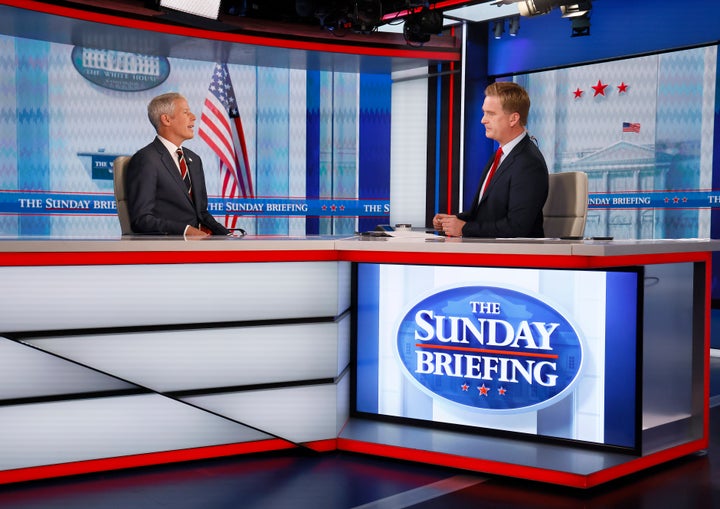
Paul Morigi via Getty Images
Confusion over Trump’s intention began minutes before he held a critical meeting in South Korea with Chinese President Xi Jinping. Trump took to his Truth Social platform and appeared to suggest he was preparing to scrap a decades-old U.S. ban on testing the country’s nuclear weapons.
Later that day, as he returned to Washington, Trump played coy about whether he really meant he was ordering the resumption of explosive testing of nuclear weapons (something only North Korea has undertaken this century) or calling for the testing of U.S. systems that could deliver a nuclear weapon, which is much more routine.
On Friday he was opaque when reporters asked him if he intended to resume underground nuclear detonation tests.
“You’re going to find out very soon,” Trump told reporters aboard Air Force One on Friday, as he headed to Florida for a weekend.
The U.S. military periodically tests its missiles capable of carrying a nuclear warhead, but has not detonated the weapons since 1992. The Comprehensive Nuclear Test Ban Treaty, which the United States signed but did not ratify, has been observed since its adoption by all nuclear-weapons countries, North Korea being the only exception.
Forget the dance hallsHelp build anewsroom
Your supportFuelsOur mission
Your supportFuelsOur mission
Become a News themezone Member
When power accumulates under gilded ceilings, true journalism remains outside, asking the questions that matter. Join the News themezone membership and keep independent reporting strong for everyone.
We remain committed to bringing you the unwavering, fact-based journalism everyone deserves.
Thank you again for your support along the way. We are truly grateful for readers like you! Your early support helped get us here and strengthened our newsroom, keeping us strong in uncertain times. As we continue, we need your help more than ever. We hope you will join us once again.
We remain committed to bringing you the unwavering, fact-based journalism everyone deserves.
Thank you again for your support along the way. We are truly grateful for readers like you! Your early support helped get us here and strengthened our newsroom, keeping us strong in uncertain times. As we continue, we need your help more than ever. We hope you will join us once again.
News themezone Support
Are you already a member? Sign in to hide these messages.
Trump announced his plans to conduct nuclear tests after Russia announced it had tested a new atomic-powered, nuclear-capable submarine drone and a new nuclear-powered cruise missile.
Russia responded to Trump’s comments on nuclear testing by stressing that it did not test its nuclear weapons and has complied with a global ban on nuclear testing.
However, the Kremlin warned that if the United States resumes testing its weapons, Russia will too, an escalation that would reignite Cold War-era tensions.