



Dick Cheney started all this
Few political figures in the past 50 years paved the way more for the country’s current crisis than former Vice President Dick Cheney, who died Monday at the age of 84.
As George W. Bush’s vice president from 2001 to 2009, Cheney promoted the theory of the unitary executive to consolidate power in the presidency, advocated abuses of international and U.S. law in the global war on terrorism, including the use of torture against detainees, and pushed a unilateral foreign policy to invade Iraq that marginalized allies and ultimately upended the entire global order.
Cheney lived long enough to see his vision fulfilled, with a unitary executive operating above and outside the law and an American foreign policy free of alliances and humanitarian laws that would materialize in the form of President Donald Trump’s second administration. In the end, Cheney came to oppose the monster he had created. After endorsing Trump in 2016, Cheney turned her back on him after the January 6, 2021 insurrection and endorsed Democratic Vice President Kamala Harris over Trump in 2024.
This reconsideration of the end of his life, however, does not undo his life’s work.
Born in Lincoln, Nebraska, in 1941, Cheney lived there until his teens, when his family moved to Caspar, Wyoming. After briefly attending and dropping out of Yale University, Cheney returned to Wyoming, where he attended the University of Wyoming and married his high school sweetheart, Lynne (Vincent) Cheney. Despite being of legal age for military service, Cheney received five deferments to avoid the draft in the Vietnam War. “In the ’60s I had other priorities besides military service,” he would later say. Instead, he went to Washington as a promising Republican operative, taking a job as a congressional intern in 1969 before moving to the Nixon White House to work with Donald Rumsfeld in the Office of Economic Opportunity. Cheney would leave for the private sector after Nixon’s re-election in 1972.
Nixon’s second term included a major change in his approach to the presidency, one that would impact Cheney’s political career. Rather than working with a Congress heavily controlled by Democrats, Nixon sought to act unilaterally through the administrative state to counter Congress’s liberal policies. He centralized power in the White House, seized funds appropriated by Congress, diverted agency priorities from those designated by Congress, and set out to implement foreign policy without Congress.
But the paranoia underlying Nixon’s pursuit of unilateral power ultimately became his undoing. The bugging of the Democratic National Committee offices at the Watergate Hotel during the 1972 presidential campaign led to his impeachment and his resignation. Congress also responded to Nixon’s abuses by passing reforms to limit the presidency.
When Vice President Gerald Ford took office in 1974, Cheney returned to the White House as deputy chief of staff under Rumsfeld.
Both Cheney and Rumsfeld, who became Ford’s defense secretary, maintained Nixon’s vision of a powerful presidency uninhibited by Congress, particularly in the realm of foreign policy. Cheney believed that Congress had gone too far in passing laws such as the War Powers Resolution and the Freedom of Information Act that sought to rein in the president, force him to share power with Congress, and provide information to the public. He also vigorously opposed Secretary of State and National Security Advisor Henry Kissinger’s policy of detente with the Soviet Union.
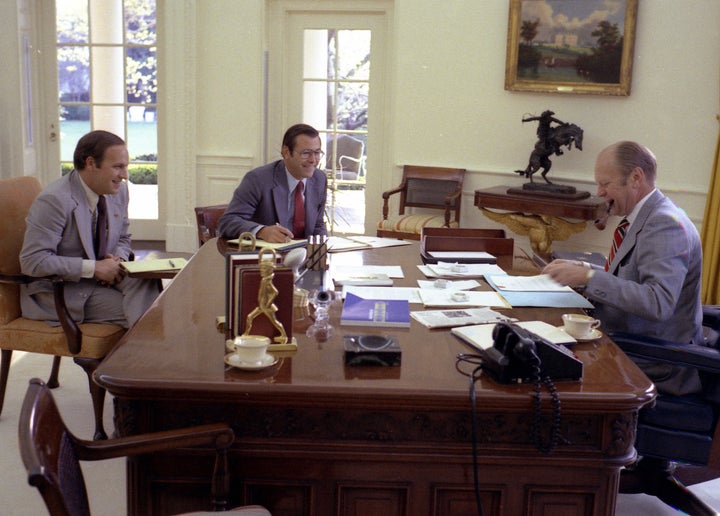
Photo by David Hume Kennerly/White House via CNP/Getty Images
So both Cheney and Rumsfeld secretly set out to undermine all of this. In 1975, they orchestrated the “Halloween Massacre,” forcing the resignation of the CIA director and Kissinger from his White House position as national security advisor and the promotion of Rumsfeld to secretary of defense and Cheney to White House chief of staff. There they undermined Kissinger’s negotiations with the Soviets and pressured Ford to adopt their more aggressive foreign policy priorities.
One result of the Halloween massacre was the promotion of George HW Bush to director of the CIA. Bush appointed a “B Team” to draft an alternative assessment of the threat posed by the Soviet Union. The alternative assessment, staffed by staunch conservatives and hawks (including Rumsfeld’s personal emissary, a young Paul Wolfowitz), used carefully selected intelligence to paint a picture of a growing Soviet threat. Ford and Kissinger attempted to bury the B-Team report, but their incorrect conclusions that the Soviet Union was engaged in a massive arms buildup that needed to be countered would be reflected in Ronald Reagan’s tough stance when he took office.
After Ford’s loss to Jimmy Carter, Cheney ran for Congress in Wyoming, winning a seat on a Republican wave in 1978. There he became a leading conservative voice and the top Republican on the House Intelligence Committee, where he worked to undermine congressional oversight of the Reagan administration. This included defending the Reagan administration when it faced congressional scrutiny over the Iran-Contra scandal.
When George HW Bush won the presidency in 1988, Cheney was named secretary of defense. In that role he worked to undermine Colin Powell, chairman of the Joint Chiefs of Staff, during the run-up to the first Gulf War. Echoing Team B’s playbook, Cheney had Wolfowitz and his aide Lewis “Scooter” Libby draw up alternative plans for the invasion of Iraq. Cheney also pressured Bush to bypass Congress by invading Iraq without congressional authorization. Bush ignored both of Cheney’s requests.
Bush lost re-election to Bill Clinton in 1992 and Cheney returned to the private sector. He was named CEO of oilfield services company Halliburton in 1995 and remained there until 2001, when he became vice president. However, he did not abandon political activism during this period. In 1997, he was a key signatory of the Project for a New American Century, a neoconservative think tank that advocated the overthrow of Iraqi dictator Saddam Hussein and the use of American military power to unilaterally reshape the world.
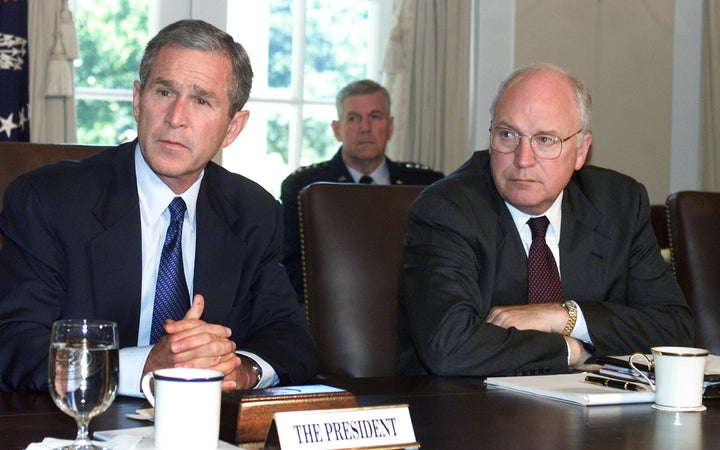
When George W. Bush won the Republican presidential nomination in 2000, he tapped Cheney to lead the search for his vice president. Cheney ultimately chose himself. The Bush administration, which barely eked out a victory thanks to an infamous Supreme Court decision, seemed at first like one of those accidental presidencies doomed to a single term. But events have a curious way of altering history.
On September 11, 2001, terrorists affiliated with Al Qaeda crashed two hijacked planes into the World Trade Center, another into the Pentagon, and a fourth was crashed by passengers in a field in Pennsylvania.
“Our war on terrorism begins with Al Qaeda, but it does not end there,” Bush said on September 20, 2001. “It will not end until all global terrorist groups have been found, stopped and defeated.”
Mark Wilson via Getty Images
From his work on the B Team to his defense of Iran-Contra and his efforts to seize control of the first Gulf War, Cheney had prepared for this moment. Centralizing power in his office, Cheney became the architect of the war on terrorism, pursuing a secret policy that viewed the White House as a unitary actor and international law as mere pieces of paper.
“However, we also have to work, on a kind of dark side, so to speak,” Cheney told NBC’s Tim Russert on September 16, 2001. “We have to spend time in the shadows in the intelligence world. Much of what needs to be done here will have to be done quietly, without any discussion, using sources and methods that are available to our intelligence agencies, if we are to be successful.”
And so the country would go to the dark side.
After the capture of suspected Al Qaeda member Abu Zubaydah, who was believed to be a “high-level detainee,” a characterization later deemed dubious, the administration rushed to extract information from him. In the CIA’s clandestine prisons, American and foreign interrogators tortured Zubaydah in March and April 2002. These interrogations led the Justice Department to retroactively approve torture techniques by issuing legal opinions known as the Torture Memorandums.
“I approved; others did too,” Cheney said in an interview from 2008.
CIA interrogators waterboarded Zubaydah 83 times, subjected him to sensory and sleep deprivation, stripped him naked, confined him in a box, held him in stress positions, punched and kicked him, pulled a collar around his neck, exposed him to cold temperatures for prolonged periods, and denied him food. FBI interrogators who interviewed Zubaydah before his torture reported that he had already given up all useful information he had before he was tortured.
What he did say after being tortured was that Al Qaeda and Hussein were working together. The Bush administration had asked interrogators to find those links. This “intelligence” would find its way into the government’s arguments in favor of war against Iraq.
The argument for invading Iraq would be supported by Rumsfeld, who was serving his second term as Secretary of Defense. As in the Ford administration, Rumsfeld created a B-Team in the form of the Office of Special Plans designed to undermine CIA intelligence on Iraq’s weapons of mass destruction capabilities and its connections to Al Qaeda. The Office of Special Plans released crude information gleaned from a fabulist appropriately nicknamed “Curveball” and other high-ranking officials linking Hussein to Al Qaeda.
But it was another trumped-up accusation that helped the administration defend the war that would ultimately lead to Cheney’s loss of power.
In his 2003 State of the Union address to Congress, Bush made the infamous claim that “the British government has learned that Saddam Hussein recently searched for significant quantities of uranium in Africa.” However, this information, coming from an Italian intelligence service, was based on falsified documents. It was also undermined by the CIA’s own investigation.
After hearing the accusation, the CIA sent Joe Wilson, former ambassador to Iraq and Niger, to investigate it in Niger. Wilson discovered that “there was nothing to the story.” After Bush’s speech, Wilson wrote an op-ed in The New York Times revealing that the “African uranium” claim was not true.
A week later, conservative columnist Robert Novak attempted to undermine Wilson’s story and the CIA’s conclusions by citing “two senior administration officials” to claim that Wilson was chosen for the mission at the behest of his wife, covert CIA employee Valerie Plame. As a CIA agent, Plame’s identity was classified. The CIA demanded that the Department of Justice investigate who leaked its identity.
The subsequent investigation into the leak would focus on Cheney’s office. A grand jury investigation revealed that Cheney told his top adviser, Scooter Libby, about Plame’s employment at the CIA and that Libby then told six other Bush administration officials, including Novak’s sources, Karl Rove and Richard Armitage, and two other reporters, Judith Miller and Matthew Cooper. Cheney reportedly spoke with Libby about leaking Plame’s identity to the press on an Air Force Two flight. In 2007, a jury convicted Libby of four counts of obstruction of justice, perjury and making false statements. His actions were largely seen as an attempt to cover up Cheney’s involvement.
Bush would sideline Cheney after this episode, but his influential vision of the presidency remained. He fought against internal bureaucrats. They fought intensely against the deep state in search of unitary presidential power, advocated savage policies in open defiance of international and US law, aimed to neutralize congressional oversight, waged a war based on lies that disparaged allies and rejected intelligence and deemed it necessary to turn to the dark side.
Much of this stemmed from Cheney’s opposition to Congress’s treatment of Nixon early in his political career, but it soon became the strongest strain in the Republican Party.
Trump’s first term was an example of all these tensions. He sought unitary control, ran his administration on a series of increasingly absurd lies, ignored congressional oversight, and broke or advocated breaking numerous international or U.S. laws. His second term has gone further with a plenary attempt at autocratic consolidation through the exercise of unitary executive power and an all-out assault on civil liberties. Cheney’s toolkit for the war on terrorism has turned inward, with immigrants treated as terrorists, detained and handed over to foreign prisons, and the political opposition labeled “domestic terrorists.” International law is set aside when Trump bombs suspected drug trafficking ships without providing intelligence to justify them. Congressional oversight under the Republican government is nonexistent.
It was Cheney who created the model for Trump. Whether or not he regretted creating this monster doesn’t matter at this point. Even in death, Cheney’s vision lives on as Trump’s autocratic character continues to spread across the country.