



Talks to end shutdown look promising, Senate majority leader says
WASHINGTON (Reuters) – Bipartisan talks in the U.S. Senate to end the federal shutdown have taken a positive turn, Senate Majority Leader John Thune said on Saturday, as lawmakers work on deals to temporarily reopen the government and introduce three longer-term funding bills for some agencies.
When asked by reporters if there have been any bipartisan conversations in the past 24 hours that have been positive in nature, Thune, a Republican from South Dakota, responded: “Yes. I would say so.”
Saturday marked 39 days of the federal shutdown, which has already sidelined many federal workers and affected food aid, air travel and national parks. After weeks of halting talks, Republicans and Democrats in the US Senate appeared to begin negotiating in earnest late this week.
On Saturday, lawmakers expected to unveil the full text of three funding measures for all of fiscal year 2026 for agriculture, food and nutrition programs, along with money for military construction projects, veterans programs and funding for the operation of Congress, according to Republican senators. The proposals would fund those operations through September 30, 2026.
But the work day ended with no bipartisan agreements announced on reopening the government and no full-year funding bills made public.
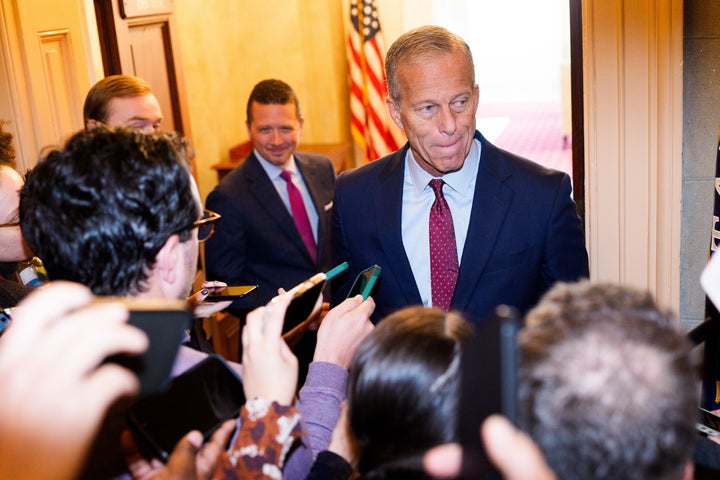
Aaron Schwartz via Getty Images
The Senate will try again with an unusual Sunday session.
Meanwhile, senators have been working on a stopgap measure that would give them more time to reach an agreement on the nine remaining “discretionary” spending bills for the rest of the federal government, such as homeland security, defense, housing and health agencies.
North Dakota Republican Sen. John Hoeven told reporters that the short-term funding, which is now set to expire on Nov. 21, would be updated with new legislation to reopen the government and keep it funded through the end of January.
Despite Thune’s optimistic speech, Senate Democratic leader Chuck Schumer attacked the Triumph administration for withholding SNAP food stamp funds and accused it of playing “politics” by imposing air travel reductions at certain airports. Schumer on the Senate floor complained that Republicans “stormed out” Friday to reject Democrats’ call for a one-year extension of an expiring health insurance subsidy as part of legislation to reopen the government.
The support of at least eight Democrats will likely be needed to break the shutdown impasse. Thune did not say how Republicans would handle Democrats’ demands to extend subsidies used by 24 million people in the Affordable Care Act’s health insurance markets.
president donald Triumph “He wants to have a solution to the health crisis in this country, which is skyrocketing premiums,” Thune said. But Republicans have said they will not negotiate on health insurance subsidies until the shutdown ends.
Triumph On Saturday he urged Republican senators to redirect federal money used to subsidize health insurance under the Affordable Care Act toward direct payments to individuals. While some Republican senators have expressed support, Democrats have so far remained silent.
“I recommend to Senate Republicans that the hundreds of billions of dollars currently being sent to money-sucking insurance companies to save the poor health care provided by ObamaCare BE SENT DIRECTLY TO THE PEOPLE SO THEY CAN BUY THEIR OWN, MUCH BETTER, HEALTH CARE, and have money left over.” Triumph he wrote in Truth Social, without offering details.
The ACA marketplaces allow people to buy policies directly from health insurers and primarily serve people who do not have coverage through employers or the government’s Medicare and Medicaid programs.
White House representatives did not respond to a request for comment on TriumphThe publication.
TriumphThe comments came after the Senate on Friday rejected legislation that would have resumed paychecks for hundreds of thousands of federal workers during the longest government shutdown in U.S. history.
The record shutdown was taking its toll on many programs.
For example, about 10,000 young children and families have been left without Head Start early learning and nutrition programs due to closures in 18 states and Puerto Rico, according to the First Five Years Fund, which advocates for child care and early learning programs at the federal level.
These programs had deadlines of October 1 and November 1 for the federal government to renew their grants. Those approvals were frozen with the start of the shutdown on October 1, when the allocated funding ran out.
(Reporting by Richard Cowan and Susan Heavey; additional reporting by Jonathan Landay; Editing by Sergio Non, Alistair Bell and Chizu Nomiyama)