



UK sends anti-drone troops to Belgium as airports close amid Russian warnings
/News/AP
London — Britain is sending anti-drone equipment and personnel to Belgium after a series of sightings near airports and military bases, the head of the U.K. army said Sunday.
While Belgium and the United Kingdom have not accused anyone of flying unidentified drones, they are the latest in a growing trend of airspace violations by mystery aircraft in about a half-dozen European nations, including around NATO military bases, which at least one U.S. ally considers part of Russia’s escalating “hybrid war.”
Last week, Belgium’s main international airport in Brussels and one of Europe’s largest cargo airports, near the Belgian city of Liege, were forced to temporarily close due to drone incursions. Before that, authorities reported a series of unknown Drone flights near a military base in Belgium where American nuclear weapons are stored.
- US troop withdrawal from Europe sparks anxiety and rebuke from Republican Party
Air Chief Marshal Richard Knighton, head of the British armed forces, said over the weekend that the UK had agreed to “deploy our people and our equipment to Belgium to assist them”, following a request from Belgian authorities.

“We don’t know (and the Belgians still don’t know) the origin of those drones, but we will help them by providing them with our equipment and our capacity, which has already begun to be deployed to help Belgium,” Knighton told the BBC.
UK Defense Secretary John Healey said the UK was sending a team of Royal Air Force specialists to NATO ally Belgium “to counter rogue drone activity”.
“As hybrid threats grow, our strength lies in our alliances and our collective determination to defend, deter and protect our critical infrastructure and airspace,” he said.
Drones plague European airports amid growing tension with Russia
Drone incidents across Europe have forced airports to suspend flights many times in recent months. While Belgium has not said who it believes is operating the drones, in some cases other NATO allies have blamed Russia.
Belgian Defense Minister Theo Francken said he believed some incidents were part of “an espionage operation” that could not have been carried out by amateurs.
Belgium is home to the headquarters of NATO and the European Union, as well as Europe’s largest financial clearinghouse that holds tens of billions of euros in frozen Russian assets. Many EU countries want to use those assets as collateral to lend to Ukraine, but Belgium has so far resisted.
The most overt blame has been placed on Lithuania, a NATO member accused Russia and its close ally Belarus at the end of October to intensify a hybrid war against Ukraine’s partners after two and a half years The full-scale invasion of Moscow.
Lithuanian Foreign Minister Kestutis Budrys said in an Oct. 27 social media post that the U.S.-led NATO alliance was facing a “deliberate escalation of hybrid warfare by Russia and its proxy, Belarus,” and called the spate of recent airspace incursions “calculated provocations designed to destabilize, distract and test NATO’s resolve.”
He called for new sanctions against Belarus and stronger NATO security measures to deter airspace violations, while Lithuania’s prime minister warned that any unidentified balloon entering the country’s airspace from Belarus would be shot down.
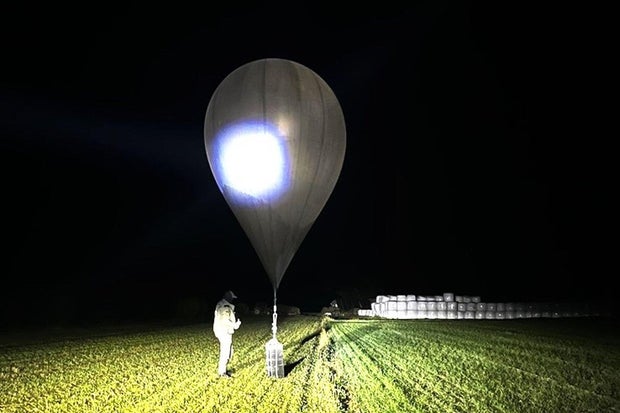
The airspace of many of the United States’ European allies has been violated in recent weeks, primarily by unclaimed drones flying around. airports and military installations in Germany, Denmark and the Baltic countries.
On October 23, a Russian Sukhoi SU-30 fighter jet and an IL-78 tanker flew just under half a mile into Lithuanian territory, according to the country’s Foreign Ministry, after departing from the Russian enclave of Kaliningrad. The coastal territory of the Baltic Sea is separated from the rest of Russia and is bordered on both sides by Lithuania and Poland.
Estonia Russian fighter jets accused to fly over its airspace for 12 minutes in mid-September. Russia denied entering the NATO member’s airspace and called the flight a routine training exercise.
In:
- War
- Ukraine
- Russia
- Belgium
- Buzz
- Vladimir Putin
- European Union
- United Kingdom
- NATO