



Moderates have something to prove after the shutdown
Since President Donald Trump took office for the second time earlier this year, Democratic politicians and pundits love to suggest that the party’s ideological divisions have become secondary to a divide between those in the party who want to fight Trump’s authoritarian impulses and those who want to continue practicing politics as usual.
But convincing the Democratic base that ideology is not correlated with the willingness to fight Trump will be more difficult after Sunday night, when a trio of Senate moderates apparently negotiated to end the current government shutdown without Democrats achieving any of their stated policy goals and at a time when the party appeared to have a clear political advantage.
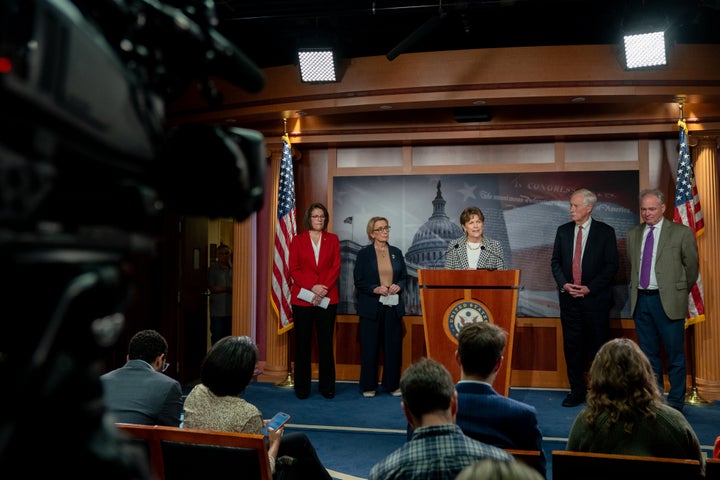
The deal was negotiated by three moderates — Sen. Angus King (I-Maine) and Sens. Maggie Hassan and Jeanne Shaheen, both Democrats of New Hampshire — and was supported in the Senate by five other moderates. (You might quibble about whether Sen. Tim Kaine of Virginia is a moderate, but everyone else proudly wears that label.) There’s a good chance Democratic primary voters will get one message from the end of the shutdown showdown: Moderates simply won’t go to the mat to fight Trump like progressives will.
If that’s the case, senators who compromised on the closing deal are sending other moderates into a crucial primary election year with one hand tied behind their backs and voters looking to more progressive candidates. (Candidates closely affiliated with Senate Minority Leader Chuck Schumer of New York, who is credited with much of the blame for the deal despite having voted against it, could face similar skepticism.)
“It’s hard to tell voters that a moderate candidate can fight back when they see moderates in the Senate walking out.”
– Democratic strategist
“The worst part about this long-term deal is that it could help candidates who can’t win a general election win a primary,” said a Democratic strategist focused on House elections who requested anonymity to speak candidly. “It’s hard to tell voters that a moderate candidate can fight back when they see moderates in the Senate walking out.”
Other centrist party strategists believe voters will be smart enough to see that most moderates in the House and Senate oppose the deal and realize that the deal was cut by a small group of senators. But they emphasize the need for those candidates to demonstrate the ability to fight the Republican Party.
“There’s a caricature of moderates who can be soft, and there’s a caricature of progressives who can be dumb, and the most successful of each attack those stereotypes,” said Jim Kessler, vice president of policy at Third Way, a centrist group that opposed the deal. “You have to play against a stereotype that is not entirely fair, but is not entirely made, in order to excite the imagination of Democratic-leaning voters.”
The end of the shutdown is not yet here (the Senate passed legislation Monday night and the House is expected to vote mid-week), but some of the political consequences are evident. Here are four other takeaways from the longest government shutdown in U.S. history:
This wasn’t about the filibuster.
Some post-shutdown opinions have focused on moderates’ desire to protect the filibuster as a major driving force behind the deal. Once Trump demanded that the Republican Party go “nuclear” to eliminate the Senate’s 60-vote requirement, moderate senators from both parties are thought to have decided to strike a deal to protect their Senate privileges.
To be frank, this idea doesn’t make sense. Moderate Senate Democrats had entered serious negotiations with the GOP and were pushing for a deal even before the 2025 election (see Vermont Sen. Bernie Sanders’ op-ed warning of a rift, published two days before Election Day) and thus well before Trump’s threats against the filibuster, which were issued following the Democratic Party’s defeat in Virginia, New Jersey and several other states last week.
Furthermore, while Trump’s stimulus had led some Republican senators to eliminate the 60-vote requirement, Senate Majority Leader John Thune (SD) was holding firm and Republicans were nowhere near having the necessary votes.
Instead, it appears that Democrats who voted for the deal were sincerely concerned about the damage the shutdown was doing to the country, particularly as airline delays mounted and Trump threatened SNAP benefits, while also thinking the party was making no progress in convincing the GOP to extend Obamacare subsidies.
Bloomberg via Getty Images
A successful tactic for the attention economy
Democrats achieved one of their main policy goals: putting health care back at the center of American politics. It is a problem in which they have maintained a clear advantage on the Republican Party throughout the Trump era. Both Democratic and Republican strategists have said the GOP is playing with fire if they don’t extend expiring Obamacare subsidies.
Center of Browsera Democratic group, has consistently found that voters believed the fight over the government shutdown was about health care rather than immigration, as Republicans initially tried and failed to insist. Republicans, at the very least, have committed to holding some kind of vote on expanding Obamacare subsidies in the near future, which will keep the issue in the news. It’s a rare example of how Democrats managed to wrest control of the news cycle from the former reality TV star in the White House.
“For 40 days, we controlled the debate for the first time while Donald Trump was president, and we controlled it on people’s health care and costs,” Kessler said. “It was definitely a factor in our wins last Tuesday.”
Will anyone remember this in November 2026?
Probably not.
All other government shutdowns in the 21st century had no significant impact on the general elections that followed. The shutdown of the Republican Party in 2013 gave Democrats a huge lead in generic voting in the polls, but that lead disappeared completely the following month when generic voting was launched. Obamacare.gov famous went wrong.
This time polls consistently showed that Republicans received most of the blame for the shutdown. As the shutdown wore on, Trump’s approval rating began to sink as he threatened food stamp programs, tore down the East Wing of the White House and hosted a splashy Halloween party at Mar-a-Lago. He is now at his lowest level on average during his second term in the polls.
Trump has rebounded in the polls before, with his approval rating plummeting after he first announced his “liberation day” tariffs and then rebounding after backtracking on some of his toughest elements. This time he could see a similar recovery.
If he doesn’t, however, the shutdown will have marked a moment when the public saw clearly Trump’s second-term priorities (more focused on rich friends and his own aggrandizement than pressing economic needs) and began to punish him for it.
Doomed from the start
There is an iron law about government shutdowns that has been in effect since Newt Gingrich first used them as a negotiating tool: the party that shut down the government never gets what it was asking for.
Republicans did not get the budget cuts they sought in 1995. In 2013, Republicans did not repeal the Affordable Care Act. During his first term, Trump did not get the border wall funding from Congress that he wanted when he forced a shutdown.
The problem for a party that shuts down the government is that it is an act born of frustration over a lack of influence. Outside of the anomalous Trump-induced shutdown of 2018, that frustration is rising from the party’s rank and file to pressure lawmakers to do something, anything, to get their policy priorities implemented. But that initial lack of influence is what dooms them from the start.
A key problem in evaluating the success or failure of a closure is conceiving of it as having any chance of achieving the objectives set in the first place. They never have and probably never will. Rather, shutdowns are political acts intended to affect public opinion and appease or galvanize a party’s frustrated political base.
Maybe Gingrich didn’t see it that way when he launched this tactic in 1995 and thought he could win, but that’s how shutdowns play out now. That 1995 shutdown was a political loser for the GOP, as President Bill Clinton handily outmaneuvered Gingrich and used the shutdown to march toward re-election in 1996. But the GOP-led shutdown in 2013 was not a loser. Republicans won a big victory in 2014, gaining nine Senate seats to claim the majority. Two years later, Trump won the White House as the avatar of the far-right faction of the party that backed the shutdown.
Closures are a double-edged sword, at least for party leaders. Their end always involves a cave-in carefully orchestrated by congressional leaders. What excites a frustrated party base also turns them against the predictable cave of leadership. The failure of the 2013 shutdown fueled the Republican Party’s roiling civil war as the growing Tea Party faction, which eventually became Trump’s base, expressed its betrayal. The surprising primary defeat of House Majority Leader Eric Cantor was the most prominent expression of this.
Now, that same energy exists in the Democratic Party. The shutdown arose from a need to show that the party can fight back against Trump’s increasingly autocratic presidency. Forty-one percent of Democrats said their main complaint against their own party is that it is not fighting Trump hard enough, according to a pre-closing Pew survey. That same poll found that Democrats’ opinion of their party was in the gutter, with 67% expressing frustration, 30% expressing anger and just 29% saying the party makes them proud. These are all much worse moves for the party than during Trump’s first term.
So,ThatNow?
Your supportFuelsOur Mission
Your supportFuelsOur Mission
Join News themezone
The shutdown may be coming to an end, but the story is not. An agreement has been reached, but there remain s you were doubts. Your membership powers reporting that goes deeper and follows what happens next.
We remain committed to bringing you the unwavering, fact-based journalism everyone deserves.
Thank you again for your support along the way. We are truly grateful for readers like you! Your early support helped get us here and strengthened our newsroom, keeping us strong in uncertain times. As we continue, we need your help more than ever. We hope you will join us once again.
We remain committed to bringing you the unwavering, fact-based journalism everyone deserves.
Thank you again for your support along the way. We are truly grateful for readers like you! Your early support helped get us here and strengthened our newsroom, keeping us strong in uncertain times. As we continue, we need your help more than ever. We hope you will join us once again.
News themezone Support
Are you already a member? Sign in to hide these messages.
So while the shutdown may very well act to keep Democratic voters engaged and enraged, that same energy may also fuel bubbling discontent within the party. Not that that’s a bad thing. Just ask Republicans who have won two presidential elections and complete control of Congress longer than Democrats since its unfortunate shutdown in 2013.