



World
/News/AP
What is believed to be the world’s largest known spider web, housing tens of thousands of arachnids, has been discovered in a cave on the border between Albania and Greece.
After researchers published their findings of two different species of spiders peacefully cohabiting in a giant colony located in a dark, sulfur-rich cave, evolutionary biologist Lena Grinsted compared the “extremely rare” occurrence to humans living in an apartment block.
“When I saw this study, I got really excited because…group living is really rare among spiders,” Grinsted, a senior lecturer at the University of Portsmouth in the United Kingdom, told The News. “The fact that there was this huge colony of spiders living in a place that no one had noticed before, I find extremely exciting.”
The results of the study, published last month in the journal Subterranean Biology, spread quickly online due to striking images of the giant 1,140-square-foot spider web, a carpet-thick expanse stretching along a narrow passage wall inside the Sulfur Cave, which extends into Albania from its entrance in Greece.
This arachnophobe’s worst nightmare was quickly labeled “the world’s largest spider web.”
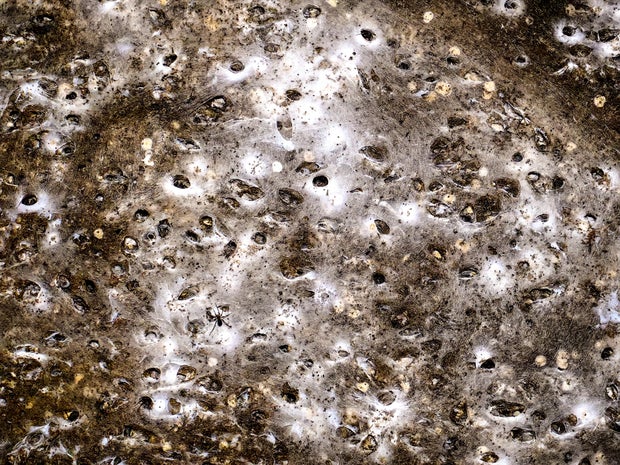
But the most surprising thing about the spider colony, which numbers about 110,000 spiders, had less to do with its size and more to do with what scientists found inside the enormous mass of funnel-shaped webs.
Two different species of spiders (about 69,000 Tegenaria domestica, or common house spider, and 42,000 Prinerigone vagans) lived side by side and thrived. The behavior, which had never been observed before, surprised scientists since normally the largest house spider feeds on its smaller neighbor.
“Very often, if you have spiders around, they get into fights and end up eating each other,” said Grinsted, who was not part of the cave study but has researched spiders extensively. “Sometimes we can see that if there is an abundance of food, they become a little less aggressive.”
In addition to spiders, the cave’s terrestrial fauna includes centipedes, terrestrial isopods, scorpions and beetles, the researchers said.
“In the stream passage near the cave entrance, a dense swarm of adult chironomid flies fills the air in the vicinity of the sulfidic stream, and a large portion of the cave wall is covered by a huge colonial spider web,” the study’s authors write.
Abundant food source
Scientists are interested in understanding how and why the two species came to coexist peacefully in a “permanently dark zone” about 160 feet from the cave entrance, carved by the waters of the Sarandaporo River to form Vromoner Canyon. (The study authors note that Vromoner means “smelly water” in Greek.)
Part of the answer, the research suggests, may lie in the combination of the roughly 2.4 million mosquitoes buzzing around the spider colony, an “unusually dense swarm” that provides a constant source of food in an environment that would otherwise be short on predators. Scientists also speculate that the friendly way of life could be because darkness impairs the spiders’ vision.
However, Grinsted says it’s more likely that larger spiders evolved or simply got used to responding to vibrational cues when small flies land on their silk web, and perhaps wouldn’t attack otherwise.
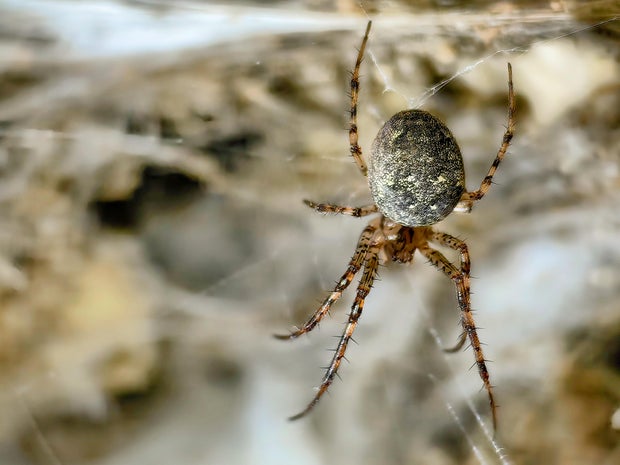
“Spiders, in general, are not particularly good at seeing things…and that includes these two species,” he said. He added that the two species could cooperate “to some extent in web construction… but I think it’s very unlikely that they would cooperate in anything else like capturing prey, caring for young, or caring for each other’s young.”
Grinsted draws parallels between cohabiting spiders and how humans tend to coexist in apartment blocks.
“You’re very happy to share the stairs and the elevator,” he said. “But if someone comes into your living room and you haven’t invited them, you will be aggressive towards them.”
He added that while many spiders are “typically solitary, very aggressive” toward other creatures, cohabitation of two species is “relatively common” once spiders have developed the ability to live in groups.
“But again, because these two species have never been found to live together and they have never been found to live in groups, it makes it particularly exciting,” he said.
“The network is dense, like a blanket”
Blerina Vrenozi, a biologist and zoologist at the University of Tirana in Albania who co-authored the research paper, told the AP that this year’s expeditions helped understand “how this mystery existed there.”
“The DNA is interesting because it revealed that the species that live inside the cave are different from those that live outside the cave,” he said. “So it’s the same species, but with different DNA.”
The gigantic network of the cave colony was first observed in 2021 by a team of Czech cavers led by Marek Audy. A year later, the Czech team was expanded to include scientists from several universities, resulting in the recently published scientific paper.
“The web is dense; it’s more like a blanket, and when there is danger, the female crawls back and hides, and no higher-order creature can get her out of there,” Audy said. “Cave spiders lay about a third as many eggs compared to spiders that live outdoors. Because they are sure to raise their young there… so they can afford to lay fewer eggs.”
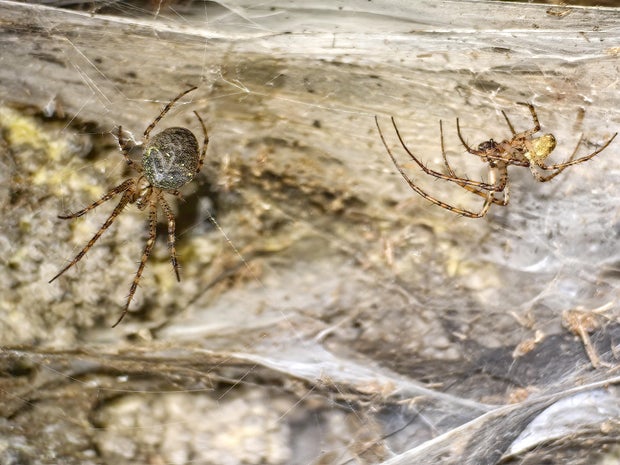
Audy added that the cave, which is also home to large colonies of bats, also thrives on the abundance of mosquitoes within the dark, humid space. “There they constantly party, both the spiders and the bats,” he said.
Seemingly ideal environment
The study noted that the methodology used could “slightly overestimate” the total count of the spider population in the colony, as some funnel webs may be abandoned or unoccupied. However, other experts agree that the team’s exciting new research could offer broader evolutionary clues and deserves further study.
Sara Goodacre, professor of evolutionary biology and genetics at the School of Life Sciences at the University of Nottingham in the United Kingdom, says these types of research projects help pave the way for more studies that could prove “fundamental to our understanding of what forces shape the world around us, whether spider-like or not.”
“Natural selection will favor the ‘best’ strategies…the ‘winning strategy,’ whatever that may be,” he said. “My guess is that the benefits of being part of this community far outweigh the costs.”
He added that if the dynamics in the seemingly ideal environment of abundant food and relative security were to change, “then the freeloader will emerge and everything will fall apart.”
Hopefully the policy of coexistence will not turn out to be more complicated on the surface. Audy said Albania has already asked whose side the newly famous spiders are on.
“From a conservation point of view, we did something interesting there and marked a boundary,” he said. “I just looked at it and the spider web is on the Greek side.”
The discovery of the enormous web comes just months after Australian scientists discovered a new species of deadly funnel-web spider that is larger and more venomous than its relatives. nicknamed him “Big Boy”.
In:
- Spider
- Greece