



Pope returns 62 artifacts to indigenous Canadians
/AP
The Vatican on Saturday returned 62 artifacts to indigenous peoples in Canada as part of the Catholic Church’s acknowledgment of its role in helping to suppress indigenous culture in the Americas.
Pope Leo XIV handed over the artifacts, including an iconic Inuit kayak, and supporting documentation to a delegation from the Canadian Conference of Catholic Bishops during a hearing. According to a joint statement from the Vatican and the Canadian Church, the pieces were a gift and a “concrete sign of dialogue, respect and fraternity.”
The objects were part of the Vatican Museum’s ethnographic collection, known as the Anima Mundi museum. The collection has been a source of controversy for the Vatican amid the museums’ broader debate over the restitution of cultural property taken from indigenous people during colonial periods.
Most of the items in the Vatican collection were sent to Rome by Catholic missionaries for a 1925 exhibition in the Vatican gardens that was a highlight of that year’s Holy Year.
The Vatican insists the items were “gifts” to Pope Pius XI, who wanted to celebrate the global reach of the church, its missionaries and the lives of the indigenous peoples they evangelized.
But historians, indigenous groups and experts have long questioned whether the items really could have been offered freely, given the power imbalances that existed in Catholic missions at the time. In those years, Catholic religious orders helped enforce the laws of the Canadian government. forced assimilation policy of eliminating indigenous traditions, what Canada’s Truth and Reconciliation Commission has called “cultural genocide.”
Part of that policy included confiscation of items used in traditional Indigenous spiritual and rituals, such as the 1885 potlatch ban that banned the comprehensive First Nations ceremony. Those confiscated items ended up in museums in Canada, the United States and Europe, as well as private collections.
Negotiations on the return of items accelerate
Negotiations over the return of the Vatican items accelerated after Pope Francis met in 2022 with indigenous leaders who had traveled to the Vatican to receive their apology for the role of the church in the management of Canada’s disastrous residential schools. During their visit, they were shown some objects from the collection, including an Inuit kayak, wampum belts, war clubs and masks, and asked for them to be returned.
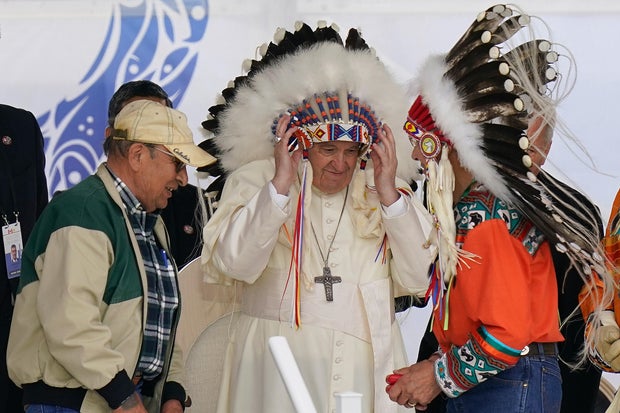
Francis later said he was in favor of returning the items and others in the Vatican collection on a case-by-case basis, saying: “In the event that you can return things, when it is necessary to make a gesture, it is better to do so.”
The Vatican said Saturday that the items were returned during the Holy Year, exactly 100 years after the 1925 exhibition where they were first displayed in Rome.
“This is an act of ecclesial exchange with which the Successor of Peter entrusts to the Church in Canada these objects that bear witness to the history of the encounter between faith and the cultures of indigenous peoples,” states the joint statement from the Vatican and the Canadian Church.
He added that the Canadian Catholic hierarchy was committed to ensuring that the artifacts are “properly safeguarded, respected and preserved.” Officials had previously said that the Canadian bishops would receive the artifacts with the explicit understanding that the final possessors will be the indigenous communities themselves.
The items are expected to be taken first to the Canadian Museum of History in Gatineau, Quebec. There, experts and indigenous groups will try to identify where the items originated, down to the specific community, and what should be done with them, officials previously said.
A process of recognition of abuses
As part of its broader examination of the Catholic Church’s colonial past, in 2023 the Vatican formally repudiated the “Doctrine of Discovery,” the theories supported by 15th-century “papal bulls” that legitimized the confiscation of native lands in the colonial era and that form the basis of some current property laws.
The statement marked a historic recognition of the Vatican’s own complicity in colonial-era abuses by European powers, although it did not address indigenous demands that the Vatican formally rescind its own papal bulls.
The Vatican on Saturday cited the repudiation of the Doctrine of Discovery in 2023, saying Leo’s return of the artifacts concludes the “journey” begun by Francis.
In:
- Pope Francis
- Religion
- Vatican City
- Indigenous
- Pope Leo XIV
- Canada
- Catholic church