



Afghanistan
/News/News
Add News themezone on Google
Jige Mughalgai, Afghanistan. Afghanistan taliban government promised on Tuesday to “respond appropriately” to overnight border attacks it blamed on Pakistan that killed 10 people, as tensions soared between the neighbors following a suicide bombing in Peshawar one day before.
“Pakistani invading forces bombed the house of a local civilian resident,” Taliban spokesman Zabihullah Mujahid said in a social media post. “As a result, nine children (five boys and four girls) and one woman were martyred” in Khost province.
Mujahid said Pakistani airstrikes targeting the border regions of Kunar and Paktika wounded four more civilians.
The attacks were carried out with drones and aircraft, according to Mustaghfir Gurbuz, spokesman for the governor of Khost.
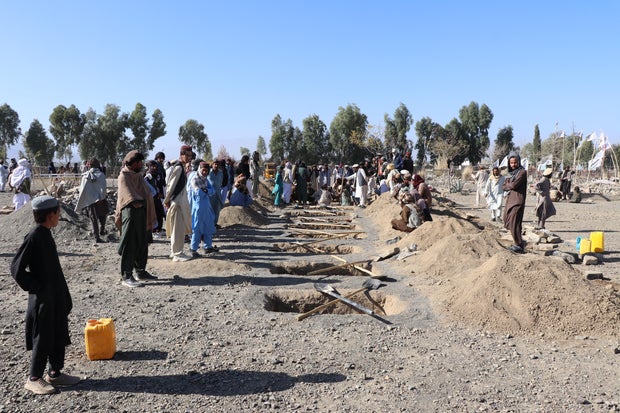
In Jige Mughalgai, near the border with Pakistan, an News correspondent saw residents searching through the rubble of a collapsed house and preparing graves for the victims.
“The Islamic Emirate strongly condemns this violation and reiterates that defending its airspace, its territory and its people is its legitimate right and it will respond appropriately at the appropriate time,” Mujahid said in a separate statement.
The Pakistani military did not comment on the attacks when contacted by News, but before the attacks, the country’s Interior Minister Talal Chaudhry said in a television interview that the people behind the deadly suicide attack in Peshawar on Monday came from Afghanistan.
“These are the same long-range attacks from Afghanistan that they used to say would reach Islamabad,” Chaudhry said, without offering any concrete evidence. “There are more than 36 terrorist groups in Afghanistan. These terrorists are representatives of India.”
The suicide attack targeted the Pakistan Federal Police paramilitary force headquarters in Peshawar, killing three officers and wounding 11 others.
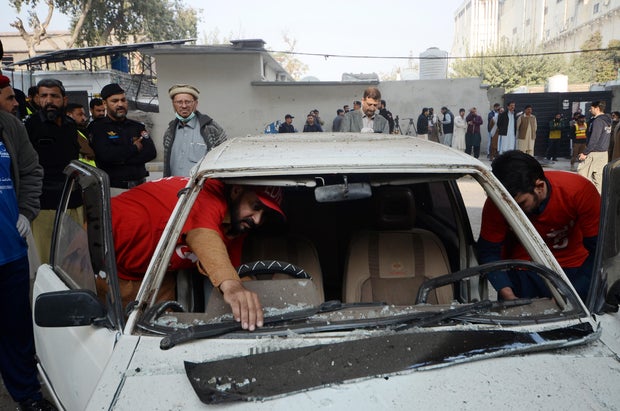
No group has claimed responsibility, but Pakistani state broadcaster PTV reported that the attackers were Afghan nationals and said President Asif Zardari blamed the foreign-backed “Fitna al-Khawarij,” Islamabad’s term for Tehreek-e-Taliban Pakistan (TTP, or the Pakistani Taliban). militants whom he accuses of operating from Afghan soil.
Another suicide bombing outside a court in Pakistan’s capital Islamabad this month killed 12 people and was claimed by a faction of the Pakistani Taliban, which shares the same ideology as the Afghan Taliban but insists it operates independently.
Islamabad blamed the attack on the capital on a militant cell that was “guided at every step by the Afghanistan-based high command.”
In a message sent to News themezone’ Sami Yousafzai on Tuesday, Amir Mohmand, TTP commander in a Pakistani region just on the Afghan border, said Pakistan’s military strikes against Afghanistan were based on a “misperception.”
“Pakistan is bombing Afghanistan because it believes that this will prevent us (the TTP) from our jihadist fight against the puppet regime in Islamabad,” he said. “He [Afghan] The Taliban came to power in 2021. We have been fighting our fight since 2006, and even before 1994. The Afghan Taliban may have sympathies on the ground, but we are independent. “No one can define the beginning or the end of our holy struggle.”
Mohamand claimed that a new wave of suicide bombers had recently completed their training and were prepared to carry out additional attacks inside Pakistan.
Pakistan has long accused the Taliban and India of covertly supporting TTP violence, and government Information Minister Attaullah Tarar on Tuesday showed a video of an alleged confession by one of the alleged suspects in the Peshawar attack, saying there is “clear evidence that the TTA [Afghan Taliban] and TTP did it together, and the suicide bomber was a resident of Afghanistan.”
“Afghanistan is fully involved… and its territory is also involved. The people who are housed there are also involved,” he said live on television, without mentioning the military attacks in the neighboring country.
The flare-up in cross-border tension is just the latest challenge to a tenuous ceasefire agreement between the neighbors that came into force in mid-October, and relations between Islamabad and Kabul have been strained since the Taliban returned to power in 2021.
Deadly border clashes in early October killed about 70 people on both sides, violence that a ceasefire brokered by Qatar and Turkey was intended to stop, but several rounds of talks in Doha and Istanbul have failed to produce a lasting agreement, and security issues, especially Pakistan’s demand that Kabul pursue TTP fighters, have proven a sticking point.
Islamabad accuses the Taliban of harboring militants behind a surge in attacks, including the TTP, which has been waging a bloody campaign against Pakistan for years. Kabul denies the accusation and responds that Pakistan hosts groups hostile to Afghanistan and does not respect its sovereignty.
In:
- India
- taliban
- War
- Pakistan
- Terrorism
- Afghanistan