



Your brain doesn’t age like you think, new research turns old beliefs upside down
NEWNow you can listen to News articles!
Previous research has found that the human brain reaches maturity sometime around age 20, but a new study suggests that it never stops developing.
Neuroscientists at the University of Cambridge have identified “five major epochs or stages” of brain structure, according to a university news release.
Throughout life, the brain “rewires itself to support different ways of thinking as we grow, mature, and ultimately decline,” the researchers noted.
BRAIN HEALTH WARNING SIGN COULD BE HIDDEN IN SIGHT, RESEARCHERS SAY
The study, published in the journal Nature Communications and led by the Brain Sciences and Cognition Unit at the MRC in Cambridge, examined the brains of 3,802 people between birth and age 90.
They were compared using a specialized MRI that tracks how water molecules move through brain tissue, the researchers said.
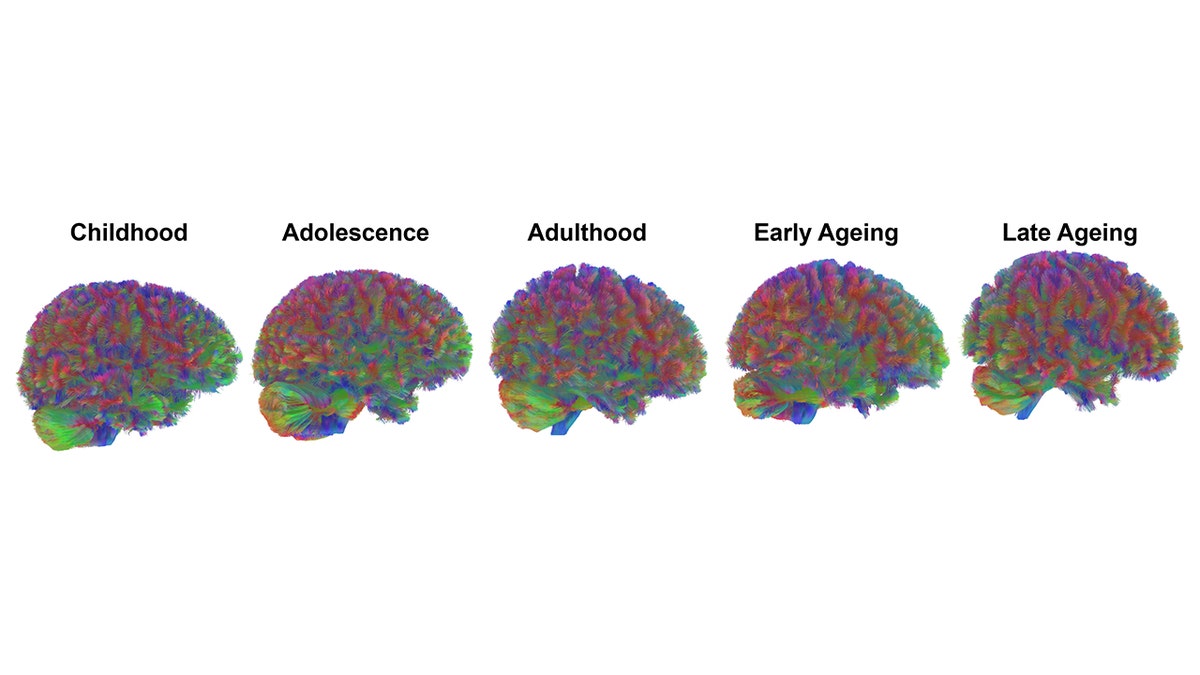
Representative magnetic resonance tractography images are shown for each era of the human brain, indicating the general pattern observed in the study brains. (Dr Alexa Mousley, University of Cambridge)
The study identified the following five general phases of brain structure, separated into four “turning points” between birth and death.
1. Childhood: From birth to 9 years
In the infantile era of the brain, rapid growth and “network consolidation” occurs, including the expansion of gray and white matter and the stabilization of the brain surface. According to researchers, gray matter is responsible for processing information in the brain, while white matter allows communication.
There is also an overproduction of neuronal connectors, or synapses, which are reduced so that only the most active ones survive.
BRAIN AGING CAN BE SLOWED WITH GREEN TEA, walnuts, and a small swamp plant, study finds
“Throughout the brain, connections are reconfigured in the same pattern from birth to approximately age 9,” the researchers noted.
At age 9, the brain experiences a “radical shift” in cognitive ability and an increased risk of mental health disorders.
2. Adolescence: 9 to 32 years
In the stage of adolescence, which lasts on average until age 32, white matter growth continues, while the brain’s communication networks become more refined and efficient.
There is also an increase in connectivity, which improves cognitive development and learning, the study found.

The first era of brain development occurs between birth and age 9, and involves an influx of neural connectors and brain matter. (iStock)
These developments peak in the early 1930s, which is defined as the “strongest topological turning point” in all of life.
Around age 32, “the greatest number of directional changes in wiring and the greatest overall change in trajectory occur,” lead researcher Dr. Alexa Mousley, a Gates Cambridge Fellow, wrote in a statement.
“While puberty offers a clear beginning, the end of adolescence is much more difficult to pin down scientifically,” he said. “Based solely on neural architecture, we found that adolescent-like changes in brain structure end around age 30.”
3. Adulthood: 32 to 66 years
Adulthood is the longest era of brain development, lasting more than three decades. At this stage, brain architecture stabilizes without major turning points, corresponding to a “plateau in intelligence and personality,” the researchers echoed other studies.
Meanwhile, brain regions during adulthood become more compartmentalized or “segregated.”
4. Early aging: 66 to 83 years old
Around year 66, there are no major structural changes, but the researchers still noted “significant changes” in the pattern of brain networks. This reorganization is likely related to general aging, coinciding with reduced connectivity and white matter degeneration.
According to Mousley, people at this age face a higher risk of health problems that can affect the brain, such as hypertension.
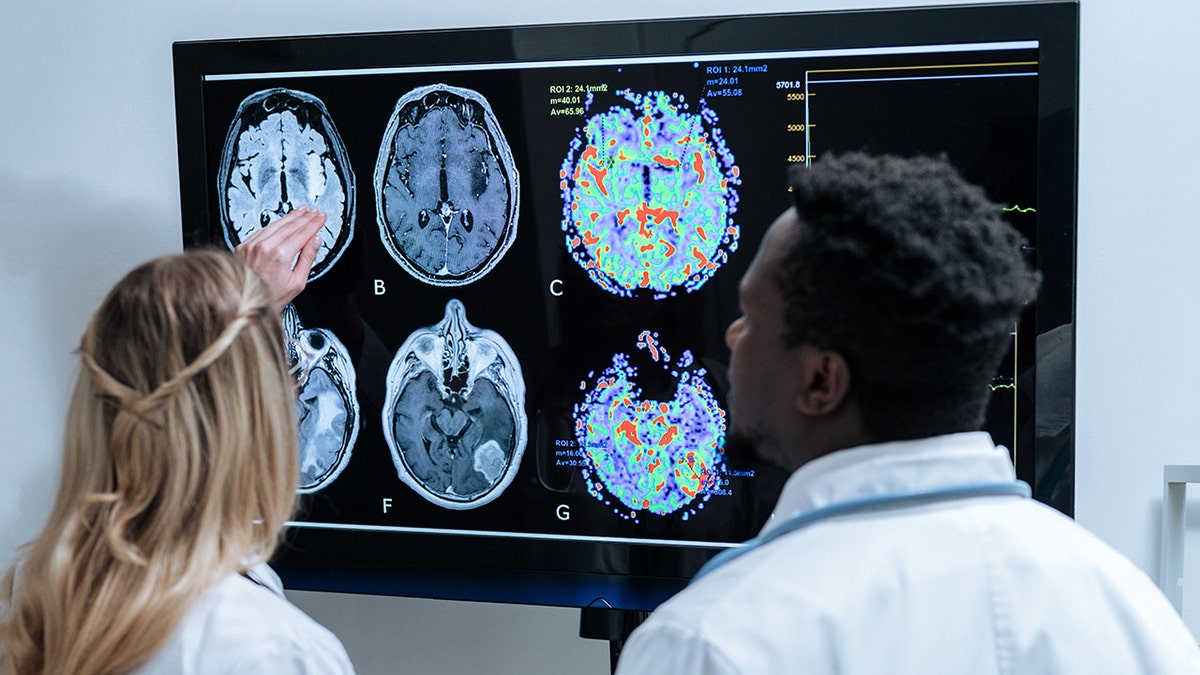
Adulthood in the brain corresponds with a “plateau in intelligence and personality,” the researchers noted. (iStock)
5. Late aging: 83 years and older
The final brain structure occurs around age 83. While data is limited for this era, there is a notable shift in decreased brain connectivity and greater reliance on certain regions, the researchers noted.
CLICK HERE FOR MORE HEALTH STORIES
‘Important context’
Lead author Duncan Astle, a professor of neuroinformatics at Cambridge, commented in a statement that “many neurological, mental health and neurodevelopmental conditions are related to the way the brain is wired.”

Final brain structure occurs around age 83, when a notable change in decreased brain connectivity occurs. (iStock)
“In fact, differences in brain wiring predict difficulties with attention, language, memory and a host of different behaviors,” he said.
“Understanding that the brain’s structural journey is not a matter of constant progression, but rather one of the major turning points, will help us identify when and how its wiring is vulnerable to disruption.”
TRY OUR LATEST LIFESTYLE QUIZ
This research is the first to identify the main phases of brain wiring throughout the human life, Mousley said.
“These eras provide important context for what our brains might be better at or more vulnerable at at different stages of our lives,” he said. “It could help us understand why some brains develop differently at key times in life, whether it’s learning difficulties in childhood or dementia in our later years.”
In an interview with News Digital, Dr. Paul Saphier, a neurosurgeon and founder of Coaxial Neurosurgical Specialists in New Jersey, commented that although he agrees with the concept of stages of brain aging, the “segregation they proposed is a little broad.”
CLICK HERE TO SUBSCRIBE TO OUR HEALTH NEWSLETTER
“I think there are more discrete fundamental milestones in earlier aging,” he said. “From birth to 9 years, substantial changes occur.”
Saphier, who was not involved in the study, noted that certain factors can influence brain aging, such as stimulating children’s brain development with verbal, written, mathematical and musical skills.

“Understanding that the brain’s structural journey is not a matter of constant progression, but rather one of the major turning points, will help us identify when and how its wiring is vulnerable to disruption.” (iStock)
“On the opposite end of the spectrum, continuing these tasks helps prevent accelerated aging in the later years of life,” he said.
CLICK HERE TO DOWNLOAD THE News APP
According to the expert, lifestyle factors, such as a healthy diet, limited alcohol intake, and avoiding illicit drug use and smoking, can also help promote long-term brain health.
Saphier added: “We also know from research in ‘blue zones’ that people who live in socially active communities and avoid isolation also have greater brain health and longevity with lower rates of dementia.”
Angelica Stabile is a lifestyle reporter for News Digital.