



Trump and Hegseth: we had nothing to do with what seems like a war crime
WASHINGTON – President Donald Trump and Defense Secretary Pete Hegseth, who gloated over the killing of suspected drug traffickers when it occurred, continued Wednesday to blame a Navy admiral for launching a follow-up attack on survivors clinging to the remains, an act described as a war crime in a U.S. military manual.
Hegseth, who from the beginning said he watched the Sept. 2 attack live off the coast of Trinidad, clarified Tuesday that he only saw the initial attack, not the follow-up.
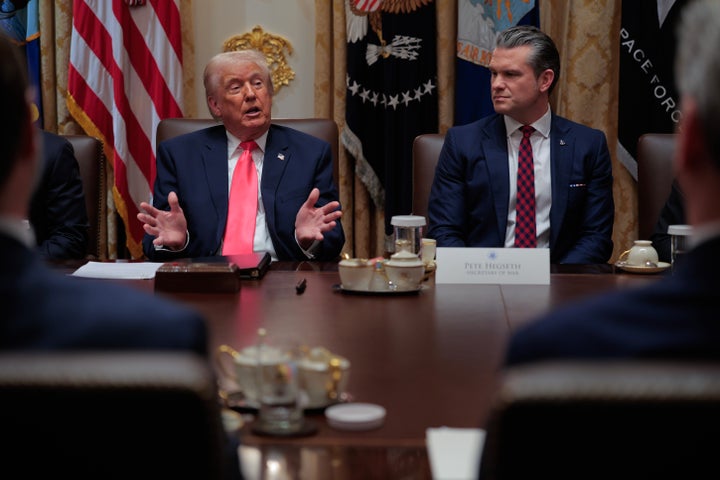
“As you can imagine, at the War Department we have a lot of things to do. So I didn’t stay an hour or two hours or whatever,” he said, using the nickname Trump gave the Defense Department in a question-and-answer session after a Trump Cabinet meeting at the White House.
Hegseth later said that Admiral Frank Bradley, on his own, decided to launch the second attack that killed the survivors.
“A couple of hours later, I found out that that commander had made the decision, which he had complete authority to do, and, by the way, Admiral Bradley made the right decision to finally sink the ship and eliminate the threat.”
The U.S. Department of Defense’s Law of War Manual defines that exact circumstance as unlawful killing: “For example, ordering the shooting of castaways would be clearly illegal.”
Trump, for his part, claimed ignorance of any of the details: “Someone asked me a question about the second attack. I didn’t know anything about the second attack. I didn’t know anything about the people. I wasn’t involved in it. I knew they took out a ship, but I would say this, they had an attack.”
Trump then repeated his unsubstantiated claim that the ships in question — all of them too small and ill-equipped to travel to the United States — were carrying fentanyl, a synthetic opioid that can kill even in minuscule doses.
“Every ship you see fly, we save 25,000, on average, lives, 25,000 lives. They’ve been shipping enough of this horrible fentanyl and other things like cocaine and other things. But fentanyl right now is the leader of the pack in killing our entire nation because one little speck on the head of a pin can kill someone,” Trump said.
In fact, the vast majority of fentanyl entering the United States is transported across the US-Mexico border by US citizens. Historically, the drug trafficked through the Caribbean is cocaine, and much of it is destined for North Africa and Europe.
Neither the Defense Department nor the White House have ever offered any evidence for Trump’s fentanyl claim, nor did they do so Tuesday in response to News themezone’s questions about the issue.
Chip Somodevilla via Getty Images
At the time of the attack, Bradley led the Joint Special Operations Command and has since been promoted to lead the US Special Operations Command. Inquiries made to SOCOM, as is known, to communicate with him did not receive a response.
Tuesday’s comments were the most extensive public comments on the issue by Trump or Hegseth since the Washington Post published an account of the Sept. 2 attack detailing the follow-up attack – or “double tap” – that killed the two survivors of the first attack.
A different attack in October also left two survivors, but in that case, they were rescued by the Navy and sent back to their home countries of Colombia and Ecuador, raising the question of how the survivors of the September 2 attack could have been so dangerous as to be killed rather than intercepted and arrested, when the October survivors were considered so harmless that they could be released.
At Monday’s White House briefing, press secretary Karoline Leavitt denied there had been any changes to protocols for dealing with survivors following the Sept. 2 attack.