



Supreme Court allows Texas to use Trump-backed congressional maps
WASHINGTON (AP) — The Supreme Court came to the rescue of Texas Republicans on Thursday by allowing next year’s election to be held under the state’s GOP-friendly congressional redistricting plan pushed by President Donald Trump, despite a lower court ruling that the map likely discriminates on the basis of race.
The justices acted on an emergency request from Texas for quick action because qualifying in the new districts has already begun, with primaries in March.
The Supreme Court’s order suspends the 2-1 ruling blocking the map at least until the high court issues a final decision in the case. Justice Samuel Alito had previously temporarily blocked the order while the full court considered Texas’ appeal.
Judges have blocked previous lower court rulings in congressional redistricting cases, most recently in Alabama and Louisiana, which came several months before the election.
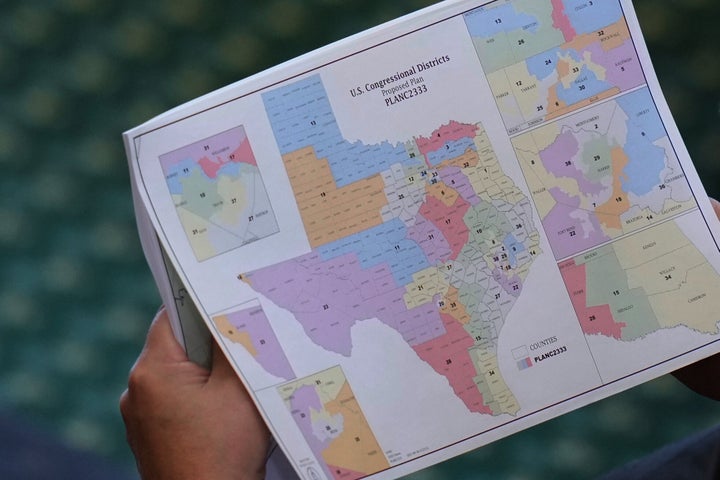
The Texas congressional map enacted last summer at Trump’s behest was designed to give Republicans five additional House seats.
The effort to preserve a slim Republican majority in the House in next year’s elections set off a nationwide redistricting battle.
AP Photo/Eric Gay, File
Texas was the first state to comply with Trump’s demands in what has become a sprawling national battle over redistricting. Republicans drew the new state map to give the GOP five additional seats, and Missouri and North Carolina followed with new maps adding one additional Republican seat each. To counter those measures, California voters approved a ballot initiative to give Democrats five additional seats there.
The redrawn maps face court challenges in California and Missouri. A three-judge panel allowed North Carolina’s new map to be used in the 2026 election.
The Trump administration is suing to block California’s new maps, but asked the Supreme Court to uphold Texas’ redrawn districts.
The justices are separately considering a Louisiana case that could further narrow racial districts under Section 2 of the Voting Rights Act. It is unclear how the current round of redistricting would be affected by the outcome of the Louisiana case.
In the Texas case, federal district judges Jeffrey V. Brown and David Guaderrama concluded that the redistricting plan likely diluted the political power of black and Latino voters, in violation of the Constitution. Trump appointed Brown in his first term, while President Barack Obama, a Democrat, appointed Guaderrama.
“Politics certainly played a role in the making of Map 2025,” Brown wrote. “But it was much more than just politics. There is substantial evidence showing that Texas racially manipulated Map 2025.”
The majority opinion drew a vituperative dissent from Judge Jerry Smith, an appeals court judge on the panel.
Smith accused Brown of “pernicious judicial misconduct” for not giving Smith enough time before issuing the majority opinion. Smith, appointed by President Ronald Reagan, a Republican, also strongly disagreed with the substance of the opinion, saying he would be a candidate for the “Nobel Prize for Fiction,” if such a prize existed.
“The biggest winners from Judge Brown’s opinion are George Soros and Gavin Newsom,” Smith wrote, referring to the liberal megadonor and Democratic governor of California. “The obvious losers are the people of Texas and the rule of law.”