



Treasure hidden in Egyptian tomb solves ancient mystery about who was buried there
/News/News
Add News themezone on Google
A hoard of 225 funerary figurines has been discovered inside a tomb in the ancient Egyptian capital of Tanis in the Nile Delta, a rare find that experts say has also solved a “long-standing archaeological mystery”.
“Finding figurines inside a royal tomb has not happened in the Tanis necropolis since 1946,” French archaeologist Frederic Payraudeau told reporters in Paris on Friday.
A discovery like this had never before occurred further south in The Valley of the Kings of Egypt near modern Luxor, apart from the tomb of the famous boy king Tutankhamun in 1922, because most of those sites have been looted throughout history, he added.
Payraudeau, who heads the French Tanis excavation mission, said the remarkable discovery was made on the morning of October 9.
The team had already excavated the other three corners of a narrow tomb occupied by an imposing, unnamed sarcophagus.
“When we saw three or four figures together, we knew right away it was going to be amazing,” Payraudeau said.
“I ran out to tell my colleagues and the officials. After that it was a real struggle. It was the eve of the weekend; we normally stop at 2:00 p.m. We thought: ‘This is not possible.'”
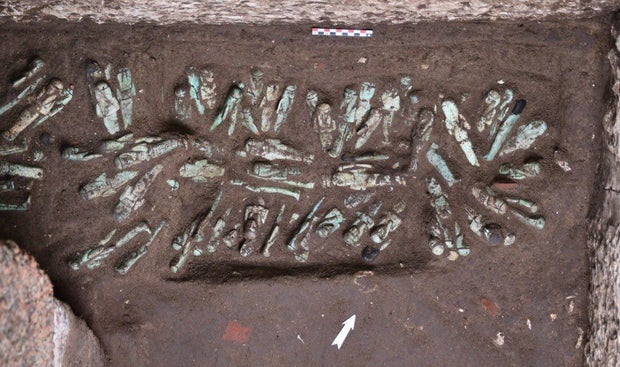
The team then installed lights to work at night. It took 10 days to carefully extract the 225 small green figures.
They were “carefully arranged in a star shape around the sides of a trapezoidal pit and in horizontal rows at the bottom,” Payraudeau said.
Funerary figurines, known as ushabti, were intended as servants to accompany the dead to the afterlife.
More than half of the figures are women, which is “quite exceptional,” Payraudeau said.
Located in the Nile delta, Tanis was founded around 1050 BC. C. as capital of the Egyptian kingdom during the 21st dynasty.
At that time, the Valley of the Kings, which had been plundered during the reign of pharaohs including Ramses, was abandoned and the royal necropolis was moved to Tanis, Payraudeau said.
“Many secrets that have not yet been discovered”
The royal symbol on the newly discovered figurines also solves a long-standing mystery by identifying who was buried in the sarcophagus. He was Pharaoh Shoshenq III, who reigned from 830 to 791 BC
This was “surprising” because the walls of a different tomb at the site (and the largest sarcophagus there) are named after him, Payraudeau said.
“Why isn’t he buried in this grave?” the expert asked.
“Obviously, for a pharaoh, building a tomb is a gamble because you can never be sure that your successor will bury you there,” he said.
“It is clear that we have new evidence that these bets are not always successful,” says Payraudeau with a smile.
Shoshenq III’s four-decade reign was turbulent, marred by a “very bloody civil war between Upper and Lower Egypt, with several pharaohs fighting for power,” he said.
Therefore, it is possible that the royal succession did not go as planned and that the pharaoh was not buried in the chosen tomb. Another possibility is that his remains were later moved due to looting.
But it is “difficult to imagine that a 3.5 by 1.5 meter granite sarcophagus could have been reinstalled in such a small place,” Payraudeau said.
Once the figurines are studied, they will be displayed in an Egyptian museum, Payraudeau said.
Experts in Egypt confirmed that the discovery marked “a decisive step in solving a long-standing archaeological mystery,” the Egyptian Ministry of Tourism and Antiquities said in a Facebook post.
In the Facebook post, Dr. Mohamed Ismail Khaled, secretary general of the Supreme Council of Archaeology, said the discovery “confirms that the Tanis site still holds many secrets that have not yet been discovered.”
Mr. Mohamed Abdel-Badii, head of the Egyptian Archaeological Sector, noted that the mission also revealed previously unknown patterns within the chamber itself, shedding light on burial methods during that period.
“It is still unclear whether the king was buried directly inside the tomb of Osarkon II, or whether his funeral collectors were moved to this location to protect him from theft,” the ministry said in its Facebook post. “We still have a lot of work to answer these questions.”
The discovery was announced just weeks after the official groundbreaking ceremony for the billion-dollar project. Grand Egyptian Museum. The GEM is one of the largest museums in the world and the largest dedicated to a single civilization: ancient Egypt. Its subject spans some 7,000 years, from prehistory to the end of the Greek and Roman eras, around 400 AD.
In:
- Archaeologist
- Egypt