



Republicans are under pressure to deliver long-awaited health care plan
WASHINGTON — As Republicans spent most of the year legislating to slash taxes on the wealthy and cut Medicaid, then taking a weeklong break from Washington while the government was shut down, House Speaker Mike Johnson (R-Louisiana) continually insisted they would be able to fix a looming spike in health care costs in December.
“We have until the end of December to sort all that out,” Johnson told reporters in September.
“That’s a December policy question,” Johnson said in October.
“That was always a December issue,” Johnson said in November.
Well, it’s December. And Republicans don’t have a solution and can’t agree among themselves on what to do.
Many Republican lawmakers strongly oppose expanding the subsidies, which Democrats passed amid the COVID-19 pandemic, while others worry that doing nothing and allowing Obamacare marketplace premiums for 20 million people to rise by more than 100%, on average, will hurt their party in next year’s midterm elections.
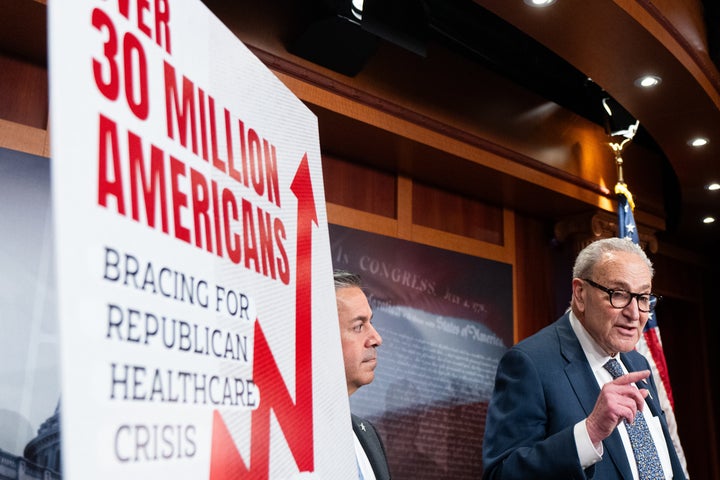
“They knew this cliff was coming and that it would only make the pain worse for Americans, yet they have decided to do nothing, absolutely nothing. They are nowhere. They don’t even have a proposal, and the American people are running out of time,” Senate Minority Leader Chuck Schumer (D-N.Y.) said Thursday.
The Republican Party’s failure to unite around a solution reflects its years-long inability to come up with a broader plan to reduce health care costs or replace Obamacare. Voters largely don’t trust Republicans on health care, and many of the party’s ideas are unpopular. that has left Senate Republicans are torn over whether to even offer a plan.
“Republicans have always had trouble uniting around an alternative, as you may have noticed,” Sen. John Cornyn (R-Texas) joked to reporters. when asked if his party will offer a competing plan in the Senate next week.
Bill Clark via Getty Images
Democrats will propose a clean three-year extension of the subsidies next week in a Senate vote they won from Senate Majority Leader John Thune (R.S.D.) as a condition of voting to reopen the government last month. That vote is almost certain to fail, however, because of GOP demands for reforms to the program to address fraud and increase eligibility requirements for higher-income earners.
Conservative Republicans are also pushing for language to restrict funding for abortion, which Democrats see as a failure and a backdoor attempt to ban abortion nationwide.
Republicans have also pointed out, time and again, that Democrats created the enhanced subsidies and set their expiration date as part of partisan legislation they passed during Joe Biden’s presidency.
“Can I remind Democrats that COVID is OVER,” said Sen. John Barrasso (R-Wyo.), the Senate’s No. 2 Republican. said Thursday.
While the increased subsidies were initially enacted as part of a coronavirus relief bill, Democrats had long favored the idea, with the most recent extension being part of the Inflation Reduction Act of 2022.
Bipartisan talks to expand the subsidies in the Senate have dragged on for months, but there is little evidence that enough Republicans are willing to vote to extend the subsidies in any form without political cover from President Donald Trump. Trump has largely disassociated himself from the process, dismissing voters’ concerns about high prices and affordability as a “hoax.” The White House proposed a two-year extension of the subsidies last month but quickly backed down due to GOP opposition.
“Republicans have always had trouble uniting around an alternative, as you may have noticed.”
– Late. Jon Cornyn (R-Texas)
President Johnson is reportedly working on a plan that will cobble together several Republican ideas, such as “partnership health plans” that will allow multiple employers to purchase coverage for their workers. It is highly unlikely that the upcoming proposals will cover as many people or be as comprehensive as Obamacare.
And a bipartisan group of House lawmakers has also been working on a bill to continue the subsidies, but with some changes to reduce their cost, such as stricter eligibility standards. Rep. Brian Fitzpatrick (R-Pa.), a moderate involved in drafting the bill, said it is the only legislation that could get the necessary 218 votes in the House and 60 in the Senate.
“It’s the only product so far that has buy-in from the White House, the House and the Senate, both Democrats and Republicans,” Fitzpatrick told News themezone.
There is widespread skepticism on Capitol Hill that lawmakers will reach a deal this month. Schumer said Democrats’ push next week for a three-year extension of Obamacare subsidies will be the last train to leave the station this year.
“Make no mistake: The vote is the last chance, the last chance before January 1, to avoid the crisis they caused and provide relief to the American people,” Schumer said.
As it stands Thursday, the bill is doomed to failure.