



Archaeologists discover possible evidence of 2,100-year ceasefire between warring kingdoms in Jerusalem
/News/AP
Add News themezone on Google
Archaeologists have finished uncovering the longest continuous remains of an ancient wall that surrounded Jerusalem, including possible evidence of a 2,100-year ceasefire between warring kingdoms.
Last week, archaeologists finished excavating the most complete portion ever discovered of the foundations of the walls that surrounded Jerusalem during the time of the Hasmonean Kingdom, when the story of Hanukkah took place. The discovery comes almost exactly one year after a rare collection of ancient coins It was unearthed by Israeli researchers, who called the find a “Hanukkah archaeological miracle.”
In Hebrew, Hanukkah means “dedication,” and the holiday marks the rededication of the Temple in Jerusalem in the 2nd century BC. C., after a small group of Jewish fighters liberated it from the occupying foreign forces, and the Hasmonean Kingdom that followed.
Jews celebrate the eight-day holiday, which this year begins on December 14, with the ritual of lighting a candle each night, in honor of the small supply of ritually pure oil they found in the temple that lasted eight nights instead of just one. Many also eat fried foods like potato pancakes, called latkes, to commemorate this miraculously long-lasting oil.
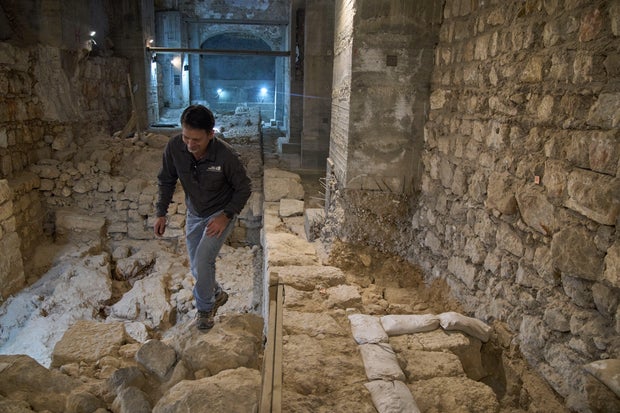
The foundations of the Hasmonean wall, excavation of which was completed last week in Jerusalem, were likely built a few decades after the Hanukkah story by the same rulers. It is almost 50 meters (164 ft) long, about half the length of a football field, and about 5 meters (16 ft) wide. It had walls that, according to estimates and some historical writings, were higher than the current walls surrounding the Old City of Jerusalem.
Much of the current walls surrounding the Old City of Jerusalem date back hundreds of years, to the Ottoman era.
The Hasmonean walls surrounded an area much larger than the present-day Old City of Jerusalem, with 60 watchtowers along the wall that were more than 10 meters (33 feet) high, according to ancient writings. The newly discovered part is one of the longest sections found intact from the foundations of the Hasmonean walls.
Separation wall and ceasefire
One of the most interesting aspects of the foundation was that the wall above it appears to have been deliberately and uniformly dismantled to a uniform height, not chaotically destroyed by the ravages of time or war, said Dr. Amit Re’em, one of the project’s lead archaeologists from the Israel Antiquities Authority.
Experts wondered why a leader would tear down a perfectly good security wall in an area that was constantly threatened by invasion.
In 132 or 133 BC. C., the Hellenistic king Antiochus the Seventh, heir to Antiochus the Fourth of the Hanukkah story, besieged Jerusalem and the Kingdom of Judea, according to the ancient Jewish historian Flavius Josephus.
While the Judean army was fighting, the Jewish king John Hyrcanus I decided to reach an agreement with Antiochus. He raided King David’s tomb for 3,000 talents of silver and offered 500 hostages, including his own brother, according to the writings of Josephus.
“Antiochus Sidetes (the Seventh) reached a ceasefire agreement with John Hyrcanus, saying that if you want me to withdraw my army, you yourself, the Jewish king, must raze the Hasmonean fortification that you and your father built,” Re’em said Monday. Josephus’ writings state that after Antiochus accepted Hyrcanus’ deal, they “broke down the walls surrounding the city.”
Other sections of the Hasmonean wall discovered elsewhere in Jerusalem were not dismantled, so it could have been just one section that was dismantled, possibly to provide a foundation for Herod’s palace, Peleg-Barkat explained. It is unlikely that Jerusalem has been left unprotected and without security walls for more than a century, he said.
Wall under a prison
The current section of the wall was discovered beneath an abandoned wing of the building known as Kishleh, which was built in 1830 as a military base. The wing was used as a prison, including by the British until the 1940s, and the walls were covered with graffiti carved by prisoners in English, Hebrew and Arabic. The remains of the iron bars of the cells are still visible on the ceiling.
Most of the building is still used by the Israeli police today, but one wing was abandoned and later moved to the Tower of David Museum. Archaeologists began excavating this wing of Kishleh in 1999, but violence in Jerusalem during the Second Intifada, which began in 2000, halted excavations until two years ago.
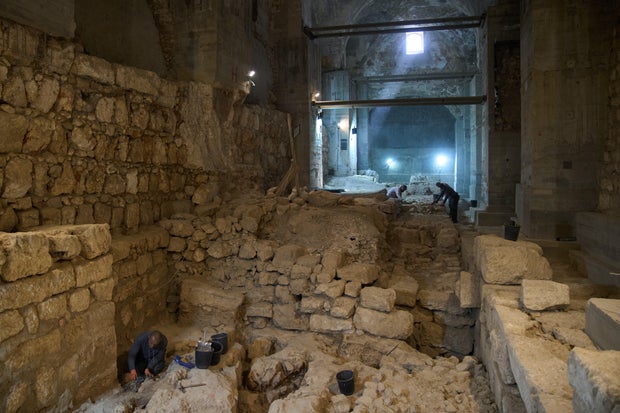
Archaeologists removed by hand the equivalent of two Olympic swimming pools of dirt and debris from the hall over the past two years. Excavations revealed what they believe to be dye pits from the Middle Ages, probably for dyeing fabric, and the long section of the Hasmonean wall foundations.
In the coming years, the Tower of David Museum will install a floating glass floor above the ruins and use the room as one of its new galleries in the Schulich Wing of Archaeology, Art and Innovation. The renovation works on this section are expected to last at least two years, once the archaeological excavation is completed.
Last year’s “Hanukkah archaeological miracle”
Almost exactly a year ago, in December 2024, Israeli researchers discovered a rare collection of ancient coins on the third day of Hanukkah, calling the find an “archaeological Hanukkah miracle.”
The coins were more than 2,000 years old and were believed to belong to King Alexander Jannaeus, the second ruler of the Hasmonean dynasty. Archaeologists found the hoard of about 160 coins during excavations in the Jordan Valley, which stretches between the Israeli-occupied West Bank and Jordan’s eastern border.
The ancient coins were unearthed on the third day of Hanukkah. Researchers noted the importance of that moment, as Alexander Jannaeus was descended from the leaders of a revolt in 167 BC. C. which, according to the Talmud, led to the restoration of the temple in Jerusalem and the first celebration of the Hanukkah holiday.
More recently, last month, archaeologists discovered evidence of an ancient religious practice in northern Israel, as well as a winepress dating back approximately 5,000 years, one of the oldest ever discovered in the country.
In:
- Jerusalem
- Archaeologist