



House Republicans Just Joined Democrats in Giving Trump a Big Rebuke
Several Republicans joined their Democratic colleagues in voting Thursday to block President Donald Trump from stripping federal workers of their union rights, a rare bipartisan rebuke of the White House from the Republican-controlled House.
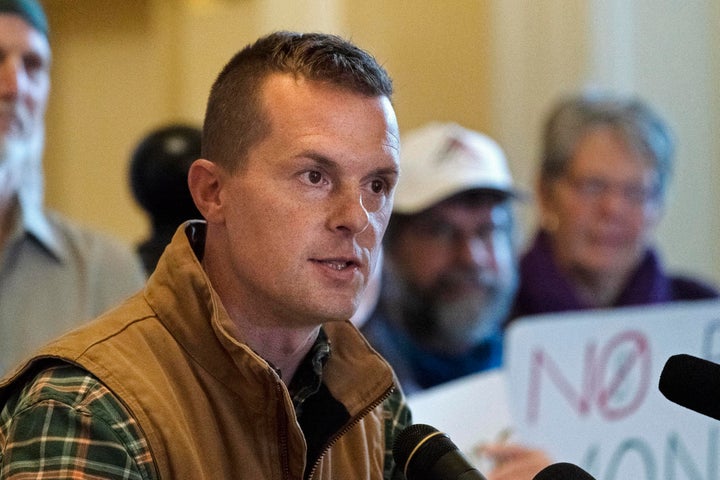
The measure, introduced by Reps. Jared Golden (D-Maine) and Brian Fitzpatrick (R-Pa.), would undo an executive order Trump signed earlier this year. cancel collective agreements covering up to 1 million workers. It passed 231 to 195, with the support of 20 Republicans.
The legislation is unlikely to go anywhere in the GOP-controlled Senate, but its success in the House shows that some moderate Republicans do not support Trump’s proposal. unprecedented union repression in federal agencies.
One of those lawmakers, Rep. Jeff Van Drew (R.N.J.), told reporters before the vote that Republicans should lean towards being more populist. He noted that typical union members are “people who love America” and “people who love hard work,” and that many of them are Republicans.
“We shouldn’t be the party of ‘no,’ the party of taking anything away, the party that hurts people,” Van Drew said.
The bill’s success is also a rebuke to House Speaker Mike Johnson (R-La.), who has been dealing with Republican defections on a variety of issues. Golden forced the vote by filing a “discharge petition” that garnered signatures from the entire Democratic caucus plus five Republicans.
Once a discharge petition gets 218 signatures, the House has to vote. Such petitions are rare, but Golden’s was the second to succeed this month after one from Rep. Thomas Massie (R-Ky.) forced the House to vote on a bill requiring the Justice Department to release its files on Jeffrey Epstein.
“The bill’s success in the House shows that some moderate Republicans do not support Trump’s unprecedented union busting in federal agencies.”
The Trump administration has promoted a An estimated 200,000 federal employees. as part of his historic assault on the administrative State. Attacking federal unions has been a key strategy in the overall plan, since union contracts can protect workers from arbitrary and unfair firing.
Trump’s March executive order aims to exempt workers in a number of federal departments from collective bargaining rights that have been enshrined in law for decades.
The reason is that these employees fulfill a “national security” function, although many of them clearly do not fulfill it. Among the agencies listed in the order are the Department of Veterans Affairs, the Environmental Protection Agency, the Department of Justice and much of the Department of Agriculture.
TO follow up order Trump signed in August and added even more agencies to the list, including the National Aeronautics and Space Administration, the U.S. Global Media Agency and the National Oceanic and Atmospheric Administration.
via News
The Trump administration made clear when it issued the first order stripping workers of their collective bargaining rights that saw federal unions as a political enemyclaiming that they had “declared war” on Trump’s agenda. Voiding contracts could help the White House weaken unions by giving workers fewer reasons to join and pay dues.
Golden told News themezone on Wednesday that the orders amounted to “the largest case of single-act union busting in American history.”
“These are collective bargaining rights that have already been negotiated,” he said. “It is already an agreement that has been closed and has been canceled arbitrarily.”
Federal unions have sued to block the orders from taking effect, arguing they are illegal. The case has not yet been resolved, but the unions cannot count on a legal victory. The Supreme Court’s conservative supermajority has given its blessing to much of Trump’s effort to remake the federal bureaucracy as he sees fit.
The House bill is part of an effort by unions and congressional allies to legislatively stop Trump’s orders in case the lawsuits fail. Federal unions and the AFL-CIO labor federation worked to build support on both sides of the aisle before the House vote.
Liz Shuler, president of the AFL-CIO, thanked Golden and Fitzpatrick for leading what she called a “rare bipartisan majority.”
“Americans trust unions more than any political party,” Shuler said in a statement. “As we head to the Senate, where the bill already has bipartisan support, workers are asking the politicians we elect to support us, even if it means taking on the anti-union boss in the White House.”