



Alzheimer’s disease could be reversed by restoring brain balance, study suggests
NEWNow you can listen to News articles!
Scientists may have identified a way to reverse Alzheimer’s disease in an animal study.
The study, led by University Hospitals Cleveland Medical Center, found that restoring a central cellular energy molecule in the brains of mice reversed markers of the disease, including brain changes and cognitive decline.
The researchers analyzed two mouse models of Alzheimer’s, as well as human Alzheimer’s brain tissue, and found severely decreased levels of NAD+.
A NEW VITAMIN COMPOUND SHOWS PROMISE FOR REVERSING ALZHEIMER’S BRAIN DAMAGE
NAD+, an enzyme that is essential for energy production, cellular maintenance, and long-term cellular health, naturally declines with age, according to the study’s lead author, Andrew A. Pieper, M.D., Ph.D., director of the Center for Brain Health Drugs at the Harrington Discovery Institute at University Hospitals in Cleveland, Ohio.
“When NAD+ drops below necessary levels, cells cannot effectively perform essential maintenance and survival functions,” he told News Digital.

Scientists may have identified a way to reverse Alzheimer’s disease in an animal study. (iStock)
Dr. Charles Brenner, Chief Scientific Advisor at Niagen, which specializes in products that increase NAD+ levels, shared that NAD+ plays an important role in powering energy-intensive organs, including the brain.
“The brain consumes about 20% of the body’s energy and has a high demand for NAD+ for cellular energy production and DNA repair,” Brenner, who was not involved in the study, told News Digital. “This is because NAD+ plays a key role in how neurons adapt to a variety of physiological stressors and support processes associated with brain health.”
“Our experiments provide proof of principle that some forms of dementia may not inevitably be permanent.”
Research demonstrates the potential benefits of NAD+ supplementation in brain health conditions such as Alzheimer’s disease, Parkinson’s disease and ataxia telangiectasia, he added.
In the UH Cleveland study, researchers used a drug called P7C3-A20 to restore normal NAD+ levels in mouse models, which blocked the onset of Alzheimer’s. According to the researchers, in brains with advanced Alzheimer’s, it reversed the accumulation of amyloid and tau and completely restored cognitive function.
ALZHEIMER’S RISK DECREASES WITH A DAILY LIFESTYLE CHANGE, RESEARCHERS SAY
The treated mice also showed normalized blood levels of phosphorylated tau 217, an important clinical biomarker used in human Alzheimer’s research.
“For more than a century, Alzheimer’s has been considered irreversible,” Pieper said. “Our experiments provide proof of principle that some forms of dementia may not inevitably be permanent.”

The study found that restoring a central cellular energy molecule in the brains of mice reversed markers of the disease. (iStock)
The researchers were “surprised” by how strongly advanced Alzheimer’s was reversed in the brains of mice when NAD+ homeostasis was restored, even without directly targeting amyloid plaques.
“This gives reason for cautious optimism that similar strategies may one day benefit people,” Pieper added.
CLICK HERE FOR MORE HEALTH STORIES
This work builds on previous research from the lab showing that restoring NAD+ balance helped speed recovery after severe traumatic brain injury.
The study, which was conducted in conjunction with Case Western Reserve University and the Louis Stokes Cleveland VA Medical Center, was published last week in the journal Cell Reports Medicine.
Risks and limitations
According to the researchers, the main limitation of the study is that it was only performed in mouse models and may not directly translate to the disease in humans.
“Alzheimer’s is a complex, multifactorial and uniquely human disease,” Pieper told News Digital. “Efficacy in animal models does not guarantee the same results in human patients.”
CLICK HERE TO SUBSCRIBE TO OUR HEALTH NEWSLETTER
While medications have been tested in clinical trials with the goal of slowing the progression of Alzheimer’s, none have been proven to reverse it in humans.
The authors also warned that over-the-counter NAD+-boosting supplements can elevate cellular NAD+ to excessively high levels that, in some animal models, have been shown to promote cancer.
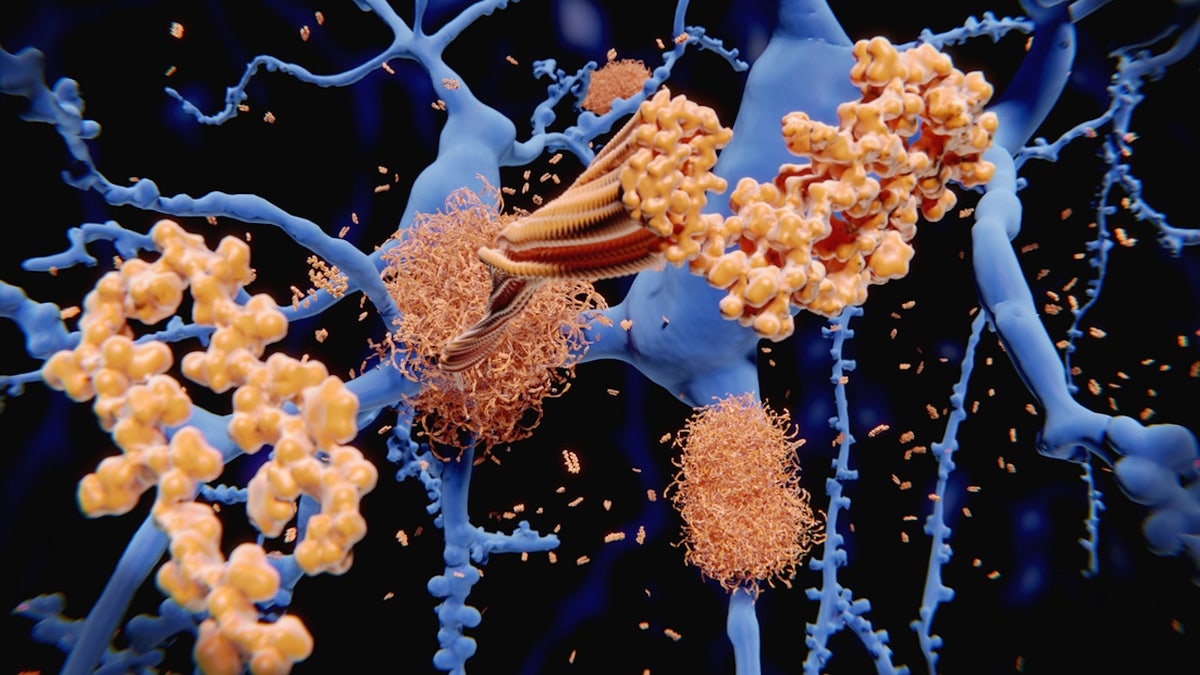
Restoring normal NAD+ levels reversed amyloid and tau accumulation in brains with advanced Alzheimer’s disease. (iStock)
“P7C3-A20, in contrast, allows cells to restore and preserve the appropriate NAD+ balance under stress without driving NAD+ to excessively high levels,” Pieper noted.
Anyone considering taking NAD+ modulating supplements should discuss the risks and benefits with their doctor, he recommended.
CLICK HERE TO DOWNLOAD THE News APP
According to the researcher, there are also proven lifestyle measures that promote brain resilience.
“Alzheimer’s disease is a complex, multifactorial and exclusively human disease.”
“These include prioritizing sufficient sleep, following a MIND or Mediterranean diet, staying physically and cognitively active, maintaining social connections, addressing hearing loss, protecting the head from physical injury, limiting alcohol consumption, and controlling blood pressure and other cardiovascular risk factors, such as avoiding smoking,” Pieper advised.
TRY OUR LATEST LIFESTYLE QUIZ
Looking ahead, the team plans to conduct more research on the impact of brain energy balance on cognitive health and test whether the strategy works for other age-related neurodegenerative diseases.
Melissa Rudy is a senior health editor and member of the lifestyle team at News Digital. Story tips can be sent to melissa.rudy@News.com.