



Venezuelan mother reveals last messages from her 18-year-old son killed in US assault on Maduro’s complex
/News/News
Add News themezone on Google
When the first explosions rocked his military base in Caracas, 18-year-old Saúl Pereira Martínez sent his mother a simple message: “I love you. It has started.”
It was the night of January 3rd and American forces were invading Venezuela. to capture the then president of the country, Nicolás Maduro, by order of President Donald Trump.
Pereira had finished his guard shift at Fort Tiuna, where Maduro was sheltered that night. However, he would not survive the assault.
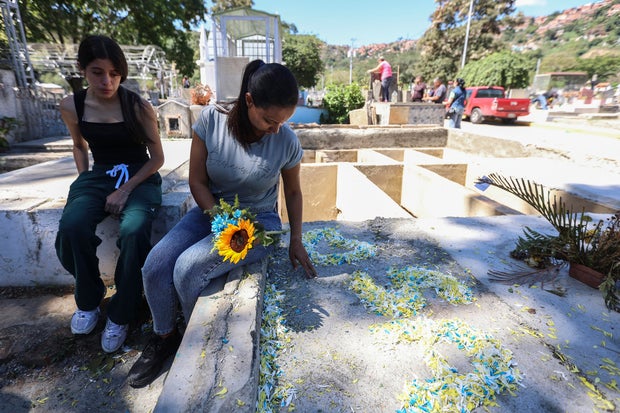
Natividad Martínez, his mother, visited the cemetery where her son’s remains are buried on Sunday, remembering the night it happened, and still in shock.
The last time he spoke to Saúl was at 2:00 am. He repeated that he loved her and told her to take care of his two brothers, ages two and nine.
Trump has repeatedly boasted about the success of the surprising operation to capture Maduro, boasting that there were no casualties.
But at least 83 people were killed in the operation, including 47 Venezuelan soldiers and 32 Cuban security personnelaccording to the Ministry of Defense in Caracas.
“You can’t come to my country and kill people like that,” Martinez said. “Because (they say) ‘it was a clean operation’. It wasn’t clean. Do you know how many people died?”
“A brave man”
When the attack began, Martinez, 38, heard explosions and began screaming, worried for her son’s safety, her husband said.
After talking to him on the phone, she fell to the ground screaming his name, she said.
“I told her to stay calm, we don’t know what’s going on,” said Saul’s stepfather, who asked not to be identified because he works as a police officer and government security official.
He believes Saúl was killed because his unit was spending the night inside the security perimeter around Maduro, making them a target for US forces.
On Sunday, Saúl’s parents met with his girlfriend and friends at the cemetery in southern Caracas.
Saúl had just completed his initial training with the Honor Guard in December and was studying at the military academy.
They brought flowers and, to the rhythm of old salsa, the family cried, remembered anecdotes and toasted in honor of the young soldier whom they remember as “a brave man.”
Saúl entered the army following in the footsteps of a childhood friend, who was at the La Carlota air base during the American attack and was wounded in the leg.
His mother had applauded the decision, having previously worried about the trajectory her son’s life was taking.
Saúl, says Natividad, went from “partying, going from here to there, doing nothing at home” to studying, cleaning the house during his visits and acquiring discipline.
“All human beings”
Despite the huge US military deployment in the Caribbean and Trump’s threats against Maduro, Martínez’s family did not expect things to get so bad.
“The president did not always remain in the same place,” his stepfather explained, and the government maneuvered to deceive even state security forces about Maduro’s whereabouts.
U.S. forces found Maduro thanks to internal informants, the stepfather said.
“(The death of) my son was a collateral effect of that infiltration,” he said.
Earlier this month, Pentagon chief Pete Hegseth said Maduro did not receive any notice The United States was closing in until moments before American forces arrived.
“Nicolas Maduro met some great Americans wearing night vision goggles three nights ago,” Hegseth said. “He didn’t know they were coming until three minutes before they arrived. In fact, his wife said, ‘I think I hear planes outside.’ They didn’t know. Do you know why? Because every part of that chain did its job.”
Hours after the attack, Natividad brought food for Saúl to Fuerte Tiuna, according to his weekly schedule.
He found only silence.
Hours later, when the names of the fallen began to circulate, she went to the battalion and stayed there, demanding answers.
“And they had to tell me,” he said, looking at the cement grave where mourners had spelled Saul’s name with yellow, blue and white flower petals.
His son, like other soldiers, was honored by the government, which promoted him posthumously.
Natividad said some seemed not to mourn these deaths because of the political polarization that has divided the nation under Maduro’s government, and that of Hugo Chávez before him.
“Those who died are also human beings. They are all Venezuelans. On one side or the other, they are all human beings, they all have people who mourn them,” he said.
Shocked but still stoic, Natividad said she was proud of her son.
“He died for his country,” he said. “Regardless of what anyone says, to me my son was a patriot, and that’s what matters to me.”
Meanwhile, American attacks in the Caribbean and eastern Pacific have killed more than 100 people on ships that, according to Washington, were transporting drugs from Venezuela. Legal experts and lawmakers critical of the attacks have argued that military action against suspected drug smuggling ships is legally dubious.
Last month, the family of a Colombian who died in a US military attack on a boat in the caribbean filed a complaint against the United States before the Inter-American Commission on Human Rights (IACHR).
In:
- Venezuela