



Synthetic drug network dismantled
/News/News
Add News themezone on Google
European police said on Wednesday they dismantled a major synthetic drugs network operating in several countries in the “largest ever operation” of its kind, dealing a “massive blow” to organized crime.
Authorities dismantled 24 industrial-scale laboratories and confiscated around 1,000 tons of chemicals used to manufacture illegal drugs such as MDMA, amphetamines and methamphetamines.
“I have been in this business for a while. This is by far the largest operation we have carried out against the production and distribution of synthetic drugs,” Andy Kraag, director of Europol’s European Center against Serious Organized Crime, told News.
“I think this is really a blow to organized crime groups involved in drug trafficking, particularly synthetic drugs,” Kraag added.
The profits generated were “considerable,” Polish police said at a press conference in Warsaw. For every euro spent on drug production, traffickers made approximately 30 euros in profit.
The year-long operation involved police from Belgium, the Czech Republic, Germany, the Netherlands, Poland and Spain, Europol said.
The agency released video of the operations, showing agents conducting raids, making arrests and seizing evidence. Europol said police carried out 50 house searches: 45 in Poland, two in Belgium, two in Germany and one in the Netherlands.
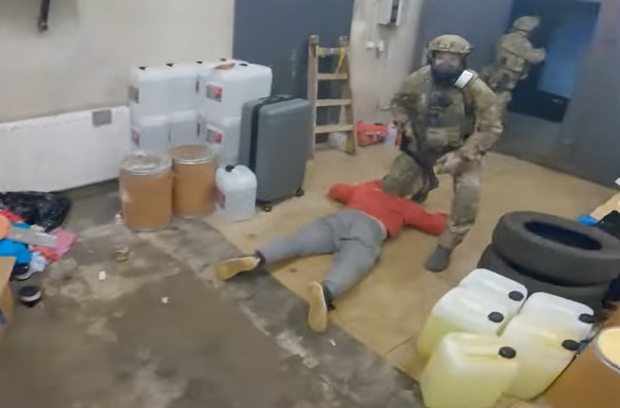
More than 85 arrests were made, including the two alleged ringleaders, both from Poland, Kraag said. Europol described the alleged ringleaders as “high-value targets.”
Suspicions arose in 2024, when Polish police discovered a network importing large quantities of legal chemicals from China and India.
“These precursors were legal and were generally used in the pharmaceutical industry,” but the quantities acquired and processed were “very large, unrelated to the real needs of the companies” that acted as a front for trafficking, the Polish police stressed.
Subsequent investigations showed that these chemicals were being repackaged, mislabeled and redistributed throughout the European Union to laboratories manufacturing synthetic drugs.
Polish police released images of the operation showing dozens of drums and tanks containing precursors stored in several warehouses, as well as processing laboratories raided by heavily armed investigators.
Most of those arrested were from Poland, but Belgian and Dutch citizens are also believed to have participated in the criminal operations.
“The operational structure of this criminal network was complex, with seven legal companies in Poland facilitating import and distribution activities, and high-level leadership coordination connecting the different criminal groups in EU countries,” Europol said.
“Supply chain strategy”
Kraag said the operation was part of a “supply chain strategy” to choke off the synthetic drugs industry at its source.
“These criminal groups no longer have supplies,” he told News.
To prevent future trafficking on a similar scale, Polish police commander-in-chief Marek Boron told News that law enforcement “constantly updates the list of precursors entering the market.”
“We are constantly at the stage of determining which chemicals are currently being misused for the production of medicines,” he added.
In addition to the health risks associated with the use of these drugs, Kraag highlighted the problems related to violence, corruption and money laundering in this criminal area.
The production of synthetic drugs also has a detrimental environmental impact, he noted.
Authorities seized more than 120,000 liters or 31,700 gallons of toxic chemical waste that criminals often dump on the ground or in streams.
“Today it is profit for criminals. Tomorrow it will be pollution,” Kraag said.
Police have other targets in their sights following the successful operation announced Wednesday by Europol, the EU police agency.
“This is one of the largest distributors, but it’s not the only one, so we’re still looking,” Kraag said.
Last month, Europol announced it had helped coordinate three major operations to disrupt “major cocaine supply chains to Europe.”
In:
- Drug traffic
- European Union
- methamphetamine