



ICE manual tells damning story about Renee Good’s death
Federal agents led by an ICE officer who surrounded and shot dead Renee Good in Minneapolis last month appear to have violated the agency’s policies regarding the use of force during nearly every step of the encounter, according to internal documents obtained by News themezone.
The ICE Directive on Firearms and Use of Force states that it “serves as authoritative guidance” for Immigration and Customs Enforcement agents. Outlines requirements for how to handle fleeing subjects, including those in a vehicle; how to properly handle firearms around people; guidelines for de-escalation; and what actions officers should take before resorting to deadly force.
“ICE employees are expected to be familiar with the contents of this Manual and must take appropriate measures to comply with the policies and procedures established therein,” it says. “Violation of the policies and procedures contained in this Manual may be grounds for disciplinary action or other appropriate action.”
Video of the encounter shows three officers approaching Good’s vehicle and at least two of them instructing him to get out. Good is sitting in the driver’s seat, while his wife is next to the vehicle. The federal agents bark orders at Good to “get out of the damn car”; one reaches inside the driver’s side window and attempts to unlock the door. ICE Officer Jonathan Ross comes from the passenger side and stands in front of the vehicle. Good appears to try to get away from the officers and walk away.
Ross, who is recording on his cell phone with one hand and holding his gun with the other, then shoots Good at least three times. He refers to her as a “fucking bitch” after shooting her in the head.
The manual states that only one officer should give orders at a time to avoid confusion, and that officers should have a “professional and courteous demeanor” and a “positive attitude” when approaching. Officers are instructed to give commands in a “firm, professional voice” and use “instructions that are simple, easy to understand, and repeated as necessary.”
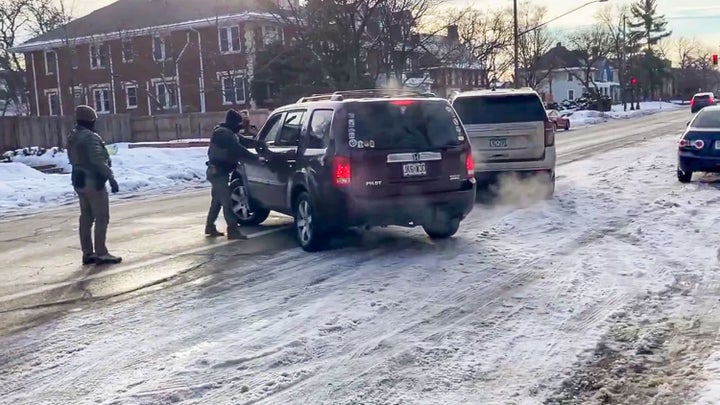
Photo by KSTP reporter KaMaria Braye
Michel Moore, former chief of the Los Angeles Police Department, explained in an interview with News themezone why this first moment of the interaction made the scene unnecessarily tense.
“The use of profanity in such a charged situation lacks professionalism and increases and intensifies tensions,” Moore said. “You don’t come up and say, ‘Mother, can I?’ or ‘Would you mind stopping?’ That’s not reasonable. But getting all the way to ‘get out of the car’…well, you’ve missed all the other steps in establishing what we call a command presence.”
Without waiting for Good to comply with this order, an officer reaches through the driver’s side window. Although this is not explicitly prohibited in the manual, it states that “ICE policy requires agents to adjust force based on changing circumstances and consider environmental and tactical factors.”
“There are a number of really serious and serious tactical and legal errors that were made by officers on the scene to ultimately precipitate a use of force that was not necessary and not proportionate to the nature of the threat,” said Matthew Barge, a senior fellow at the Police Policing Project at New York University School of Law. He has spent 18 years researching law enforcement and public safety issues and has reviewed thousands of hours of footage of deadly or excessive force. The officers approached Good in a “completely uncoordinated and really chaotic” manner, Barge said.
At the same time, Ross was filming the encounter with Good and his wife with his cell phone. The manual does not explicitly prohibit handling a phone while holding a gun, but it does emphasize control, awareness and safe handling of a gun when in close contact with others.
Authorities widely recognize that moving into the path of a vehicle is a high-risk tactic. An ICE officer previously told News themezone that they were trained to view vehicles as deadly weapons, and after the Good shooting, officials told them not to step in front of cars and to be “cautious around them.” A senior Department of Homeland Security official told NBC News that ICE officers are trained to never approach a vehicle from the front and instead approach at a 90-degree “tactical L” angle to avoid injury.
“Deadly force is not authorized solely to prevent the escape of a fleeing suspect,” the manual states. “Deadly force against a fleeing subject is only authorized if there is probable cause to believe that the suspect’s flight would pose an imminent danger of death or serious bodily injury to the officer or another person.”
“The use of excessive force by ICE employees is strictly prohibited,” the manual warns.
The Department of Homeland Security did not respond to a request for comment on apparent violations of ICE’s use of force policy.
Even if officers had probable cause to believe Good was interfering with their operations and she attempted to flee from them as they approached her car, Moore said most law enforcement officers would recommend letting her leave and then investigating later. “You don’t shoot at a moving vehicle,” he said. “Stay away from that.”
Even considering that a vehicle could be seen as a potentially deadly weapon, protocol suggests that Ross may have moved too quickly when deciding to fire his weapon.
ICE operates under a “use of force continuum,” the manual says. Officers should weigh the “totality of the circumstances” and first consider using “intermediate force” to de-escalate if reasonable. (Last year, the Supreme Court used the same phrase – “totality of the circumstances” – in explaining what investigators should consider when evaluating whether an officer who used deadly force acted reasonably.)
De-escalation tactics mentioned in the manual include giving verbal warnings or establishing containment zones, such as blocking a street so a subject in a vehicle cannot flee. Even the use of chemical agents to deter a subject can be considered reasonable force, according to the manual.
But the administration has so far delayed the criminal investigation of the officers involved in Good’s killing, after Trump officials initially smeared her as a “domestic terrorist.” The FBI excluded state and local officials from the investigation. And the path to prosecution of federal agents is narrow.
The manual warns that agents will face consequences for violating ICE policy. Ross appears to have faced only one consequence since the Jan. 7 shooting: A Department of Homeland Security spokesperson told News themezone last week that he had been placed on leave.