



Key Lawmakers Read Hidden Epstein Files, Say Pam Bondi Is Covering Up
WASHINGTON – Millions of files released, a US cabinet member implicated, multiple European governments in crisis. And members of Congress who forced the Justice Department to release its investigative files on billionaire sexual predator Jeffrey Epstein said the government is still covering up.
“It’s both very much an expose, but also a cover-up,” Rep. Ro Khanna (D-Calif.) told News themezone.
Khanna, Rep. Jamie Raskin (D-Md.) and Rep. Thomas Massie (R-Ky.) said it’s clear that President Donald Trump’s administration is still unnecessarily and illegally withholding information about Epstein and his relationships with other powerful figures. Khanna and Massie were chief sponsors of the Epstein Records Transparency Act, while Raskin led Democrats in a House Judiciary Committee grilling of U.S. Attorney General Pam Bondi, where she insisted the department had done everything it could.
“More than 500 attorneys and reviewers spent thousands of hours painstakingly reviewing millions of pages to comply with Congressional law,” Bondi said. “We have published more than 3 million pages, including 180,000 images, all to the public, while doing the best we could within the time frame allotted by legislation to protect victims. And if you brought us a victim’s name that had been inadvertently released, we redacted it immediately.”
Bondi lashed out at lawmakers during the hearing, accusing them of ignoring Epstein’s crimes during previous presidential administrations and claiming that several lawmakers, including Massie, suffer from “Trump derangement syndrome.”
Massie, a frequent target of Trump’s criticism, told News themezone during a break in the hearing that it’s actually the other way around.
“She has Massie Derangement Syndrome,” Massie said. “It’s her thing now. In the administration, she’s eating them up.”
When he looked at the Justice Department files, Khanna said there were hundreds of FBI documents chronicling interviews with Epstein’s victims that had been incorrectly redacted. Fixing those redactions, he said, could reveal the identities of co-conspirators who could potentially face charges. (The Justice Department told Khanna that the drafting errors were the FBI’s fault.)
“It will answer people’s questions about who these powerful men were,” Khanna said.
Khanna and other members accessed less redacted material on four computers inside a Justice Department office. After they used the classified material to highlight inappropriate redactions in the public material, the department unredacted them, revealing the identities of several men associated with Epstein who had been named as possible co-conspirators, including the former CEO of Victoria’s Secret and a prominent Emirati businessman.
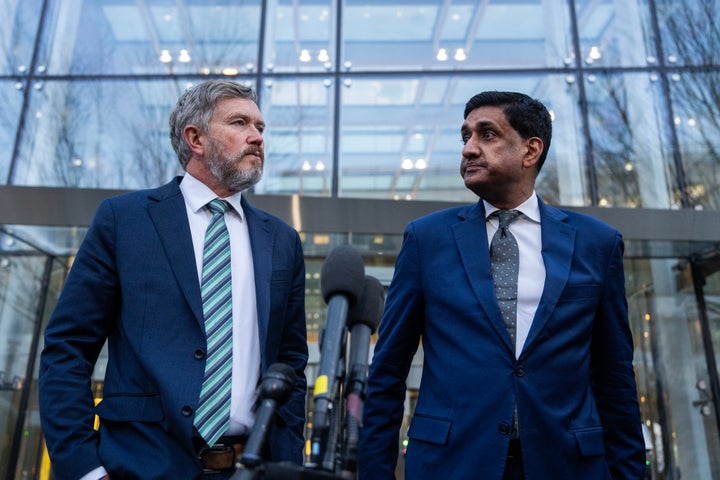
Tom Williams via Getty Images
This weekend, the department faces another deadline: justifying its redactions in writing to members of Congress. The law specifically prohibits redactions “for reasons of embarrassment, harm to reputation, or political sensitivity, including to any government official, public figure, or foreign dignitary.” Whatever the department tells lawmakers will likely spark another round of high-profile questions about the government’s failure to follow the law.
Rep. Nancy Mace (RS.C.), one of three Republican women who joined Massie in using a parliamentary maneuver known as a “discharge petition” to force House Speaker Mike Johnson (R-La.) to allow a vote on Epstein’s disclosure bill, echoed Khanna’s complaint.
“Memos and attachments drafted by the Department of Justice regarding possible accomplices remain hidden. The excuse? This is how they received the data,” Mace he said Tuesday on social media after reviewing the files personally. “The American people deserve every page. Every name. And every truth the government clings to.”
As for how to make sure the Trump administration lives up to its promises, Khanna suggested that the methods they have used so far (including both court filings and constant media interviews) should still be effective.
“We can do things in court. We can do things in terms of continued public pressure. That has worked, but we and survivors can also take legal action,” Khanna said.
In a series of posts on He suggested FBI Director Kash Patel lied to Congress when he said the FBI had no evidence that other people committed sex trafficking crimes along with Epstein and his accomplice, Ghislaine Maxwell.
The most recent batch of material also included a Palm Beach The police detective’s memory of speaking with Trump in 2006.and Trump saying, “Thank God you’re stopping him, everyone knows he’s been doing this.” The report raises new doubts about Trump’s earlier claim that he had “no idea” what kind of criminal mischief his former friend had been up to, not to mention the president’s account of how his friendship with Epstein ended.
Last year, amid growing public pressure to release Epstein’s material, the White House claimed that Trump cut ties with Epstein because he was a “disgust.” The president said it was because Epstein had stolen staff from his Mar-a-Lago club in Palm Beach, Florida. The alleged poaching occurred around 2000; The first report that Trump banned Epstein from Mar-a-Lago was in 2007, after his criminal behavior became public.
Another document from the new batch, one that was redacted incorrectly, makes the Trump-Epstein timeline even more confusing. Raskin, the ranking Democrat on the House Judiciary Committee, was one of the first to see the less redacted material from the Justice Department. He found that the department had improperly redacted an email from Epstein to Maxwell that contained a summary of his conversation with Trump’s lawyers around 2009. Raskin told News themezone that he had seen the redacted version of the email in public disclosures and then saw the unredacted version on the Justice Department’s computer.
“He recorded [Trump] in the interview he said Epstein was not a member of Mar-a-Lago, but he was a guest and we never fired him,” Raskin said.
Raskin was unclear why the material was removed, except that he was pretty sure it wasn’t done for a good reason.
“It’s certainly not within the terms of federal law, which is just written to protect victims’ privacy,” Raskin said.