



Minnesota held election amid ICE surge. It’s a warning.
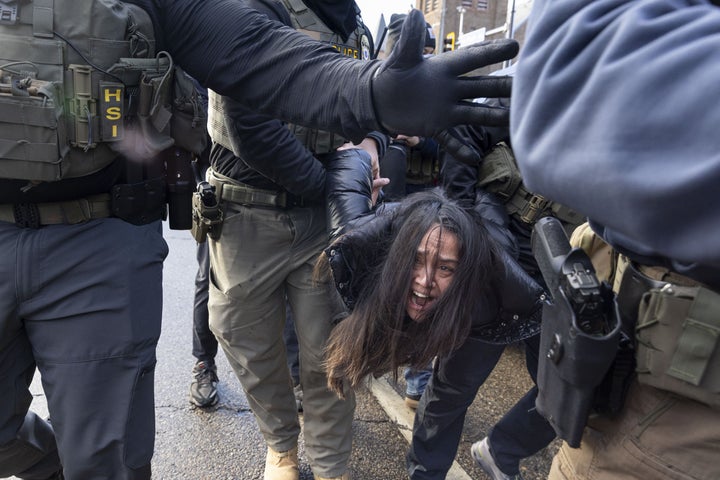
There was a lot to worry about before Minnesota state Rep. Meg Luger-Nikolai cruised to victory in the Jan. 27 special election to fill a vacant state legislative seat in St. Paul. His district, like neighboring Minneapolis, faced a brutal occupation by more than 3,000 federal agents from Immigration and Customs Enforcement and Customs and Border Patrol. Those officers had killed two Twin Cities residents and brutalized countless citizens and non-citizens alike.
The brutal crackdown on Minneapolis-St. Paul and comments from the Trump administration and its allies in the right-wing media and Congress had raised serious concerns that ICE would be used to disrupt the election by surveilling or surrounding polling places.
“We were quite concerned about that, particularly because of her race,” Secretary of State Steve Simon, a Democrat, said of Luger-Nikolai.
Those fears have only grown as Trump allies threatened to use ICE around the polls.
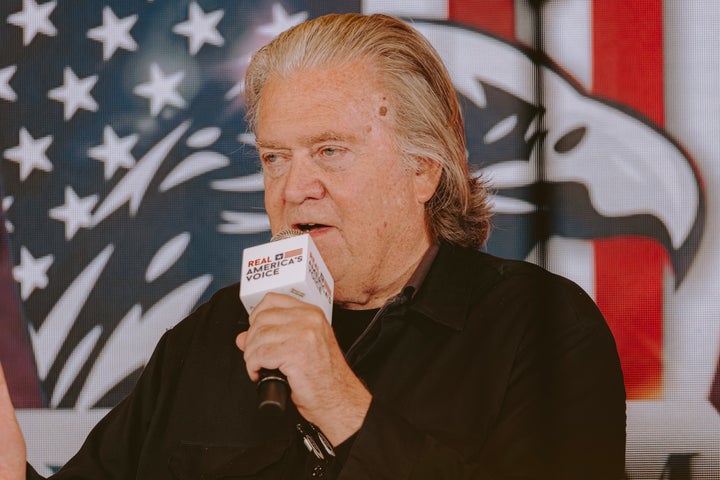
“You’re absolutely right: ICE will surround the polls in November,” former Trump adviser Steve Bannon said on his podcast on February 4.
Republican lawmakers, such as Sen. Mike Lee (R-Utah) and Rep. Jason Smith (R-Mo.), I said there is There is nothing wrong with ICE showing up at the polls to question voters.
But last month in Minnesota those fears and threats did not materialize. Or at least not in the way some worried.
Mostafa Bassim/Anadolu via Getty Images
“The good thing is that there were no reports of ICE near the polls,” Luger-Nikolai said. “That part was good.” But that doesn’t mean everything was almost normal.
While the worst fears did not materialize, Minnesota’s experience hosting elections under the most extreme ICE crackdown seen to date offers lessons in how such an oppressive operation can significantly undermine the basic functions of elections and democracy.
Luger-Nikolai’s special election campaign began normally, as she won her party’s primary in December. But as Trump’s Operation Metro Surge escalated and became increasingly violent, she and the state’s Democratic-Farmer-Labor Party had to change tactics.
“After winter break into January, we realized that knocking on doors was a very bad idea,” Luger-Nikolai said.
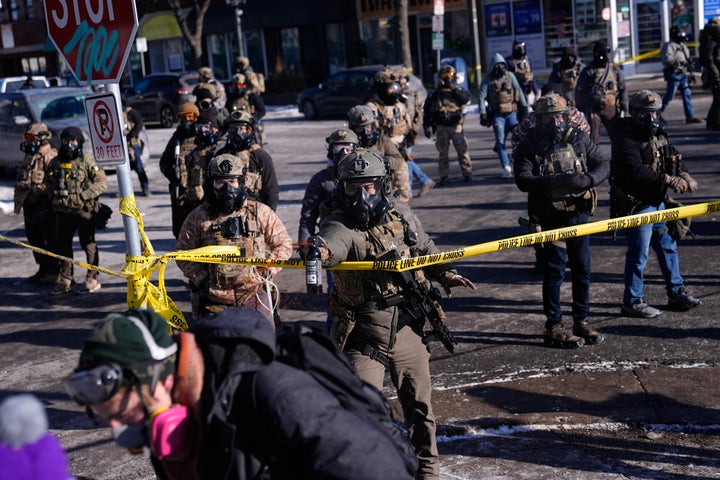
Thanks to a crucial Supreme Court decision in its shadow docket that authorized immigration agents to racially profile people they thought might be undocumented, Operation Metro Surge saw agents target anyone (citizen or non-citizen) who was not white for questioning, detention, or, in many cases, brutal treatment. ICE began going door-to-door in predominantly minority neighborhoods to ask where residents were born, sometimes dragging them from their homes at gunpoint. Officers fired pepper spray and tear gas indiscriminately at residents, including at the car of a family that was hospitalizing a baby.
“What that did was have an incredibly chilling effect on the way people move in our communities,” said Richard Carlbom, chairman of the Minnesota Democratic-Farmer-Labor Party. “There are American citizens who are black, brown or Asian who do not leave their house and we have to deliver food to them weekly because they are afraid of being detained.”
These fears meant that the party had to change tactics and limit the way it carried out its voter contact and get-out-the-vote operations. At first, the Luger-Nikolai campaign stopped knocking on doors at single-family homes so as not to scare off anyone they couldn’t contact in advance. Instead, they focused on apartments where they could coordinate with superintendents and other building caretakers to inform residents when there would be callers in the building, alleviating fears.
But then, on January 7, ICE officer Jonathan Ross shot and killed Renee Good, a 37-year-old mother, who had been acting as an observer for ICE law enforcement operations. Then even that line of contact dried up.
Abbie Parr via News
“After Renee Good was murdered and things started to get worse, we started getting notes from caregivers saying, ‘We’ll let you in the building, but I wouldn’t recommend it,’” Luger-Nikolai said. “The residents told them they were scared.”
That meant his campaign had to rely on phone banking and leaving campaign literature at buildings without making contact with voters. This was a “suboptimal” way to run a campaign, Luger-Nikolai said, noting that knocking on doors is the number one way to contact voters to inform them about your candidacy and get them out to vote.
“This is not how I would have liked to run a campaign,” he added. “It reminded me a little bit of 2020,” when the COVID-19 pandemic limited traditional political campaigns.
Fears of strangers knocking on doors also varied depending on the residents’ race or ethnicity. According to Luger-Nikolai, it wasn’t the predominantly white communities that were afraid of someone knocking at the door. It was the diverse Latino, Black, Somali and Asian communities that feared that any knock on the door could end in an interrogation by immigration agents, a gun pointed in their faces, or worse.
What this experience shows is that even in the absence of ICE around the polls, Trump’s immigration enforcement operations sow enough fear and chaos to terrorize minority communities and significantly transform the way campaigns are run. Considering that Black, Latino and Asian communities are important parts of the Democratic Party coalition, instilling fear in them could suppress their votes and help Republicans.
It remains illegal under multiple federal and state laws for federal officials to interfere with elections or even be near polling places. But the administration is trying to get away of these laws ahead of the 2026 midterm elections: Since returning to power in 2025, President Donald Trump has governed as an authoritarian, with a blatant disdain for dissent and democratic elections that could undermine his quest for total power.
Concerns about ICE being a party to any attempt by Trump to interfere with the 2026 midterm elections first arose late last year, when Trump launched immigration enforcement operations in Los Angeles and Chicago and then sent, or threatened to send, National Guard troops to support those operations. California Governor Gavin Newsom and Illinois Governor JB Pritzker, both Democrats, argued that these operations were not just to deport undocumented immigrants, but rather a preview of using armed federal agents or troops to take control of the elections. Congressional Democrats have increasingly pointed to the potential threat ICE could pose to the election as chaos escalated in Minnesota.
OLIVIER TOURON via Getty Images
The White House has said that deploying ICE agents around the election was not being considered, but did not rule it out.
“That’s not something I’ve ever heard the president consider, no,” said White House press secretary Karoline Leavitt. saying last week in response to a question about Bannon’s comments. But he added: “I can’t guarantee that an ICE agent won’t be near a polling place in November.”
Even if there is an effort to suppress voting, in the November election or any other, that does not mean it is guaranteed to be effective. The Luger-Nikolai special election victory was the most of any Democrat who ran in a special election over the past year, albeit in a very safe seat. And a week later, still under ICE/CBP occupation, the state party held its caucuses across the state and saw record turnout with more than 35,000 people.
However, the party had prepared in advance: it had trained 9,000 observers and had lawyers ready to intervene in case of any problems with ICE in the electoral assemblies.
The party’s electoral successes and enthusiasm show that Trump’s attempts to suppress the vote and tear down its communities may be having the opposite impact. This is evident in the rise of dispersed community networks that sprang up in Minnesota to document ICE everywhere they went, to challenge every arrest and deportation attempt in court, and to provide mutual aid to people who were too afraid to leave their homes.
Instead of cowering in fear or withdrawing into themselves and distancing themselves from their neighbors, residents united to fight. And those networks could become very powerful in helping to overcome whatever Trump tries next.
In addition to tracking any attempts to interfere with the polls in November, Carlbom believes “that these networks will activate voters, get them to the polls and make sure voters have what they need,” he said. “And ultimately, make sure that as many voters as possible show Republicans in this state that when you supported Donald Trump and not us, we won’t forget.”
Related