



Alexei Navalny
/News/News
Add News themezone on Google
The mother of the late Russian opposition leader Alexey Navalny said Monday she felt vindicated by a European. assessment that his son died from poisoning in a remote penal colony. He called for justice as Russia’s government rejected the European claim, the Trump administration said there was no reason to doubt it, and supporters of the late dissident marked two years since his death.
Navalny, Russian President Vladimir Putin’s fiercest domestic opponent, He died in an Arctic penal colony. in February 2024 while serving a 19-year sentence.
Britain, Sweden, France, Germany and the Netherlands issued a joint statement on Saturday saying they believed he was poisoned with epibatidine, a toxin found in poisonous frogs. They based their assessment on samples taken from his body, according to the statement.
“This confirms what we knew all along. We knew that our son did not simply die in prison, he was murdered,” Navalny’s mother, Lyudmila Navalnaya, told reporters outside the cemetery where he was buried in Moscow. “I think it will take some time, but we will find out who did it. Of course, we want this to happen in our country and we want justice to prevail.”
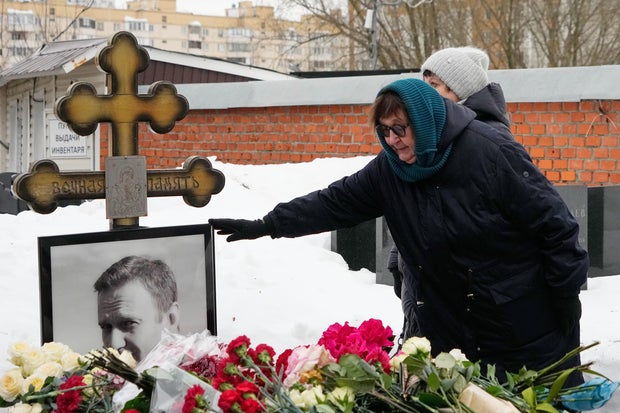
“Naturally, we do not accept such accusations. We do not agree with them,” Kremlin spokesman Dmitry Peskov told reporters in Moscow on Monday. “We consider them biased and unfounded. And, in fact, we firmly reject them.”
Russian authorities had branded Navalny and his organization “extremists” before his death, and anyone who mentions him or his exiled anti-corruption foundation can be prosecuted.
Speaking to reporters Sunday during a brief stop in Slovakia, U.S. Secretary of State Marco Rubio said the Trump administration was “not challenging” the report from European nations, which he called “very concerning.”
Rubio said Navalny’s death was “very serious” and added that the United States’ decision not to join the report “does not mean that we do not disagree with the result,” which he called a European-led initiative.
“Sometimes countries go out and do their own thing based on the intelligence they’ve gathered. We were obviously aware of the report. It’s a worrying report,” he said. “We certainly have no reason to question it or we are not arguing or fighting with these countries about it.”
Russian authorities have never offered many details about the cause of Navalny’s death.
His widow Yulia Navalnaya, who lives in exile with a prominent arrest warrant in Russiasaid about six months after her husband’s death that Russian investigators told her he had died from a combination of “a dozen different illnesses” and that he eventually succumbed to an arrhythmia, or irregular heartbeat, after a walk.
Navalnaya said her husband had no case of heart disease before he was imprisoned.
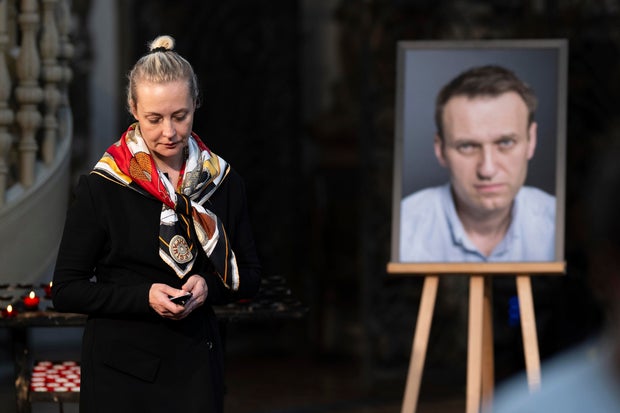
“Russia claimed that Navalny died of natural causes,” the European nations said in their joint statement over the weekend. “But given the toxicity of epibatidine and the reported symptoms, it is very likely that poisoning was the cause of his death. Navalny died while in prison, which means that Russia had the means, the motive and the opportunity to administer this poison to him.”
British Foreign Secretary Yvette Cooper said in a statement that “Russia saw Navalny as a threat” and poisoned him as a show of force.
“By using this form of poison, the Russian state demonstrated the despicable tools it has at its disposal and the overwhelming fear it has of political opposition,” Cooper said.
The UK Foreign Office said that “only the Russian state had the means, motive and opportunity to deploy this lethal toxin against Navalny” and that it “holds it responsible for his death.”
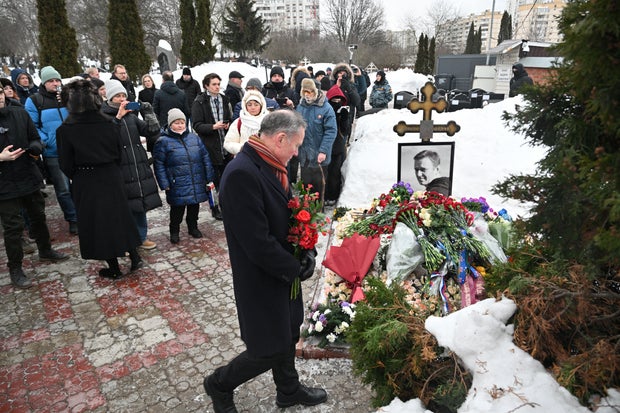
Dozens of people visited his grave early on Monday, including foreign diplomats, according to an News journalist present at the scene. Some of those who attended wore masks or bandanas over their faces.
Navalny had crusaded for years against official corruption and organized mass protests against the Kremlin. He was previously poisoned with the Soviet-era nerve agent. novichok while flying from Moscow to Siberia in 2020, and eventually recovered after a long period of treatment in Germany. He said Lesley Stahl of 60 Minutes. He later believed the poisoning was an assassination attempt masterminded by Putin, another claim Russian officials have always denied.
Navalny returned to Moscow in 2021, knowing that he faced sure arrest. He was convicted three times on various charges and sentenced to 19 years in prison on charges related to extremism, which he always dismissed as politically motivated.
He was imprisoned in January 2021 and then moved almost three years later to the arctic penal colonywhere he died in February 2024.
Kerry Breen contributed to this report.
In:
- War
- Ukraine
- Alexei Navalny
- Alexei Navalny
- Russia
- Vladimir Putin
- Poisoning
- frogs