



In
Ohio Republicans are exploring different ways to crack down on what they suspect is widespread fraud in government-funded child care, from implementing mandatory state surveillance of child care centers to requiring that children be photographed every day so the state can verify their attendance.
Born amid a right-wing social media frenzy over fraud allegations, the proposals have sparked alarm among advocates for child care providers who fear higher costs and the stigmatization of government-subsidized care. Many centers rely on federal and state dollars to serve the children of low-income workers.
In a sign of how controversial the proposals could be, the main sponsors of an Ohio bill are already backing away from their plan to require child care centers to install cameras in their common areas and provide the state Department of Children and Youth with live access to the feeds. That bill amassed 26 Republican cosponsors before its primary sponsors decided to rewrite it.
“This is just an attempt to further defund the child care system,” said Tami Lunan, director of the Care Economy Organizing Project, an advocacy group representing Ohio child care providers. “What really worries us is that they will try to replicate these policies in other places.”
In a viral video from December, conservative YouTuber Nick Shirley sought to expose rampant scams among Somali-born child care providers in Minnesota who receive government funding. The story was promoted by high-profile figures on the right, including Vice President JD Vance, even though state officials said the video was misleading.
“We are in the era of the Epstein files. Anything can happen.”
– State Rep. Ashley Bryant Bailey (D)
The fighting in Ohio shows how the right’s anger has spread far beyond Minnesota.
Ohio Rep. Josh Williams (R), a lead sponsor of the bill proposing surveillance, told News themezone that he is trying to reach a deal with child care providers while taxpayers demand that lawmakers do something.
“Voters were asking for an end to all publicly funded child care until we got a full audit of the system,” said Williams, who represents parts of the Toledo area. “But we know how detrimental that would be to our workforce.”
After meeting with providers, Williams said he is already moving away from the “full use of the camera system” laid out in his bill. He noted that parents who benefit from subsidies already have their image taken every time they enter and leave their daycare centers on tablets. Instead, he plans to propose using tablets to take pictures of children.
“There is no evidence that the child is actually present; that is what many of our voters and taxpayers want,” he said.
Child care is incredibly expensive nationwide, with an average annual cost of $12,351 for a baby in Ohio, according to the group Groundwork Ohio, which advocates for early childhood education. The federal government provides funds to help low-income workers cover these costs, and states administer the programs and provide a certain amount of matching funds. Providers serving qualifying families are reimbursed based on attendance.
Although investigations have shown some degree of fraud, as well as what are likely honest accounting errors, child care advocates say the prevalence of scammers across the country is probably nowhere near the degree right-wing influencers describe.
Ohio Gov. Mike DeWine, a Republican, attempted to calm the public after the Minnesota controversy. There are about 5,200 centers across Ohio that receive public funding. DeWine said his state had made more than 10,000 unannounced visits to child care centers throughout 2025, resulting in 38 closures, and that a “comprehensive review process” was in place to help prevent fraud.
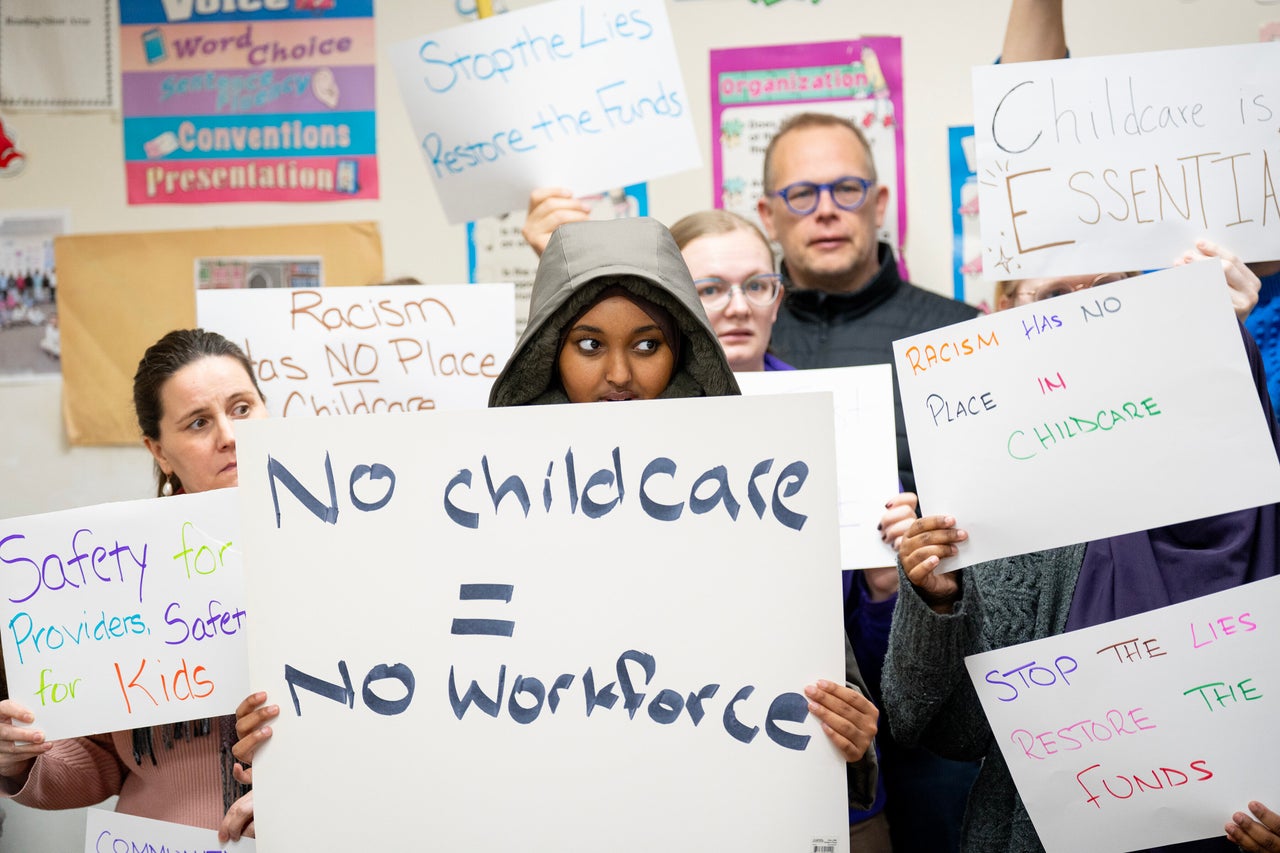
Photo by Alex Kormann/The Minnesota Star Tribune via Getty Images
While encouraging the public to submit tips, DeWine also seemed to acknowledge that many fraud watchdogs seemed to be jumping to conclusions.
“For example, [the state] received a social media tip regarding a daycare in Columbus on State Route 161,” he said in a statement. “This address has caused concern on social media because the Google Maps image of the address shows a tobacco store and not a daycare. After investigating the tip, [the state] determined that the Google Maps image was from 2022. The facility did not open as a daycare until earlier this year.”
Williams received some criticism from Democrats for his photo proposal at a House hearing Tuesday. Rep. Ashley Bryant Bailey of Cincinnati said she was concerned about the footage falling into the wrong hands and that using existing tablets instead of live camera feeds didn’t eliminate that fear.
“We are in the era of the Epstein files,” Bryant Bailey said. “Anything can happen.”
Ali Smith, senior project coordinator for the progressive research group Policy Matters Ohio, told News themezone that the idea of photography “makes providers and their parents nervous.”
“There has to be a better way than taking pictures of children and invading their privacy like that,” he said.
Smith is also concerned about due process for child care providers in the current environment. The text of the bill debated Tuesday calls for funding to be withdrawn in the event of “likely or suspicious waste, fraud or abuse” (emphasis added), which makes her wonder if an influencer’s YouTube video might be enough.
“It all seems reactionary and short-sighted. We already have huge child care deserts in Ohio.”
– Ali Smith, Senior Project Coordinator at Policy Matters Ohio
When asked what kind of due process people should expect, Williams told News themezone that the state Department of Children and Youth would determine when exactly a provider’s funding would be cut off. He said a preliminary investigation, as opposed to a “full-fledged investigation,” should be enough to withdraw funds if it suggests fraud.
“It does not mean that if the accusations turn out to be [untrue] that the funds cannot be returned,” he said.
A separate Republican bill in Ohio would make it easier for the state to stop payments if there is “reason to suspect” misuse of the funds. It would also prevent the state from moving toward enrollment-based child care reimbursements, while maintaining the current attendance-based system. Supporters say payments tied to enrollment are more reliable and consistent for providers.
“It all seems reactionary and shortsighted,” Smith said of both bills. “We already have huge child care deserts in Ohio… I’m in Appalachia, where there are entire counties that don’t have a center that accepts publicly funded child care. Some people rely on in-home providers. Closing a couple of them could be a really big problem.”
Smith’s group has been urging lawmakers to put the brakes on any plans, believing that panic over alleged fraud is a dangerous climate for lawmaking.
At Tuesday’s hearing, a House lawmaker, Republican Tracy Richardson, raised an alternative to taking photographs of children.
“I also agree that photos of children are a sensitive topic, and where those photos land is a sensitive topic,” Richardson said. “But here’s an idea: why not fingerprints?”
Republican Rep. DJ Swearingen, a major sponsor of the bill along with Williams, did not embrace the idea outright. He acknowledged that they were navigating “sensitive” terrain. But he said he was confident lawmakers could come up with a low- or no-cost plan that parents and child care providers would feel comfortable with.
“I think everything we do with children is going to be under a microscope, whether it’s photographs, fingerprints or any number of things, because rightly so it’s a very sensitive topic,” Swearingen said at the hearing. “I don’t want anyone taking pictures of my kids. There are all kinds of freaks and weirdos out there.”