



Zelenskyy says Putin does
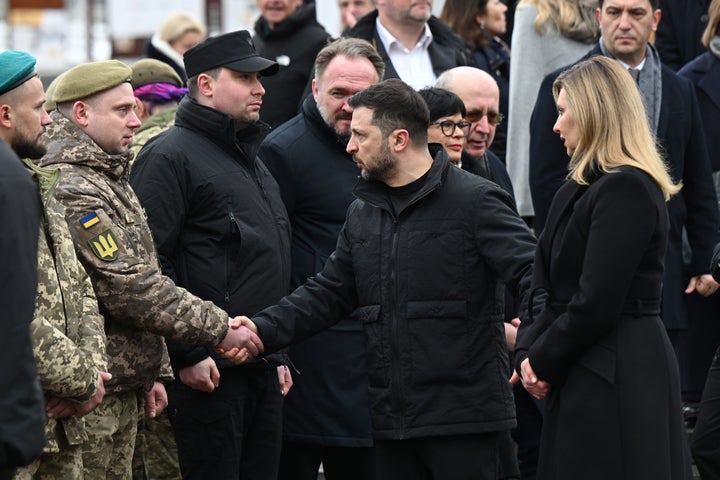
kyiv, Ukraine (AP) — More than a dozen top European officials were in the Ukrainian capital on Tuesday in a show of support on the fourth anniversary of Russia’s all-out invasion of Ukraine, a grim milestone in a war that has killed tens of thousands of people and made European leaders nervous about the scale of Moscow’s ambitions on the continent.
Ukrainian President Volodymyr Zelenskyy was defiant despite the devastating death toll, insisting that Russia has not “broken the Ukrainians” or won the war.
Leon Neal via Getty Images
Zelenskyy said his country has withstood the onslaught of the larger and better-equipped Russian army, which over the past year of fighting captured just 0.79% of Ukraine’s territory, according to the Institute for the Study of War, a Washington-based think tank.
“Looking back at the beginning of the invasion and reflecting on the present, we have every right to say: we have defended our independence, we have not lost our statehood,” Zelenskyy said on social media, adding that Russian President Vladimir Putin “has not achieved his goals.”
“He has not broken the Ukrainians; he has not won this war,” Zelenskyy said.
Talks no closer to peace
But as the corrosive war of attrition enters its fifth year, a U.S.-led diplomatic push to end Europe’s biggest armed conflict since World War II appears no closer to finding compromises that will make a peace deal possible.
Negotiations are deadlocked over what happens to the Donbas, the industrial heartland of eastern Ukraine that Russian forces mostly occupy but have failed to fully seize, and the terms of a postwar security agreement that kyiv demands to deter any future Russian invasion.
The number of soldiers killed, wounded or missing on both sides could reach 2 million by spring, and Russia will suffer the highest number of troop deaths of any major power in any conflict since World War II, a report last month by the Center for Strategic and International Studies estimated.
European leaders see their own countries’ security at stake in Ukraine amid concerns about Putin’s broader goals and have demanded that their leaders be consulted in ongoing U.S.-brokered talks.
German Chancellor Friedrich Merz wrote in
“We can only put an end to it if we are strong together, because the destiny of Ukraine is our destiny,” he added.
Putin’s dangerous bet
Putin believes that time is on the side of his larger military, Western officials and analysts say, and that Western support will wane and Ukraine’s military resistance will eventually crumble.
But French President Emmanuel Macron described the war as “a triple failure for Russia: military, economic and strategic.”
The war “has strengthened NATO (the very expansion that Russia sought to prevent), galvanized the Europeans it hoped to weaken, and exposed the fragility of an imperialism from another era,” Macron said in X.
The war has brought widespread hardship to Ukrainian civilians. Russian airstrikes have devastated families and denied civilians electricity and running water.
It has drawn in countries far beyond Ukraine, giving the conflict a global dimension and threatening to worsen shortages, hunger and political instability in developing countries.
While NATO countries have come to Ukraine’s aid, Russia has been helped by North Korea, which has sent thousands of troops and artillery shells; Iran, which has provided drone technology; and China, which the United States and analysts say has provided machine tools and chips.
A war with global dimensions
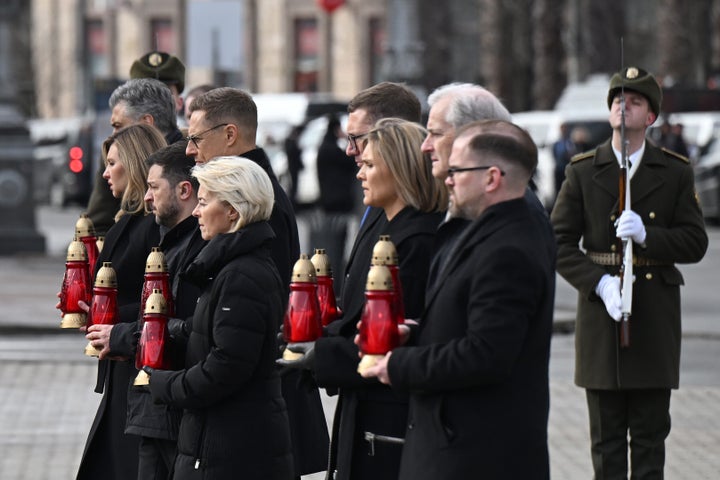
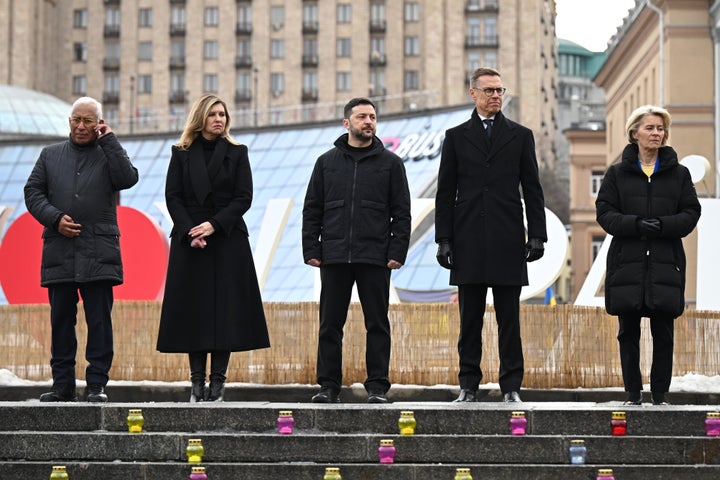
European officials visiting kyiv on Tuesday included European Council President Antonio Costa, European Commission President Ursula von der Leyen and Finnish President Alexander Stubb, as well as seven prime ministers and four foreign ministers.
Leon Neal via Getty Images
The only American included among the official guests at the kyiv ceremonies was Lt. Gen. Curtis Buzzard, an American officer representing NATO in Ukraine.
Since Ukraine cannot sustain its fight against Russia without foreign help, NATO countries are now providing military aid and buying American weapons after the Trump administration broke with Washington’s previous policy and stopped delivering weapons to kyiv.
The European Union has also sent financial aid, but has sometimes met with reluctance from its members Hungary and Slovakia.
Leon Neal via Getty Images
British Armed Forces Minister Al Carns said Russia’s war against Ukraine was “the most decisive conflict” in decades.
“I don’t think any of us were able to guess (when the war started) the scale and size of what happened,” he said.
According to Carns, the war has brought about a “revolution in military affairs,” especially thanks to the rapid development of drone technology by both sides. Drones now account for the vast majority of battlefield casualties, he said.
The United Kingdom on Tuesday announced a new package of military and humanitarian support to Ukraine, including sending teams of British military doctors to carry out medical tutoring inside Ukraine, drawing on battlefield experience in Iraq and Afghanistan.
The cost of rebuilding war-torn Ukraine would amount to nearly $588 billion over the next decade, according to the World Bank, the European Commission, the United Nations and the Ukrainian government.
This is almost three times Ukraine’s estimated nominal GDP for last year, they said in a report on Monday.
___
News reporters across Europe contributed to this story.
___
Follow AP’s coverage of the war in Ukraine at https://apnews.com/hub/russia-ukraine