



Live updates: US and Israel attack Iran, and Trump confirms it
Video shows air defenses launched in northern Iraq amid attacks on US bases
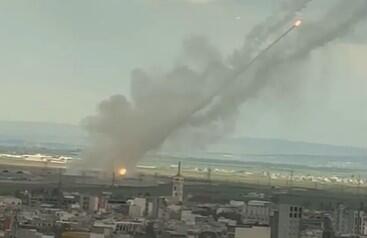
Video obtained by News themezone on Saturday showed interceptor rockets being launched from a facility near a US military base at Erbil airport in northern Iraq, as Iran launched ballistic missiles at US bases across the region.
Erbil International Airport is used as a base by the US military and its partners in the international coalition fighting ISIS in the region. According to local security sources in Erbil, air defenses on Saturday intercepted rockets and drones targeting both the base and the newly built US consulate in the city.
It was unclear whether the base in Erbil faced incoming fire from Iran or from Iranian-backed militias in Iraq.
Iran’s state media says US or Israeli strike hit girls’ school, killing dozens
Iran’s state news agency IRNA claimed on Saturday that a US or Israeli strike had hit a girls’ primary school in the country’s far south, killing dozens of students.
IRNA quoted a spokesman for Iran’s Education Ministry as saying that at least 53 students were killed in the attack on the school in the city of Minab, in Iran’s Hormozgan province.
The semi-official Fars news agency, affiliated with Iran’s Revolutionary Guard Corps, posted a video on social media showing people screaming amid rubble around a badly damaged building said to be the school.
News themezone has not yet been able to verify the reports or the video posted by Fars.
In a statement posted on social media, Iranian Foreign Ministry spokesperson Esmaeil Baqaei accused the United States and Israel of “an egregious and unjustified act of aggression against Iran by indiscriminately attacking Iranian cities,” calling the alleged attack on Minab’s school “a flagrant crime” and urging the world and the United Nations Security Council to “stand up to this grave injustice.”
The News said the White House did not immediately respond to a request for comment on the reported walkout at Minab’s school.
Russia calls US-Israeli attack on Iran an “act of unprovoked armed aggression”
The Russian Foreign Ministry called the joint US-Israeli attacks on Iran an “unprovoked act of armed aggression against a sovereign and independent member state of the UN.”
In its statement on Saturday, the ministry demanded an immediate halt to the bombing, accusing the United States and Israel of “hiding behind” concerns about Iran’s nuclear program while actually seeking regime change.
The Russian Foreign Ministry said the country was ready to help negotiate a “peaceful resolution,” accusing the United States and Israel of plunging the Middle East into “an abyss of uncontrolled escalation.”
News/AP
Oman’s foreign minister, who brokered the US-Iran talks, is “dismayed” and says strikes will not serve the US.
Oman’s foreign minister, who was mediating indirect negotiations between the Trump administration and Tehran over Iran’s nuclear program until late last week, chastised the United States on Saturday for launching the attack in the middle of diplomacy.
“I am shocked,” Foreign Minister Badr Albusaidi said in a social media post. “Once again, active and serious negotiations have been undermined. Neither the interests of the United States nor the cause of global peace are benefited by this. And I pray for the innocents who will suffer. I urge the United States not to get caught up any longer. This is not their war.”
Albusaidi’s statement about undermining negotiations “again” appeared to be a reference to the US attacks on Iran’s nuclear facilities in June 2025, which also came amid ongoing indirect talks between Washington and Tehran.
After the latest round of talks in Geneva, Switzerland, Albusaidi told News themezone on Friday that negotiators had made “substantial progress” toward a deal to curb Iran’s nuclear program.
The Omani diplomat told “Face the Nation” moderator Margaret Brennan that “a peace agreement is within our reach.”
He said Iran had agreed that it would “never, ever have… nuclear material that could create a bomb,” which he called a “great achievement.”
Bahrain evacuates area where US Navy Fifth Fleet is located after missile attack
Bahrain’s Interior Ministry said Saturday that residents of a neighborhood housing the headquarters of the U.S. Navy’s Fifth Fleet would be evacuated following an Iranian-led missile attack.
“The Ministry of Interior has started evacuating citizens and residents in the Juffair area,” the ministry said in a social media post. “We urge you to cooperate with relevant authorities.”
Earlier on Saturday, Bahraini state media and a News themezone source confirmed that the US Navy’s Fifth Fleet headquarters was the target of a missile attack.
Eyewitnesses told News themezone that the fleet headquarters was hit by at least three missiles, but there was no immediate confirmation that the missiles hit the base, nor of any damage inflicted.
Iran’s semi-official Tasnim news agency, associated with Iran’s Revolutionary Guard, said the Bahrain base was targeted by Iranian attacks.
Lebanon’s prime minister vows country will not be drawn into war
Lebanese Prime Minister Nawaf Salam promised on Saturday that Lebanon would not be drawn into a regional conflict.
In a social media post, Salam urged the Lebanese people to “exercise wisdom and patriotism.”
“We will not accept anyone dragging the country into adventures that threaten its security and unity,” he said.
The Iran-backed militant group Hezbollah is based in Lebanon. In 2024, Israel and Hezbollah were involved in violent conflict which ended with a ceasefire mediated by the United States.
Rubio alerted some members of the “Gang of Eight” before the Iran attack
Secretary of State Marco Rubio spoke to at least some members of the US Congressional “Gang of Eight” to alert them before attacks on Iran began, News themezone has confirmed.
A source familiar with the matter told News themezone that Sen. Mark Warner, vice chairman of the Senate Intelligence Committee, was one of the lawmakers briefed ahead of the action. It was unclear whether Rubio was able to contact the eight.
The Gang of Eight consists of the top four leaders of the House and Senate, along with top Democrats and Republicans on the House and Senate intelligence committees.
The European Union calls for “maximum moderation”
The European Union on Saturday called for “maximum restraint” as the joint US-Israeli military strike against Iran sparked retaliatory attacks on US bases in the Middle East.
European Commission President Ursula von der Leyen called the developments “very worrying” as the 27-nation EU moved to withdraw non-essential staff from the region.
“We reaffirm our firm commitment to safeguarding regional security and stability,” he said in a joint statement with European Council President Antonio Costa. “Ensuring nuclear security and preventing any actions that could further escalate tensions or undermine the global non-proliferation regime is critically important.”
“We call on all parties to exercise maximum restraint, protect civilians and fully respect international law,” the EU statement said.
The EU’s Aspides naval mission in the Red Sea remains “on high alert” and is ready to help keep the sea corridor open, the bloc’s top diplomat Kaja Kallas said, adding that she had spoken with Israeli Foreign Minister Gideon Saar and “other ministers in the region.”
“Our consular network is fully committed to facilitating departures of EU citizens. Non-essential EU staff are being withdrawn from the region,” Kallas said on social media. “The latest developments in the Middle East are dangerous. Iran’s regime has killed thousands of people. Its nuclear and ballistic missile programs, along with support for terrorist groups, pose a serious threat to global security.”
Pro-Iran group in Iraq says it will attack US bases after airstrike kills fighters
An Iraq-based pro-Iran militant group warned Saturday that it would begin attacking U.S. bases in the Middle East in retaliation for an airstrike it said hit one of its own bases earlier in the day, amid U.S. and Israeli attacks on Iran.
The Iraqi Hezbollah Brigades, which are separate from the main Iranian proxy group Lebanon-based Hezbollah said it would “soon begin attacking US bases in response to their aggression,” in a statement shared on social media.
The Iraqi group said two of its fighters were killed on Saturday in airstrikes that hit one of its bases in southern Iraq.
The Iraqi Hezbollah Brigades, or Kata’ib Hezbollah, are designated a terrorist organization by the United States, as is the larger pro-Iran Hezbollah group in Lebanon.
Iran’s Foreign Ministry condemns attacks by the United States and Israel during the “diplomatic process”
Iran’s Foreign Ministry condemned the military strikes launched on Saturday by the United States and Israel, calling them a “serious violation of Iran’s territorial integrity and national sovereignty.”
In a statement published on
“Now is the time to defend the homeland and confront the enemy’s military aggression. Just as we were ready for negotiations, we have been more prepared than ever for defense,” the statement said. “The armed forces of the Islamic Republic of Iran will respond to the aggressors with authority.”
“History attests that Iranians have never surrendered to foreign aggression and hegemony; this time too, the response of the Iranian nation will be decisive and determining and will make the aggressors repent of their criminal act,” the statement said.
Israeli military official says strikes are response to Iran beefing up ballistic missiles
An Israeli military officer told reporters on Saturday that he was working with United States to carry out dozens of attacks throughout Iran. The official said the decision to act now was made after intelligence indicated an acceleration of Iran’s ballistic missile program.
The official also said that Iran’s government was operating, as well as acting to conceal and strengthen, its nuclear program to continue advancing it, and that the goal of the offensive was to significantly reduce the capabilities of the Iranian regime.
In an interview with French network TF1 published online 10 days ago, Rafael Grossi, director general of the UN’s International Atomic Energy Agency, said that most Iran’s enriched uranium remained untouched after the US attacks on nuclear facilities in June 2025, but said there was no indication that Iran was working to develop nuclear weapons capabilities.
“No,” he told TF1 when asked if the IAEA saw evidence that Iran was trying to work towards a weapon, adding: “On the contrary, today I see a willingness on both sides to reach an agreement.”
“Most of the material that Iran had accumulated until June of last year, despite the [U.S.] bombings and attacks, it is still there, in large quantities, where it was at the time of the attacks,” Grossi told the French network. “Some of it may be less accessible, but the material is still there. From the point of view of non-proliferation, the material remains. “That is why there is so much interest (I would say urgency) in reaching an agreement that prevents new military actions in the region.”
Grossi was directly involved in the latest rounds of indirect talks between the US and Iranian delegations in Geneva, Switzerland, last week.
The Israeli military official said Saturday that there were a variety of initial targets in the initial strikes, from practical targets that would create more freedom of operation to “essential personnel,” although the official declined to comment on who may have been targeted when asked by reporters.
Israeli military official says operation was planned in unprecedented coordination with US
An Israeli military official told reporters that Saturday’s joint strikes with the United States followed weeks of extensive planning and coordination between the two countries at a level never seen before.
The official did not give a timeline on the estimated duration of the operation, saying only that it would take as long as necessary to cripple the Iranian regime’s capabilities.
Latest assessments of Iran’s ballistic missile arsenal ranged from hundreds to a few thousand, the official said.
The official said that, as far as they knew, Iran’s counterattack against Israel had not resulted in any significant impact so far.
Israel is prepared for any scenario that unfolds in response to the attack on Iran, including retaliation by Iran’s proxies in Iraq and Syria, along with Hezbollah in Lebanon and Hamas in Gaza, the official added.
Last year, Iran spent an estimated $700 million to $900 million on its proxies, primarily Hezbollah, the official said, adding that both Israel and the United States determined that the cost of inaction was too high as the threat posed by Iran and its allied groups could have increased.
Death reported in Iran’s counterattack on Abu Dhabi
One person was killed by shrapnel from an Iranian missile attack in Abu Dhabi, capital of the United Arab Emirates, The News reported, citing the country’s state media.
The death reported by the United Arab Emirates’ state news agency WAM was the first attributed to Iranian missile launches carried out in response to US and Israeli attacks on the Islamic Republic.
Trump says he wants “freedom for the people” in Iran
The Washington Post reports that in a brief phone interview overnight, President Trump said he wants Iran to be a “secure nation.”
“The only thing I want is freedom for the people,” he told the newspaper. “I want a safe nation, and that’s what we’re going to have.”
Iran’s supreme leader and president targeted by Israeli attacks, source says
A source involved in the Israeli attacks on Iran told News themezone that Iran’s supreme leader, Ayatollah Ali Khamenei, and its president Masoud Pezeshkian were among the targets of the first round of attacks.
According to The News, the first attacks of the joint US-Israeli attack appeared to target Khamenei’s home in central Tehran. It was not immediately clear whether he was there at the time, but Iranian media reports claimed that both the president and Khamenei were safe.
By Michal Ben-Gal
Australian Prime Minister expresses support for US attacks
Australian Prime Minister Anthony Albanese indicated on Saturday that he believed the US strikes against Iran were necessary to prevent Tehran from developing a nuclear weapon.
“We support the United States acting to prevent Iran from obtaining a nuclear weapon and to prevent Iran from further threatening international peace and security,” Albanese wrote in a lengthy social media post.
He also said that calls for Iranian leaders to defend human rights had “gone unheeded”, adding that “a regime that depends on the repression and murder of its own people to retain power has no legitimacy.”
Albanese has been a key ally of President Trump. the two leaders signed a critical minerals deal last October.
Iran, Iraq and Israel close their airspace, News reports
Israel, Iran and Iraq closed their airspace to civilian traffic, News reports, while airlines canceled flights in the region.
Part of Syria’s airspace, along the country’s southern border with Israel, was also closed for 12 hours, the French news agency reported, citing the Syrian Civil Aviation Authority.
Air France told News it canceled its Saturday flights to and from Beirut, Lebanon, as well as flights to and from Tel Aviv, “due to the security situation at the destination.”
Lufthansa also said it would suspend flights to and from cities in the region, the outlet reported.
Democratic Senator John Fetterman praises Trump for US attack on Iran
Democratic Senator John Fetterman of Pennsylvania expressed his support early Saturday for US strikes against Iran.
“President Trump has been willing to do what is right and necessary to bring about real peace in the region,” Fetterman said in a social media post. “God bless America, our great military and Israel.”
Last summer, Fetterman united his Republican colleagues voted against a measure that would have prevented Trump from using military force against Iran. He was the only Democrat to do so.
Iran condemns attack and says military will respond with “all its forces and resources”
Iran’s Foreign Ministry released a statement Saturday condemning the US and Israeli military attack, calling it “a serious violation of Iran’s territorial integrity and national sovereignty.”
He accused the United States and Israel of violating the United Nations Charter with “clear armed aggression” and vowed to defend himself.
“The armed forces of the Islamic Republic of Iran will use all its forces and resources to confront this criminal aggression and repel the enemy’s evil,” the Foreign Ministry said.
“Now is the time to defend the homeland and confront the enemy’s military aggression. Just as we were prepared for negotiations, we are more prepared than ever for defense.”
Israel warns Iranians to stay away from military facilities as attacks continue
The Israeli military posted an online notice in Farsi on Saturday warning Iranians to stay away from military facilities in their country as joint US-Israeli attacks continued.
The Israel Defense Forces message warned “all persons located in or near military industrial factories and military infrastructure” that they were “near weapons and facilities that are dangerous.”
The IDF warned Iranians to evacuate those areas immediately, “until a further announcement is issued.”
“Your presence in these places puts your life at risk,” the notice said.
Sources tell News themezone that US bases in Bahrain and Jordan were attacked with missiles
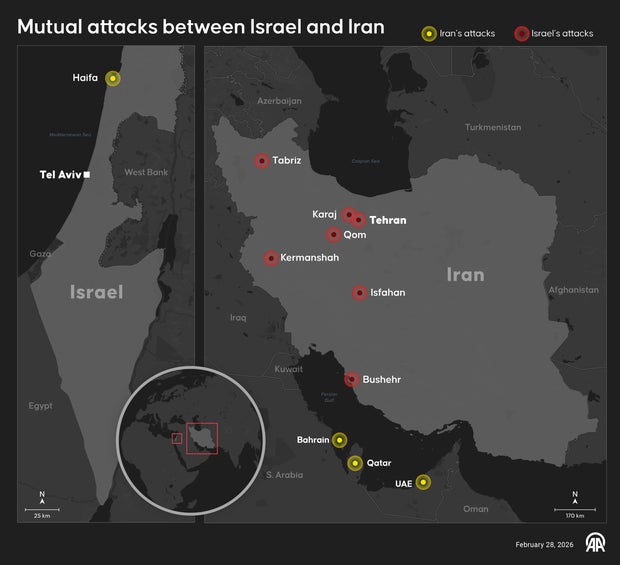
A major US military base in Bahrain has been the target of a missile attack, a local source confirmed to News themezone. Bahraini state media said the headquarters of the US Navy’s Fifth Fleet was the target of a missile attack.
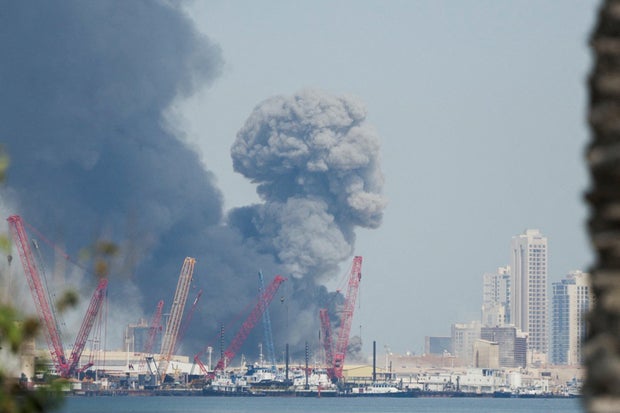
US bases were also attacked in Jordan, sources told News themezone. There were no immediate reports of missiles hitting US bases.
Explosions were heard in Kuwait, according to numerous media outlets, where the United States also has a significant military presence, as well as in Abu Dhabi, capital of the United Arab Emirates, where there is a base that houses American military personnel, according to the News news agency.
Qatari broadcaster Al Jazeera also reported explosions in the Qatari capital Doha, and the country’s Defense Ministry said missiles had been intercepted.
Iranian state media claimed that “all” US bases in the Middle East were under attack in response to continued US and Israeli attacks on the country.
Iran’s Fars news agency reported that the US Al Udeid air base in Qatar, Ali Al Salem air base in Kuwait, Al Dhafra air base in the United Arab Emirates and the US Navy’s Fifth Fleet base in Bahrain had been attacked.
Flights canceled as Israel closes airspace
Commercial flights to and from Tel Aviv were being canceled or diverted after Israel closed its airspace amid the conflict.
United Airlines said flights heading to Tel Aviv early Saturday would return to their departure points or divert elsewhere, while flights later in the day were canceled. Passengers would get travel waivers to change their plans at no cost, the airline said.
Senator Lindsey Graham calls the operation “necessary and long justified”
Republican Senator Lindsey Graham of South Carolina, a Trump ally and long-time advocate of action against Iran, praised the operation against Iran, writing in X: “The end of the largest state sponsor of terrorism is upon us.”
“This operation is long overdue and necessary,” Graham said.
US embassies in the Middle East issue lockdown warnings
US embassies in the Middle East issued shelter-in-place alerts to US citizens in at least five countries, citing regional security concerns as the US and Israel attacked Iran.
“The U.S. Embassy in Jordan is implementing a shelter-in-place for all staff. We encourage all Americans to do the same until further notice,” the embassy in Amman said, echoing similar alerts issued in Israel, the United Arab Emirates, Qatar and Bahrain.
The warning from the embassy in Bahrain, in particular, cited the threat of missile or drone attacks.
Iran’s exiled Crown Prince Pahlavi tells protesters ‘time to return to the streets is near’
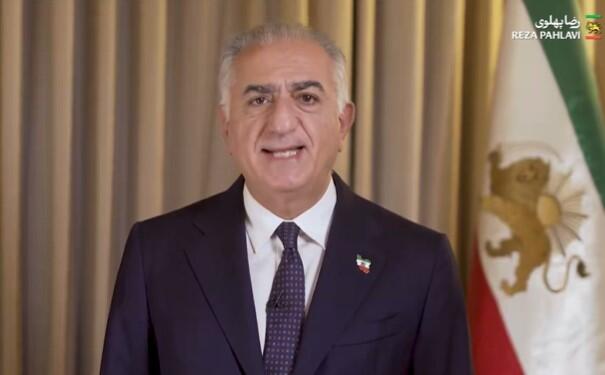
Reza Pahlavi, the long-exiled son of Iran’s last monarch, shared a message addressed to the Iranian people on social media on Saturday, as the United States and Israel launched attacks on the country.
“The aid that the president of the United States promised to the brave people of Iran has already arrived. This is a humanitarian intervention; and its target is the Islamic Republic, its repressive apparatus and its killing machine, not the country and the great nation of Iran,” Pahlavi said. “But even with this help arriving, the final victory will still be forged in our own hands. It is we, the people of Iran, who will finish the job in this final battle. The time to return to the streets is near.”
Some protesters who participated in recent large-scale demonstrations against the regime had expressed support for Pahlavi, but it is unclear how much influence he actually has within the country, and President Trump has poured cold water on the idea of Pahlavi leading Iran.
His father was Shah Mohammad Reza Pahlavi, who was overthrown after decades of rule by the Islamic Revolution of 1979, which brought the current regime to power.
“Now that the Islamic Republic is collapsing, my message to the country’s military, police and security forces is clear: you have taken an oath to protect Iran and the Iranian people, not the Islamic Republic and its leaders. Your duty is to defend the people, not a regime that has taken our homeland hostage through repression and crime. Join the people and help achieve a stable and secure transition. Otherwise, you will go down with the ship of Khamenei and his regime,” Pahlavi said after the United States announced its attack on Iran.
He called on Trump to “exercise the utmost caution” to protect civilian lives.
Democratic US senator says Americans should not die for ‘a war that has not been explained or justified’
U.S. Sen. Ruben Gallego, an Arizona Democrat, Iraq War veteran and considered a possible contender in the upcoming U.S. presidential election, suggested that Trump’s decision to attack Iran was illegal.
“I lost friends in Iraq because of an illegal war. Working class youth should not pay the ultimate price for regime change and a war that has not been explained or justified to the American people,” Gallego said in a social media post early Saturday. “We can support the democratic movement and the Iranian people without sending our troops to die.”
The Pentagon calls the US attacks “Operation Epic Fury”
The US military appeared to have dubbed the military strikes against Iran “Operation Epic Fury,” according to a Department of Defense X post.
Israeli Prime Minister Benjamin Netanyahu referred to his country’s operation, which was launched alongside the US strikes, as “The Lion’s Roar.”
Iran launches second round of missiles at Israel, IDF says
Iran launched a second barrage of missiles at Israel, the Israeli military said.
The Israel Defense Forces said on social media that “an additional barrage of missiles was launched towards Israel.”
Israel’s missile defense system was “identifying and intercepting threats,” the Israeli military said.
Emergency alert sirens sounded intermittently across the country on Saturday and Israeli Defense Minister Yisrael Katz announced a state of emergency.
“A near total Internet blackout” in Iran, says the organization NetBlocks
The Internet appeared to have been cut off in Iran on Saturday amid US and Israeli attacks, the organization NetBlocks said.
“Network data shows that Iran is now in the midst of a near-total internet blackout with national connectivity at 4% or normal levels. The incident comes amid US-Israeli combat operations and is consistent with measures used during last year’s war with Israel.”
Iranian authorities blocked virtually all web traffic and most phone communications for weeks earlier this year during their crackdown to quell mass street protests.
Netanyahu: Operation aims to “eliminate existential threat” posed by Iranian regime
Israeli Prime Minister Benjamin Netanyahu said the military operation launched by Israel and the United States was aimed at “eliminating the existential threat posed by the terrorist regime in Iran.”
“This murderous terrorist regime must not be armed with nuclear weapons that would allow it to threaten all of humanity,” Netanyahu said in a video statement. “Our joint action will create the conditions for the brave Iranian people to take their destiny into their own hands.”
Netanyahu called on the Iranian people to “free themselves from the yoke of tyranny and achieve a free and peaceful Iran.”
He said the military action – an operation he said was called “The Lion’s Roar” – would require “endurance and fortitude”, but did not specify how long it was expected to last.
By Michal Ben-Gal
Israeli military says missiles fired by Iran were detected and alerts were activated in the country
The Israel Defense Forces said on Saturday that alerts were activated in several parts of the country after missiles launched from Iran were detected.
The IDF said in a post on X that the Israeli Air Force was working to intercept the threat and urged residents to follow instructions.
Iranian media reports attacks in Tehran and across the country
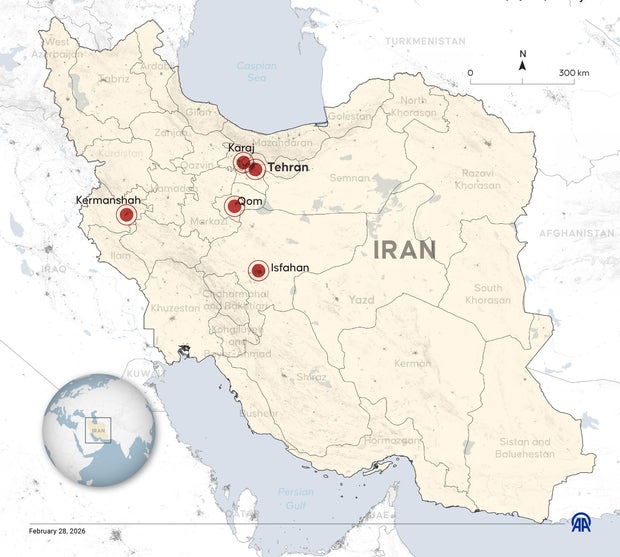
Iranian media said on Saturday that in addition to the attacks on Tehran, near the leaders’ homes and offices, there were also attacks on locations across the country, including in Isfahan, where there is a major nuclear facility, the holy city of Qom, and in Karaj, Kermanshah, Lorestan and Tabriz.
Trump urges Iran’s military to lay down its arms and civilians to “take control of their government”
After announcing “massive” US military strikes against Iran, Trump issued a warning to Iran’s powerful Revolutionary Guard Corps, which is under the direct command of Supreme Leader Ayatollah Ali Khamenei, as well as the rest of the Iranian military and police, telling them to “lay down their arms and have complete immunity or, alternatively, face certain death.”
He encouraged Iranian civilians to seek shelter, warning of heavy bombing, but also urged them to overthrow the Islamic Republic regime that has ruled the country since 1979.
“The hour of your freedom is near,” he said. “When we’re done, take control of your government. It will be yours. This will probably be your only chance for generations.”
Read more here.
Trump: “We may have casualties”
The president said U.S. operations in Iran could result in the loss of American lives.
“The Iranian regime seeks to kill. The lives of brave American heroes may be lost and we may have casualties. That happens often in war. But we don’t do it for now. We do it for the future, and it is a noble mission,” Trump said in his video statement shared on social media.
US urges citizens of Qatar and Bahrain to shelter in place
The US embassies in Qatar and Bahrain told their staff to shelter in place on Saturday.
“We recommend all Americans do the same until further notice,” both embassies said in online statements, encouraging people to shelter in place and “keep a low profile” amid US and Israeli attacks on Iran.
Located across the Persian Gulf from Iran, Qatar and Bahrain are U.S. allies that host significant contingents of U.S. forces. Iran retaliated against the US attacks last June against its nuclear facilities, launching a missile attack against the US Al Udeid air base in Qatar.
US Ambassador to Israel Mike Huckabee also urged US citizens in the country: “Stay close to shelters and take immediate action at the sound of warnings or sirens.” Embassy employees and their families were ordered to shelter in place.
Israel declares state of emergency and warns of Iranian retaliation
Israeli Defense Minister Yisrael Katz declared a state of emergency across Israel on Saturday, warning people to “obey the instructions of the Home Front Command.”
Katz said that “in the immediate future, an attack with missiles and drones against the State of Israel and its civilian population is expected.”
By Michal Ben-Gal
Trump calls attacks on Iran a “massive, ongoing operation”
In an eight-minute video posted on Truth Social, Trump said the United States is “conducting a massive, ongoing operation to prevent this radical and evil dictatorship from threatening the United States and our core national security interests.”
The president said the United States will “destroy its missiles and raze its missile industry,” “wipe out its Navy” and “ensure that the region’s terrorist proxies can no longer destabilize the region.”
He said the United States had “repeatedly sought to reach an agreement” to curb Iran’s nuclear program, but alleged that Iran has “rejected any opportunity to give up its nuclear ambitions.”
“This regime will soon learn that no one should challenge the strength and might of the United States military,” Trump said.
See the full statement here.
US launches ‘major combat operations in Iran’, says Trump
President Trump announced at Truth Social that the United States began launching “major combat operations in Iran” early Saturday morning.
Trump’s latest threats to Iran focused on its nuclear program, not protests
President Trump’s threats to Iran earlier this year focused on the regime’s brutal crackdown on mass street protests in January. But on Jan. 28, Trump threatened Iran in a Truth Social post with an attack “far worse” than the strikes he ordered against the country’s nuclear sites in June if it did not accept a deal to curb its nuclear program.
It was the first time he linked the US Navy’s major deployment in the Persian Gulf region to the long-stalled nuclear negotiations.
“A huge Armada is headed to Iran,” he said in his Jan. 28 post. “It is moving quickly, with great power, enthusiasm and purpose… Let us hope that Iran will quickly ‘come to the table’ and negotiate a fair and equitable deal – NO NUCLEAR WEAPONS – one that is good for all parties. Time is running out, it really is of the essence!”
In the weeks that followed, Trump suggested on multiple occasions that he would order strikes on Iran if a deal on its nuclear enrichment was not reached.
The president pressed his advisers to offer options that would deliver a punitive blow substantial enough to force Iranian leaders to return to negotiations on more favorable terms. News themezone reported on February 23. But military planners warned that such an outcome could not be guaranteed and that limited attacks could open the door to a broader confrontation.
Mr. Trump alleged during his State of the Union address that Iranian officials were once again “pursuing their sinister ambitions” after the United States attacked nuclear sites last year. He said he would like to resolve their disagreements through diplomacy, but “one thing is certain: I will never allow the number one sponsor of terrorism in the world, by far, to have a nuclear weapon.”
Military strikes follow several rounds of talks between the United States and Iran
In the lead-up to the US attacks on Iran, the two countries engaged in multiple rounds of talks aimed at securing a nuclear deal.
Negotiators from both sides held indirect talks in Oman in early February, followed by two rounds of negotiations in Switzerland at the end of the month. Iranian officials described the talks in generally positive terms, and Trump has said Iran wants a deal. Omani Foreign Minister Badr Albusaidi, who has helped mediate the talks, told News themezone after the third round of negotiations that an agreement was “within reach” and that they simply “needed a little more time.”
But Mr. Trump told reporters Shortly after the third round, he said he was “not happy” with the pace of progress and said Iran was “not willing to give us what we have to have.”
The president said he wanted Iran to agree “not to do any enrichment.” But Iran has He ruled out abandoning completely its uranium enrichment program, which it claims is for peaceful purposes.
Albusaidi couched the negotiations in more optimistic terms, saying that Iran had agreed that it would “never, ever have… nuclear material that could create a bomb,” and that its existing stockpiles of enriched uranium would be “blended to the lowest possible level.” He said Iran also agreed to grant International Atomic Energy Agency inspectors “full access” to nuclear sites.
“There would be zero accumulation, zero storage and full verification,” he said.
The scope of any potential deal is also a question. Talks between the United States and Iran largely focused on the nuclear program, but Israeli Prime Minister Benjamin Netanyahu has called for any agreement with Iran also include restrictions on ballistic missiles and funding of proxies in the region.
Secretary of State Marco Rubio told reporters in late February that it was up to the president to pursue a nuclear-only deal with Iran, but said Iran’s “insistence on not discussing ballistic missiles is a big, big problem.”
Trump told Netanyahu in December that he would support Israeli strikes on Iran’s ballistic missile program if a deal could not be reached. News themezone previously reported.
The United States sent two aircraft carriers to Iran before the attacks
As Trump pressured the Iranian regime, the United States sent a large contingent of warships to the Middle East, including two aircraft carriers and their escort ships.
As of Feb. 26, at least 12 ships were in the area overseen by U.S. Central Command, which covers the Middle East, according to a Navy official. That includes the aircraft carrier USS Abraham Lincoln, seven destroyers and three littoral combat ships.
A second aircraft carrier, USS Gerald R Ford, and two destroyers were in the eastern Mediterranean, and three more destroyers were in the Mediterranean, but their location was less clear. The Ford was previously in the Caribbean region, as part of a broader military buildup near Venezuela.
dozens of Air Force and Navy aircraft They were also seen flying east from the US to Europe and the Middle East in February, including refueling, transport and surveillance aircraft, according to public flight tracking data.
Iran’s supreme leader warns of ‘regional war’
Iran’s Supreme Leader Ayatollah Ali Khamenei warned in early February that any US attack would trigger a “regional war” in the Middle East, according to the Tasnim news agency.
“Americans must be aware that if they fight a war this time, it will be a regional war,” the supreme leader said, claiming that the United States sought to take control of Iran’s mineral wealth.
Later in February, as another US aircraft carrier and its escort ships approached the region, the supreme leader issued an even more precise warning, releasing an AI-generated image of a US ship on the ocean floor.
“A warship is certainly a dangerous weapon, but even more dangerous is the weapon capable of sinking it,” Khamenei said in a speech in Tehran.
What you need to know about Iran’s nuclear program
Iran’s nuclear program has vexed presidents of both parties for decades.
As of mid-June 2025, shortly before the United States attacked three Iranian nuclear facilities, Iran had enriched about 400 pounds of uranium to 60% purity, according to the International Atomic Energy Agency. That’s a significant increase from the 605.8 pounds reported in February 2025.
That material is just a short step away from 90% weapons-grade enriched uranium. A summary of US intelligence from June found that Iran could potentially build a nuclear weapon within three to eight months.
What is not clear, however, is whether Iran has made the decision to build a nuclear weapon. Iran is believed to have stopped its nuclear weapons program in 2003, and the U.S. intelligence community assessed last spring that the country was not manufacturing a weapon at the time.
It is also unclear to what extent the nuclear program was affected by the airstrikes last June.
Trump has long said that the operation “wiped out” the three sites that were attacked, go back the program for “basically decades.” Director General of the IAEA, Rafael Grossi said in mid-February that Iran’s nuclear material “is still there, in large quantities” despite the US attacks, although “some of it may be less accessible.”
Iran is not currently enriching uranium, Secretary of State Marco Rubio told reporters on February 25, although he claimed that “they are trying to get to the point where they can finally do it.”
Iran, the United States and several other world powers reached a deal in 2015 to limit Iran’s uranium stockpile and enrichment capacity for a set period of time in exchange for sanctions relief. Mr. Trump withdrew from that Obama-era agreement during his first term, and the Biden administration’s efforts to revive it were unsuccessful.
Iran, for its part, has long insisted that its nuclear program is entirely peaceful, although its stockpile includes uranium enriched far beyond the level needed for most non-military uses.
Read more here.
What options does Trump have in Iran?
Trump had been briefed on a wide range of military and covert options for acting against Iran, far beyond conventional airstrikes, News themezone. reported in mid-January.
Air power and long-range missiles remain critical to any potential military operation, but Pentagon planners also presented Trump with options for cyber operations and psychological campaigns, according to two US officials who spoke to News themezone on condition of anonymity.
Officials said cyber and psychological operations can occur simultaneously with traditional military force, or could be deployed as stand-alone options.
Here’s a look at some of the options:
- The Islamic Republic’s elite Revolutionary Guard Corps would likely be among the main targets of US military strikes, according to Alex Vatanka, director of Iran’s Middle East Institute.
- Iranian Supreme Leader Ayatollah Khamenei could also find himself in the crosshairs of the US military, experts told News themezone.
- Beyond direct attacks, the White House also weighed cyberattack options, U.S. officials said in January, a strategy that experts believe could hamper communications and spark fear among regime loyalists. Officials told News themezone that the psychological campaigns could disrupt Iranian command structures and state media.
Read more here.
Iran’s attacks follow previous US attacks on Iranian nuclear facilities
This is not the first time Trump has ordered strikes against Iran.
United States formerly carried out air raids on three major Iranian nuclear facilities in June, hitting targets in Fordo, Natanz and Isfahan with B-2 bombers and submarine-launched missiles.
Iran responded launching missiles at the US Al Udeid air base in Qatar, the largest US base in the Middle East, two days later. No Americans or Qataris were injured in Iran’s counterattack, and Mr. Trump saying The Iranian government had offered “early warning” about the attacks.
The June attacks took place amid a nearly two-week conflict between Israel and Iran, with airstrikes killing dozens in Israel and hundreds in Iran, according to the govt. iers of both countries. Mr. Trump announced a ceasefire between the two countries at the end of June.
Furthermore, during Trump’s first term, Trump ordered the murder of General Qassem Soleimani, who led the paramilitary Quds force of the Iranian Revolutionary Guard and served as one of the most powerful figures within the Iranian regime. Iran responded with a series of missile attacks against a US base in Iraq. injuring more than 100 American service members.
Iran faced the largest wave of protests in years and Trump threatened to hit Iran if it cracked down.
In late December and early January, Iran faced weeks of nationwide protests due to the terrible state of the country’s economy, which led to harsh repression by the country’s government.
Protests were recorded in hundreds of cities in the country’s 31 provinces and on dozens of university campuses, according to monitoring groups opposed to the regime, marking the largest wave of protests in the country since 2022.
The demonstrations began in the capital of Tehran, when merchants went on strike over the devaluation of the Iranian currency and double-digit inflation. After that, the protests expanded, with demonstrators expressing greater discontent with the country’s hardline regime.
After initially attempting to strike a conciliatory tone, Iran’s security forces cracked down amid an internet blackout. At least 12,000 people died. two sources told News themezone on January 13. A man in Iran described to News themezone an incident in the city of Yazd, in which he said government forces began shooting at a crowd of about 1,500 people from the front and rear.
On multiple occasions, Trump threatened to take action against Iran if it killed protesters. He did not specify what measures he might take against Iran, although he and his administration have not ruled out military force. It is also unclear what could trigger action, given that large numbers of protesters have been reported dead.
He told reporters on January 14 that he had heard on “good authority” that “the killings in Iran are ceasing” and that no executions were planned.