



Ali Khamenei
March 1 (Reuters) – A grandson of Ayatollah Ruhollah Khomeini, the late founder of the Islamic Republic of Iran, is likely to feature prominently in deliberations by clerics who will determine who will replace Ayatollah Ali Khamenei as Supreme Leader.
The assassination of Khamenei, 86, in an attack between the United States and Israel has given new urgency to the question of who will be the next Supreme Leader, a question that had been dormant for a long time and on which there had been no clarity despite his age.
Hassan Khomeini is the most visible of the late ayatollah’s 15 grandchildren and is seen as a relative moderate within Iran’s clerical establishment. He enjoys close ties with reformists, including former presidents Mohammed Khatami and Hassan Rouhani, who pursued policies of engagement with the West when in office.
Khomeini, 53, plays a symbolically important role in public life as custodian of his grandfather’s mausoleum in southern Tehran. He has never served in government.
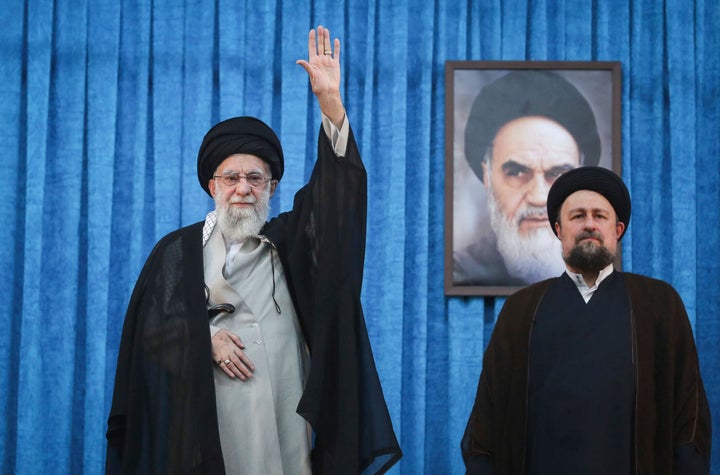
Office of the Iranian Supreme Leader via AP
Some politicians inside Iran have seen him as a rival to the hardliners who gained influence under Khamenei, particularly his son, Mojtaba.
The argument for installing a moderate successor to Khamenei gained momentum among some Iranian politicians in the wake of the unrest that hit Iran in January as a way to shore up the Islamic Republic in the face of growing dissent.
Christian Bruna via Getty Images
Khomeini demanded responsibility for Amini’s death
While loyal to the Islamic Republic established after the Shah’s overthrow in 1979, Khomeini has a history of urging reform and has occasionally voiced dissent against the authorities.
In 2021, he criticized the Guardian Council, the branch of the Iranian theocracy responsible for vetting presidential candidates, after it banned reformists from running.
The council’s move paved the way for victory for hardliner Ebrahim Raisi, who died in a helicopter crash in 2024.
“You can’t pick someone for me and tell me to vote for them!” Khomeini said at that time.
He also demanded accountability after Mahsa Amini, a young Iranian woman, died in 2022 after being detained by morality police, accused of violating conservative dress codes, an incident that sparked protests across the country.
The authorities “must give a transparent and accurate account of what happened to this 22-year-old girl under the pretext of ‘guidance and education,'” he said.
But, reflecting his loyalty to the system, the mid-ranking cleric also criticized protesters who chanted anti-Khamenei slogans.
During the riots that hit Iran in December and January – the deadliest since the 1979 revolution – he supported the establishment, accusing rioters of serving Israel, participating in a pro-government march and comparing some of the violence to the actions of the Islamic State.
In a letter of condolence, Khomeini said that Khamenei would forever be “the hero of the people of Iran and Muslims,” adding: “The noble people of Iran will once again walk the path of the Imam (Khomeini) overcoming this incident.”
‘Progressive theologian’
A close friend of Khomeini, speaking to Reuters in 2015, described him as a progressive theologian, especially regarding music, women’s rights and social freedom. He follows trends on social media and is interested in both Western philosophy and Islamic thought.
His wife, Sayyeda Fatima, is the daughter of an ayatollah and they have four children.
Some reformers urged him to run for president in 2012, but he declined.
Khomeini supported the Rouhani government that negotiated the 2015 nuclear deal, which eased sanctions in exchange for limits on the nuclear program, until U.S. President Donald Trump tore it up in 2018.
He has spoken openly about the economic difficulties that Iranians suffered during the years of sanctions imposed over the nuclear program.
Prevented from applying for an assembly of experts
A decade ago, Khomeini attempted to run for election to the Assembly of Experts, the body responsible for electing the Supreme Leader.
He got an initial nod of approval for his candidacy from Khamenei, who reportedly gave his blessing and at the same time warned Khomeini not to harm his grandfather’s name. But he was later disqualified by the Guardian Council.
Although his religious credentials were cited for disqualification (Khomeini holds the clerical rank of Hojatoleslam, one step below the ayatollah), the move was seen as intended to head off a potential challenge from the reformist camp.
In 2008, he was seen as critical of Iran’s powerful Islamic Revolutionary Guard Corps (IRGC) when he said in an interview that those who claimed loyalty to his grandfather’s legacy should follow his order that the military should stay out of politics. However, it enjoys close ties with the Guard, an elite force tasked with safeguarding the Islamic Revolution.
During the 12-day air war between Israel and Iran last year, Khomeini wrote to Khamenei praising his leadership and saying that Iranian missiles had become a nightmare for Israel and a source of satisfaction for the Iranian nation, according to Jamaran, an Iranian news website dedicated to Khomeini’s memory.
Khomeini has described Israel as the “evil Zionist regime” and “a cancerous tumor” backed by the West, and has said that the Muslim world should become strong to confront Zionism, according to statements recorded by Jamaran.
He speaks fluent Arabic and English, according to the biography, and was passionate about soccer until he was 21, when his grandfather insisted he go to the city of Qom to study Islamic theology.
(Additional reporting by Parisa Hafezi; writing by Tom Perry, editing by William Maclean and Janet Lawrence)