



New device could detect explosives favored by terrorists
By Kris Van Cleave
/News themezone
Add News themezone on Google
In the raid of the suspects’ apartment in Brussels, police found a homemade explosive called TATP.
Terrorists like it because it is made with household chemicals, such as nail polish remover, ingredients that do not raise suspicion when purchased. Now, American researchers have a new device to detect it.
Dr. Jimmie Oxley is the director of the Explosives Detection Center at the University of Rhode Island. The university received a $1 million grant from the Department of Homeland Security to develop a sensor for the highly volatile explosive TATP.

“It doesn’t take pounds to cause catastrophic failure,” Dr. Oxley explained.
It only took one-tenth of a pound of TATP to destroy a car door. On Tuesday night, Belgian police confiscated 33 pounds of the explosive, or 300 times more.
TATP is made with hydrogen peroxide and acetone, items that are easily purchased at a pharmacy. For years we have relied on bomb-sniffing dogs to detect TATP, but with long hours and fatigue, they have their limits.
From a campus lab, Professor Otto Gregory designed the sensor that detects TATP.
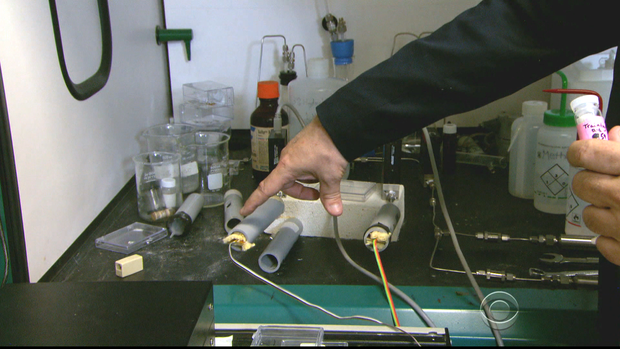
“It is an electronic trail detection system that can compete with a dog and does not need rest. It detects 24 hours a day, 7 days a week.”
Gregory says that in closed spaces like airports, the sensor can detect quantities as small as 1 part per billion. He held up a vial containing traces of TATP and, within seconds, the computer graph went off, alerting of the presence of the explosive.
“We’d like to launch it yesterday,” Gregory said of completing testing on the device.
The device will enter real-world testing later this year. The goal is to shrink it to the size of a smartphone so an officer can attach it to things like a tourniquet.
In Rhode Island, researchers are developing a new device to detect a homemade explosive called TAPT
New device could detect explosives popular with terrorists
(02:13)