



Players
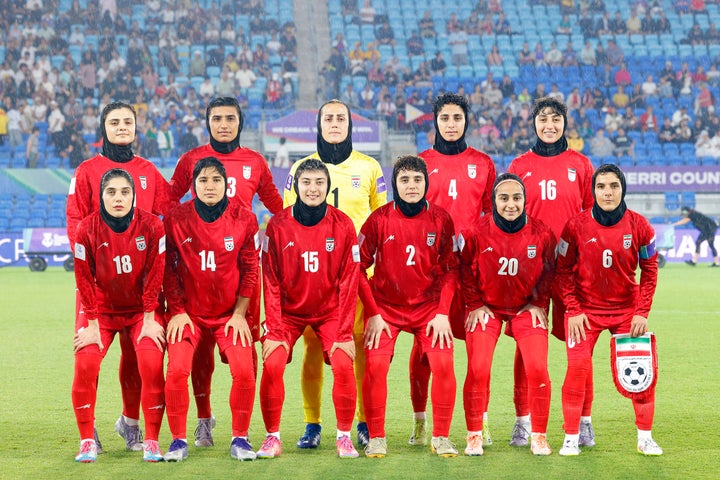
SYDNEY (Reuters) – The global players’ union FIFPRO said on Monday there were serious concerns for the welfare of the Iranian women’s soccer team as they prepared to return home after being labeled “wartime traitors” for refusing to sing their national anthem before an Asian Cup match.
The Iranians’ campaign in the Australian-hosted tournament began last weekend just as the United States and Israel launched airstrikes against Iran, killing the Islamic Republic’s supreme leader, Ali Khamenei.
News via Getty Images
The team was eliminated on Sunday after losing 2-0 to the Philippines. Fans waved the pre-1979 Iranian flag, booed the national anthem and tried to stop the team’s coach from leaving by chanting “Save our girls!” amid concerns for his safety after the silence of the anthem.
More than 66,000 people have also signed a petition calling on the Australian government to ensure the players, who are based on the Gold Coast in Queensland, do not leave “while credible fears remain for their safety”.
Beau Busch, FIFPRO president for Asia and Oceania, said the union had been unable to contact the players to discuss whether they would like to apply for asylum in Australia.
“The reality right now is that we can’t get in touch with the players. That’s incredibly concerning. That’s not something new. This has really happened since the crackdown really ramped up in February and January,” Busch told reporters. “So we are really worried about the players, but our responsibility now is to do everything in our power to try to make sure they are safe.”
Busch said the organization was working with FIFA, the Asian Football Confederation and the Australian government to ensure “all pressure is applied” to protect players and give them “agency over what happens next.”
“It’s a really challenging situation,” he said.
“There may be players who want to return. There may be some players within the group who want to apply for asylum and stay in Australia for longer.”
‘The pinnacle of dishonour’
The players’ decision to remain silent during Iran’s anthem before their first match against South Korea was called the “pinnacle of dishonour” by an Islamic Republic of Iran Broadcasting commentator.
“Traitors in times of war must be treated more severely,” said presenter Mohammad Reza Shahbazi.
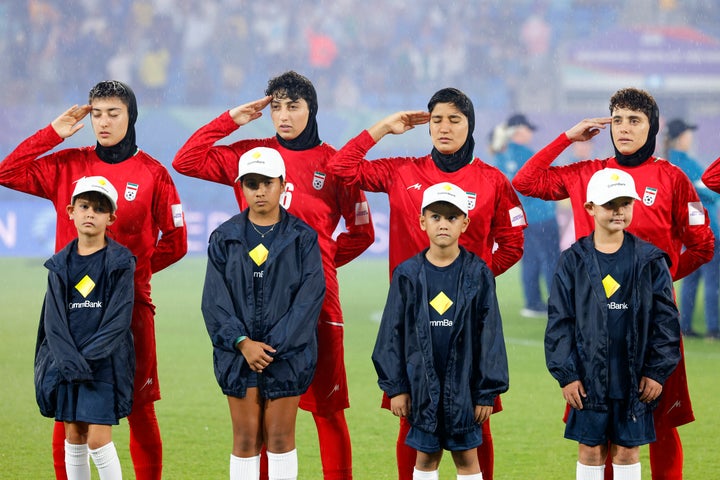
When they sang the anthem and saluted before their second match against Australia, human rights activists feared the team had been coerced by government minders.
News via Getty Images
Iran coach Marziyeh Jafari said they were looking forward to returning home. “We’re looking forward to getting back,” he said during a post-match news conference. Most airspace in the Middle East remains closed as a result of the war.
Asked whether Australia would grant asylum to the players, Matt Thistlethwaite, assistant minister for foreign affairs and trade, said the government could not “go into individual circumstances for privacy reasons”.
“Anyone looking to come to Australia or apply for a visa obviously has to meet the conditions, but I can’t go into specific details,” he told Sky News.
(Reporting by Christine Chen in Sydney; Editing by Kate Mayberry)