



Live Updates: Iran
Israeli Army: more than 1,900 commanders and soldiers of the Iranian regime killed
Israel Defense Forces spokesman Nadav Shoshani told reporters Wednesday night that Iran-backed Hezbollah in Lebanon had launched an attack in coordination with Iran that included about 200 rockets fired from Lebanon and ballistic missiles from Iran at the same time.
He said Israel had destroyed several launchers and prevented the attack from becoming even larger.
Shoshani also claimed that Hezbollah was attempting to send agents towards Lebanon’s border with Israel, and that Israel would continue to carry out attacks for as long as necessary to eliminate the threat.
Shoshani said Israel had been working to attack Iran’s elite Quds Force, which he said served as a connection between Hezbollah and Iran’s leadership, and that the IDF had killed several commanders of the unit in recent days.
Israel has carried out more than 4,200 strikes across Iran, he said, which he said had “neutralized” 80% of Iran’s defense systems.
He said more than 400 Iranian regime targets had been attacked and more than 1,900 regime commanders and soldiers killed, adding that in recent days, IDF attacks had shifted their focus to the Islamic Republic’s weapons production sites.
Israel prepares to expand operations in Lebanon, warns Lebanese president’s territory could be confiscated
Israeli Defense Minister Israel Katz said he had spoken to Lebanon’s president and warned him that “if the Lebanese government does not know how to control the territory and stop Hezbollah from threatening communities in the north and shooting at Israel, we will take the territory and do it ourselves.”
In a meeting with senior IDF commanders, Katz also said that he and Israeli Prime Minister Benjamin Netanyahu had “ordered the IDF to prepare for an expansion of IDF activity in Lebanon and for the restoration of peace and security in northern communities.”
The Lebanese Ministry of Public Health said that, as of Wednesday, at least 570 people had been killed in the country since Israel intensified its offensive against Hezbollah when the war with Iran began.
The UN says up to 3.2 million people have been displaced in Iran by the war, and that number is likely to ‘continue to rise’
The United Nations refugee agency said Thursday that up to 3.2 million people have been displaced in Iran by the ongoing war between the United States and Israel against the country’s hardline Islamic theocracy.
The UNHCR said most of the displaced Iranians had fled the country’s capital, Tehran, and other major cities to the north or rural areas.
“Between 600,000 and 1 million Iranian households are currently temporarily displaced within Iran as a result of the ongoing conflict, according to preliminary assessments, representing up to 3.2 million people,” the agency said. “This figure is likely to continue to rise as hostilities persist, marking a worrying escalation in humanitarian needs.”
“UNHCR emphasizes the urgent need to protect civilians, maintain humanitarian access and ensure borders remain open for those seeking safety, in line with international obligations,” he said.
Israeli military says it attacked Iranian nuclear complex
The Israeli military said Thursday that it had attacked the site of Iran’s Taleghan nuclear program during the course of its operations. He said the facility “was used by the regime to advance critical capabilities for developing nuclear weapons.”
The Israel Defense Forces said the complex had been used in recent years to conduct experiments and develop advanced explosives “as part of the ‘AMAD’ project, the covert nuclear weapons development program in the 2000s.”
The IDF stated that “the Iranian regime had continued its efforts to advance and develop the capabilities necessary for the development of a nuclear weapon” and that it had “identified that the regime had taken steps to rehabilitate the complex after its attack in October 2024.”
Analysis of satellite images by the Institute for Science and International Security appeared to show that three bunker-busting bombs had penetrated the top of the Taleghan-2 facility, “directly in the area where a highly explosive containment vessel suitable for testing related to nuclear weapons development was suspected to have been located,” the Institute said.
“The fire control and instrumentation building at Taleghan-1 was also completely destroyed,” the Institute said. “This site has been under construction since before the June 2025 war and has continued unabated until now. Iran made significant efforts to harden and secure the site, but clearly those efforts were not enough. Penetration holes indicate that the internal facility has likely been bombed, destroying everything inside.”
Iran has repeatedly denied that it was seeking to produce a nuclear weapon and claimed that its nuclear program was for peaceful purposes. The head of the U.N. nuclear monitoring agency, the IAEA, said 10 days before the United States and Israel launched the current war that the agency had seen no evidence that Iran was working to develop nuclear weapons capabilities.
Qatar says it intercepted another Iranian missile attack
Qatar’s Defense Ministry said on Wednesday that its military had intercepted another missile attack aimed at the Gulf state. Iran has attacked Qatar repeatedly over the course of the war, drawing harsh criticism from its former diplomatic partner and warnings that the small country could retaliate.
Cathay Pacific Airline Announces Fuel Surcharge Increase, Fare Doubles for Flights Purchased in the US
Cathay Pacific, Hong Kong’s flag carrier, announced Thursday an increase in its fuel surcharges for virtually all of its flights, as the Iran war continues to limit global oil production and transportation in the Persian Gulf.
Surcharges vary depending on where travel is booked, but for flights purchased in the US, for example, Cathay Pacific passengers will have to absorb a 105% increase, from $72.90 to $149.20, starting March 18.
The CEO of United Airlines told the Wall Street Journal this week that he expected airfares to rise because of the war, but then normalize as the fighting subsides.
“My personal assessment is that this will last a few more weeks and then the Strait of Hormuz will open again,” he said. “Oil prices are starting to return to normal and we are in a world where we have a surplus.”
Iranian military shares dramatic video of attack on US-owned oil tanker
Iran’s semi-official Tasnim news agency, which is closely linked to the country’s Islamic Revolutionary Guard Corps, posted a dramatic video online Thursday showing an apparent missile attack on a U.S.-owned oil tanker in the Persian Gulf. The video, apparently filmed aboard an IRGC attack ship, shows a massive explosion on a cargo ship which is then engulfed in flames as people aboard the attack ship can be heard celebrating.
News themezone Confirmed identified the ship seen hit in the video as the Safesea Vishnu, a crude oil tanker sailing under the flag of the Marshall Islands but owned by the New Jersey-based company Safesea Group LLC.
Based on the ship’s last known position and information provided by Iraqi officials, it appears to have been hit Wednesday afternoon at the northern end of the Gulf, near the Iraqi coast and not far from Iranian or Kuwaiti waters.
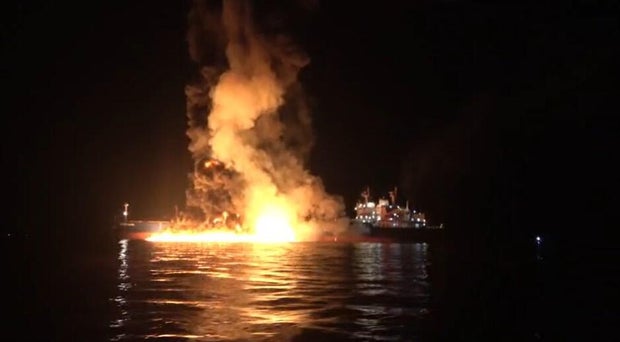
The British military’s UK Maritime Trade Operations agency said it received a report on Wednesday night of an incident at the same location involving two tankers “hit by an unknown projectile.”
UKMTO said an official on “an affected ship confirmed that the attack had caused a fire on board” and “reported that the crew had been evacuated and were safe”.
“The CSO [Company Security Officer] The second tanker involved has confirmed that the ship was hit and that the attack caused a fire on board. All crew members have been evacuated. “No environmental impact has been reported at this time,” UKMTO said.
The director general of Iraq’s General Ports Company, Farhan al-Fartousi, said Thursday that a ship was attacked during a ship-to-ship cargo transfer about 30 miles off the country’s coast the night before. He identified “the smaller tanker” involved as Maltese-flagged, and was separately identified as the oil and chemical tanker Zefyros.
Iran says if US or Israel attack its Gulf islands, they will ‘abandon all restraint’
Iran’s powerful speaker of parliament, Mohammad Bagher Ghalibaf, warned Thursday that Tehran would “abandon all restraint” if the United States or Israel attack any of its Gulf islands.
“Any aggression against the soil of the Iranian islands will destroy all restraint. We will abandon all restraint and make the Persian Gulf run with the blood of the invaders,” Ghalibaf declared in a post on social media.
It was not immediately clear which islands he was referring to, but a recent Axios report cited US officials as saying that the capture of Kharg, a small island just 30 miles off the coast of Iran in the Persian Gulf, was on the table as the war in the Middle East escalated.
News/News
Explosions heard in Jerusalem and Dubai, alarms sound in Bahrain, Kuwait and Saudi Arabia intercept drones
Explosions were heard over Jerusalem on Thursday after the Israeli military reported missiles fired from Iran, as Iran continued its campaign against Israel and the Gulf States in response to the ongoing US-Israeli offensive.
Explosions were also heard in central Dubai in the United Arab Emirates, where the government media office reported a “minor drone incident” in the al-Badaa neighborhood but said no one was injured. He later said interception fire downed a drone and shrapnel hit the facade of a building on Sheikh Zayed Road, the 12-lane highway that runs through the heart of Dubai, but that there were no injuries in that incident either.
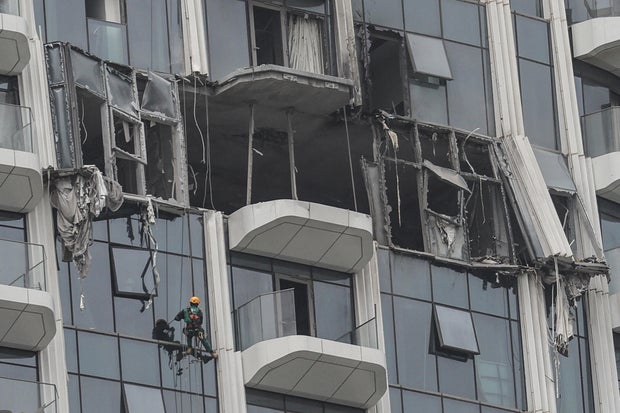
Kuwait’s international airport was “targeted by several drones, causing only material damage,” according to the age The country’s official news agency, citing its civil aviation authority.
Saudi Arabia’s Defense Ministry said it intercepted and destroyed two drones heading towards the Shaybah oil field in the country’s southeast, after previously saying it had shot down a drone approaching a district housing foreign embassies and another in the country’s east.
Meanwhile, Bahrain’s Interior Ministry urged citizens to remain calm and head to the “nearest safe place” in the small Gulf state, as alarms warned of more possible Iranian missile or drone fire.
News/News
Oil prices rise again and stocks sink again despite the release of strategic reserves
Oil prices climbed back above $100 and stocks sank on Thursday as Iran’s attempts to disrupt supplies in the Middle East and bring down the global economy overshadowed a record release of strategic crude. of reserves by the International Energy Agency.
Asian stock markets closed lower on Thursday and European markets opened lower as investors saw few signs that the US-Israeli war with Iran would end soon, despite President Trump’s repeated assurances that it would.
US Secretary of Energy Christopher Wright announced On Wednesday it announced that the United States would release 172 million barrels of oil from its Strategic Petroleum Reserve, while the International Energy Agency (which has 32 member countries, including the United States) announced it would release 400 million barrels from its own reserves.
U.S. benchmark Brent crude, the international standard, was trading 5.3% higher at around $97 a barrel on Thursday after hitting $100.50 on Wednesday.
In stocks, the S&P 500 future lost 0.4% while the Dow Jones Industrial Average future fell 0.5%. Germany’s DAX lost 0.4% to 23,533.60 on Thursday, while Paris’ CAC 40 lost 0.7% to 7,982.64. Britain’s FTSE 100 sank 0.7% to 10,285.91.
In Asia, Tokyo’s Nikkei 225 closed down 1% at 54,452.96, South Korea’s Kospi lost 0.5% to close at 5,583.25 and Hong Kong’s Hang Seng gave up 0.7% to close at 25,716.76. The Shanghai Composite Index lost 0.1% to 4,129.10, while in Australia, the S&P/ASX 200 fell 1.3% to close at 8,629.00.
News/News
Israel announces another ‘wave of extensive attacks on Iran’ as expert says chances of regime change ‘very slim’
The Israeli military announced in a brief social media post on Thursday the beginning of a new “wave of extensive attacks against the terrorist regime’s infrastructure throughout Iran.”
While President Trump has repeatedly talked in recent days about ending the war “soon” whenever he decides to do so, even telling Axios on Wednesday that there was “virtually nothing left to attack” in Iran, neither Israel nor Iran have shown any inclination to slow down their attacks.
A veteran Middle East analyst said Matt Gutman of News themezone. this week that the United States and Israel underestimated Iran’s capabilities and that the regime in Tehran is unlikely to collapse.
Danny Citrinowicz, a nonresident fellow at the Atlantic Council, a nonpartisan think tank, told News themezone that he believes the chances of regime change are “very slim,” especially without the use of ground troops, which he said would be a potentially disastrous tactic.
“We had too many hopes,” he said. “If someone thinks that through an air campaign you can overthrow this regime, even though it is weak but still very strong, I think we should think twice.”
Three crew members ‘believed trapped’ on Thai ship attacked in Strait of Hormuz, owner says
Three crew members were believed to be “trapped” aboard a Thai bulk carrier that was hit by two shells on Wednesday while sailing through the crucial Strait of Hormuz, the ship’s owner said.
Iran’s Revolutionary Guard said on Wednesday it had attacked the Thai-registered Mayuree Naree, as well as a Liberian-flagged ship, in the strait because the ships had ignored “warnings.”
The Thai ship was struck Wednesday morning while transiting the Gulf waterway after leaving a port in the United Arab Emirates.
“The attacks damaged the ship’s engine room and caused a fire,” Thai shipping company Precious Shipping said in a statement late Wednesday.
“Three crew members are missing and believed to be trapped in the engine room,” he said, adding that authorities were working to rescue them.
The Omani navy had rescued 20 sailors and efforts were underway to rescue the remaining three, the Thai navy said on Wednesday.
Thailand’s Foreign Ministry said all 23 crew members were Thai.
An Indian crew member was killed when two oil tankers were attacked in Iraqi waters, officials say
An Indian sailor was killed when a US-owned oil tanker was attacked near the Iraqi port city of Basra, the Indian embassy in Baghdad said on Thursday.
The ship, the Safesea Vishnu, which flies under the flag of the Marshall Islands, was attacked on Wednesday while operating near Basra, the embassy said.
The remaining 15 Indian crew members were evacuated and are safe, the embassy said.
Farhan Al-Fartousi of Iraq’s General Ports Company told Iraqi state television that 38 crew members were rescued in total and that “the search for the missing continues,” according to French news agency News.
A second oil tanker was also attacked near Iraq, News reports.
The Iraqi State Oil Marketing Organization (SOMO) confirmed in a statement that two oil tankers were attacked, without providing details on how. An employee at the Iraqi oil terminal in Basra told News that it was not clear “whether it was an attack by drones or boats loaded with explosives.”
SOMO said the Maltese-flagged tanker Zefyros was attacked as it prepared to enter the port of Khor Al-Zoubair.
Both ships had fires on board, reports the Reuters news agency.
News/AP
Italy says US-led coalition joint base in Iraqi Kurdistan hit and damaged
Italian Foreign Minister Antonio Tajani said there had been an attack on an Italian base in the Iraqi Kurdish city of Erbil, but that there were no injuries at the compound, which also houses a US base.
A Kurdish security source said international forces based at Erbil airport shot down drones over Erbil.
The commander of the Italian Singara camp in Erbil, Stefano Pizzotti, told Italian television that “the type of threat, whether it was a drone or a missile, is still being determined.”
Tajani condemned the attack on the base, which he said occurred “within a complex that includes other bases of other countries, especially Americans.”
“We don’t know if it was aimed at the Italians or the complex in general,” he said, adding in a social media post that, “fortunately, all of our soldiers are safe and safe in the bunker,” although there was “some damage to the base’s infrastructure and equipment.”
News/News
Dozens of US forces in Kuwait suffered serious injuries, sources say
An Iranian drone attack in Kuwait that killed six US service members in the early hours of the war with Iran was more serious than previously revealed, and dozens suffered injuries, including brain trauma, shrapnel wounds and burns, multiple sources told News themezone. At least one may require amputation of a limb.
Sources described a chaotic scene after the strike at a tactical operations center to the Shuaiba Port on the outskirts of Kuwait City on March 1st. Smoke quickly filled the building, making it difficult to rescue those inside.
Defense Department officials did not initially specify how many had been injured in the Kuwait attack, but said on March 1 that five were seriously injured and “several others suffered minor shrapnel injuries and concussions.”
The Pentagon has a process for notifying families of wounded soldiers and seeks to protect them from learning from news releases about the severity of their injuries. The military defines a serious injury as one that “requires medical attention, and the competent medical authority declares that death is possible but not likely to occur within 72 hours.”
At least one American was killed in another attack in Saudi Arabia on March 1. It is unclear how many others may have been injured in that attack.
On Tuesday, Pentagon spokesman Sean Parnell said about 140 U.S. service members had been injured so far, without specifying where or when they were injured. He said that “the vast majority of these injuries have been minor, and 108 service members have already returned to duty,” with eight still listed as seriously injured.
Read more here.
First week of war against Iran cost US about $11.3 billion, Pentagon tells lawmakers
Military officials told members of Congress in a briefing this week that the U.S. war against Iran cost about $11.3 billion in its first week, according to sources familiar with the meeting.
That figure is a low estimate and does not include the accrual costs of moving the assets into place before the start of operations on February 28.
The estimate was first reported by The New York Times.
Sen. Chris Coons, the ranking Democrat on the Senate subcommittee that handles defense appropriations, told reporters Wednesday: “I expect the total operational number to be significantly higher than that.”
He said it would be a “fair assumption” that the daily cost of the war exceeds $1.5 billion, although it varies day to day depending on military operations. The cost of replacing munitions that have been used in the war probably “already exceeds $10 billion,” he said.
The Delaware senator said he hopes the Pentagon will ask lawmakers to approve a supplemental funding package for the Iran war. He did not specify how much money he expects the administration to request.
“Before you even begin to consider something like this, they owe us an accounting of how much has been spent,” Coons said. “We had long exchanges yesterday about that. I am not satisfied with the information I have so far.”