



Gabbard says the Iranian regime is
Gabbard says Trump asked her to go to Fulton County ‘the day of’ search
Ossoff asked Gabbard when the president asked her to go to the FBI raid in Fulton County, Georgiato seize the 2020 electoral ballots and registrations.
“The day of the raid,” she replied.
He did not reveal how the message was delivered, but said “it was a request from the president and his administration to help oversee the execution of this order, along with the deputy director of the FBI.”
Gabbard confirms assessment that Iran’s nuclear enrichment was ‘wiped out’ in 2025 attacks
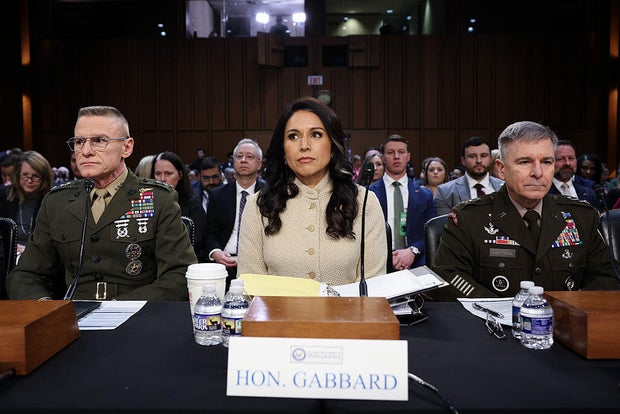
During questioning by Democratic Senator Jon Ossoff of Georgia, Gabbard reiterated that the intelligence community assessed that Iran’s nuclear enrichment program was “wiped out” in last year’s attacks; he omitted a portion of his written testimony in his opening statement.
“So the intelligence community’s assessment is that Iran’s nuclear enrichment program was destroyed by last summer’s airstrikes,” Ossoff asked.
“Yes,” Gabbard said.
Ossoff asked if “no effort had been made since then to try to rebuild its enrichment capacity.”
“Correct?” asked.
“That’s right,” he said.
Ossoff also asked him if the intelligence community had assessed that there was an imminent nuclear threat posed by the regime. Gabbard said Iran “maintained the intention to rebuild and continue to increase its nuclear enrichment” and only the president “can determine what is and is not an imminent threat.”
“It is not the responsibility of the intelligence community to determine what is and is not an imminent threat,” he said. “That’s up to the president, based on the volume of information he receives.”
Reed asks if regime collapse can be achieved with air power alone
Democratic Senator Jack Reed of Rhode Island asked Lt. Gen. James Adams, director of the Defense Intelligence Agency, what conditions would have to be present to bring about the collapse of the regime and whether it could be achieved with air power alone.
Adams said he would prefer to talk about the conditions that would precipitate the collapse of the regime in the closed-door hearing that followed the public session.
“I understand that, but there is a very basic question here. Will air power alone be able to destroy this regime?” Reed continued. “Do you think air power alone will be enough?”
“Senator, the capabilities our joint force brings can accomplish many missions,” Adams said. “To predict exactly what can and cannot be achieved with this goal, I prefer not to guess or predict about it.”
Kelly Asks About Pro-Trump Group’s Fundraising Email Offering ‘Private National Security Briefings’
Kelly pressed Ratcliffe and Gabbard about a pro-Trump political action committee that sent out a fundraising email last week offering “private national security briefings” for donors. The New York Times reported that the group Never Surrender sent a fundraising email featuring an image of the president in a dignified ride for fallen soldiers, offering “private national security briefings, unfiltered updates on the threats facing the United States.”
“Director Gabbard or Director Ratcliffe, do you think the public should be able, the president’s supporters should be able to pay for and receive their private national security briefings?” -Kelly asked. “I assume these are briefings, Director Ratcliffe, that you provide to the president and that they will now be provided to someone who makes a donation.”
Ratcliffe said that regardless of what that document says, “it didn’t happen.” He said the Hatch Act would prevent him from engaging in such activity.
Gabbard said she was “not familiar” with that document.
Kelly said he would provide them with the fundraising email.
Ratcliffe and Gabbard address Russia benefiting from rising oil prices
Democratic Senator Mark Kelly of Arizona asked Gabbard and Ratcliffe if they agreed that “China and Russia are our main geopolitical rivals.”
“Yes, they are primary strategic competitors,” Gabbard said, changing the wording of Kelly’s question.
“I agree with that, although I don’t think they are equal in terms of the threats they pose,” Ratcliffe said.
Kelly mentioned how the war with Iran has caused a “shock” to the world’s oil supply.
“But not everyone is losing,” Kelly said, asking whether Russia has gained billions of dollars from rising oil prices and a pause in U.S. sanctions.
“That’s what’s been reported,” Gabbard said, referring the question to the Treasury and Energy secretaries.
“I’m not an economist,” Ratcliffe said. “I’m not going to try to make those calculations. But as I mentioned before, sometimes decisions are made that will benefit adversaries at the same time that policymakers think they will benefit the American people.”
Bennet and Ratcliffe clash over Iran war goals
Democratic Sen. Michael Bennet of Colorado spent most of his time criticizing the Trump administration’s shifting war goals with Iran. He said that “the war is not ending, it is escalating” and that the mission “has become less clear.”
“Iran’s nuclear program is damaged, no doubt,” Bennet said, “but it still has uranium reserves.”
He also predicted that the conflict with Iran would become “a perpetual war because what Iran will do is exactly what it has always done.”
Ratcliffe accused Bennet of mischaracterizing the administration’s goals.
“The defined objectives are very clear,” Ratcliffe said, adding that the administration intends to destroy and degrade Iran’s missile and drone inventory and its military industrial base.
The two talked over each other until Bennet asked the committee chairman to intervene.
“They’re both big boys, they can handle themselves,” Cotton told them.
Defense Intelligence Agency chief faces questions about impact of Iran’s war on Ukraine
Republican Senator Jerry Moran expressed concern about the impacts of the Iran war on the ability of the United States and its allies to support Ukraine against Russia. He asked Lt. Gen. James Adams, head of the Defense Intelligence Agency, about the “supply chain implications.”
“How do we do both?” asked. “Are we doing both? Is US support for Ukraine maintained or diminished as a result of [Operation] Epic Fury?”
Adams said the DIA continues to “watch” what happens around the world in other crises.
“Unfortunately, in the current situation, based solely on force composition and the delta between Russian and Ukrainian forces, the advantage goes to the Russians,” Adams testified. “As we move into the classified audience, we can talk a little more specifically about the supply chain-related elements.” Adams referred further questions to the Pentagon.
Moran asked Adams to be prepared for the classified portion of the hearing, which will take place after the public portion.
“Our supply chain issues are unclassified in the sense that every hearing I participate in as a defense appropriator has Department of Defense officials testifying about the need for more assistance,” Moran said. “And really, I’m asking for the facts of what has happened as a result of Operation Epic Fury in recent weeks in our supply to Ukraine and our NATO allies who are supplying Ukraine.”
Adams said efforts are underway to boost munitions and defense industrial base capabilities.
Ratcliffe says he had ‘countless meetings’ with Trump before Iran attacks
Sen. Angus King of Maine, who identifies as an independent but is part of the Democrats, asked Ratliffe and Gabbard if they were in the room when the president decided to attack Iran.
“Senator King, in probably dozens and dozens of briefings with the president, I don’t know if there was a single meeting where there was a single moment where a decision was made,” Ratcliffe responded.
King asked more specifically about meetings held about two weeks before the United States launched the attacks. Ratcliffe said there were “countless meetings with the president” during that period. Gabbard said she was “also” present at such meetings. Ratcliffe said the president “constantly receives briefings on intelligence.”
“What I can tell you is that Iran had specific plans to attack American interests in energy sites throughout the region, and that is why the War Department and the State Department took steps for the protection of forces and personnel prior to Operation Epic Fury,” Ratcliffe said. “I think that’s the most important thing.”
Ratcliffe estimated that he briefs the president, on average, “10 to 15 times a week.”
Ratcliffe says he disagrees with Trump official who resigned over Iran war
Ratcliffe told Sen. John Cornyn, R-Texas, that he disagreed with Joe Kent, who resigned Tuesday from the National Counterterrorism Center over the Iran war. Kent said that “Iran did not pose an imminent threat to our nation” and that he could not support war.
“Is there anything to indicate that Iran had ceased its nuclear ambitions or its desire to continue building ballistic missiles capable of threatening American troops and allies in the Middle East?” -Cornyn asked.
“No, in fact, the intelligence reflects the opposite,” Ratcliffe said.
“So you don’t agree with Mr. Kent?” Cornin said.
“Yes,” Ratcliffe said.
Wyden presses Gabbard on ‘foreseeable’ and ‘intended’ consequences of attacking Iran
Democratic Sen. Ron Wyden of Oregon pressed Gabbard on what he called the “foreseeable” and “foreseeable” consequences of attacking Iran. Wyden cited intelligence agencies’ assessment that Iran was capable of inflicting damage on attackers, executing regional attacks and disrupting the Strait of Hormuz.
“All the problems we are seeing now were not only foreseeable but were also predicted by intelligence agencies,” he said.
Wyden asked whether intelligence agencies stood by their assessment that Iran had the ability to close the Strait of Hormuz in the run-up to the war.
“The intelligence community has continued to provide the president and his team with intelligence information related to this operation in Iran. Earlier and on an ongoing basis,” Gabbard said.
Wyden asked whether intelligence agencies assessed that Iran might respond by attacking US forces.
“The IC assessment has always taken very seriously the threat from the Iranian regime’s missile capabilities and how our US troops in the region may be at risk,” Gabbard responded.
Wyden highlighted the president’s comments that no experts thought Iran could attack its partners in the Gulf states. Wyden asked if the intelligence community had assessed that Iran might attack its American partners.
“The intelligence community has continued to assess potential threats to the region, existing threats to the region, and provide those assessments to policymakers and decision makers,” Gabbard responded.
Warner argues with Gabbard over Fulton County search and foreign interference
Warner pressed Gabbard about why she was seen in late January at a police search at the elections office in Fulton County, Georgia. His presence raised alarm among Democrats, who questioned why the intelligence chief was involved in domestic police operations.
“Where is the authority for you to engage in internal police activity?” -Warner asked.
Gabbard said she “did not participate in police activity, nor would I, because that does not exist within my authorities.” Gabbard said she was there at the president’s request “and to work with the FBI to observe this action.” He said he was “not aware of what was in the order.”
Warner also noted that ODNI’s 2026 annual threat assessment is the first report since 2017 that “doesn’t even mention foreign interference.”
“Are you saying there is no foreign threat to our midterm elections this year?” -Warner asked.
Gabbard said the annual assessment “coincides with threat prioritization,” but did not directly answer the question.
“I would conclude that there should be no foreign threat to our elections in 2026,” Warner said.
Ratcliffe praises CIA successes: ‘The CIA has delivered’
CIA Director Ratcliffe spoke about the agency’s contributions to recent US operations, such as in Venezuela and Iran. During his confirmation hearing, Ratcliffe said he promised a more aggressive CIA focused on its core mission, “getting back to the business of stealing secrets so we can provide our policymakers with a decisive strategic advantage that would enable, advance and contribute to foreign policy and national security successes.”
“To the credit of the CIA workforce, the CIA has delivered,” Ratcliffe told Cotton. “Some of those successes have been very public. As you mention, senator, Operation Midnight Hammer, Operation Absolute Resolve. Impeccable military operations like this are hostage to an impeccable intelligence image.”
Ratcliffe said foreign intelligence gathering has increased significantly in key areas such as China, counter-drugs, artificial intelligence and counterterrorism.
Cotton asked Ratcliffe about Iran’s ability to attack the United States in just six months, without intervention.
Eventually, “if left unhindered, yes, Senator, they would have the ability to launch missiles toward the continental US.”
Ratcliffe did not give an exact timeline for when that would be possible. But he said that’s why degrading Iran’s capabilities “is so important to our national security.”
Warner asks Gabbard why she left out part of opening remarks on Iran’s nuclear enrichment
In the written version of her opening statement that the committee posted on its website, Gabbard said: “As a result of Operation Midnight Hammer, Iran’s nuclear enrichment program was destroyed. Since then there have been no efforts to try to rebuild its enrichment capacity. The entrances to the underground facilities that were bombed have been buried and cemented shut.”
But he omitted that passage in his spoken comments. Warner asked him why.
“Was it because the president said there was an imminent threat?” Warner said.
“I realized time was running out and I skipped part of the part you chose,” Gabbard said.
Warner said he chose to omit part of the assessment that contradicts the president.
Gabbard: Iranian regime “seems intact but largely degraded”
Gabbard said the intelligence community assesses that sustained attacks on Iran have diminished the regime’s power, although it remains capable of attacking U.S. interests in the Middle East.
“Iran’s regime appears to be intact but largely degraded due to attacks on its leadership and military capabilities,” he said in his opening statement. “Its conventional military power projection capabilities have been largely destroyed, leaving limited options. Iran’s strategic position has been significantly degraded.”
He continued: “Even so, Iran and its proxies remain capable and continue to attack the interests of the United States and its allies in the Middle East. The IC assesses that if a hostile regime survives, it will seek to begin a year-long effort to rebuild its missile and unmanned aerial vehicle forces.”
Gabbard says testimony doesn’t convey her personal views
Gabbard began her testimony by telling viewers that her testimony “conveys the intelligence community’s assessment of the threats facing American citizens, our homeland, and our interests, not my personal views or opinions.”
Warner highlights electoral security and accuses Gabbard of using her role to “interfere in domestic politics”
In his opening statement, Sen. Mark Warner of Virginia, the committee’s top Democrat, asserted that Gabbard’s office is failing to protect U.S. elections from foreign interference, accusing Gabbard of an “organized effort to abuse her national security powers to interfere in domestic politics…and provide a pretext for the president’s unconstitutional efforts to seize control of the upcoming election.”
“For months, the committee has repeatedly requested IC reports, reports required by law, on legitimate foreign threats to the midterm elections,” Warner said. “We have not received a response.”
The Virginia Democrat accused Gabbard of abusing her authority to “interfere” in domestic politics, highlighting her presence in a police operation to seize ballots and voting machine records in Fulton County, Georgia. Fulton County, which Trump lost in 2020, has long been a source of frustration for the president. Gabbardo told lawmakers the president requested his presence.
“When the warrant supporting the raid was revealed, it showed something deeply troubling: There was no foreign connection to justify the involvement of our nation’s top spy,” Warner said.
“This raises a very serious question: If the intelligence community is not being deployed, mobilized against foreign threats, why is it being deployed on a domestic matter? The DNI’s appearance in this raid, as well as its involvement in the seizure of Puerto Rico voting machines, suggests something that should also alarm all Americans: I believe an organized effort to abuse its national security powers to interfere in domestic politics and potentially provide a pretext for the president’s unconstitutional efforts to take control of the next elections”.
As for the FBI, Warner also said that agents working on a task force focused on threats from Iran, “clearly something that is very important right now,” were “fired because they had previously participated in the investigation of the president’s mishandling of classified information.”
Warner also criticized the administration’s evacuation of Americans in the Middle East.
“This was a foreseeable security crisis,” Warner said. “When you start a war by choice, when there was no imminent threat, you should be able to prepare to make sure you get Americans out of the war zone.”
Cotton praises operations of Iran and Venezuela
Sen. Tom Cotton of Arkansas, the committee’s Republican chairman, opened the hearing by praising military operations in Iran and Venezuela that overthrew the previous leadership.
Cotton said Iran’s regime is “finally brought down.”
“After 47 years of indecision and timidity, the United States has finally put its foot down,” he said.
He also noted the capture of former Venezuelan President Nicolás Maduro in January.
“Let this be a warning to those who wish to harm America, we leave no stone unturned and there is no one or anything close to you that cannot betray you.”
Ahead of Gabbard’s testimony, Leavitt says the president has complete confidence in her
Moments before the hearing, White House press secretary Karoline Leavitt was asked on News if the president has full confidence in Gabbard.
“Yes, yes, and we look forward to seeing the director’s hearings today,” Leavitt said.
Gabbard, opposed to conflict with Iran in the past, has not publicly expressed support for war.
Gabbard had not spoken publicly about the war with Iran since it began until she released her statement following Kent’s resignation.
In the past, Gabbard has expressed strong opposition to intervening militarily in Iran.
“President Trump promised us during his campaign to get America out of ‘stupid wars,'” Gabbard said in a 2019 ad when she was running for president, which featured multiple statements by Trump about avoiding wars in the Middle East. “…But he is about to launch a very stupid and costly war with Iran. We have to stop President Trump from starting a war with Iran.”
She never deleted that X post, which was one of multiple comments Gabbard made expressing her opposition to the conflict with the Islamic Republic. “No to war with Iran,” Gabbard wrote on January 7, 2020. She also advertised t-shirts that read “No to war with Iran.”
Gabbard’s precisely worded statement following Kent’s resignation on Tuesday did not express personal support for the war. He said it’s up to the president to determine what constitutes an “imminent threat,” and the president made that determination.
Top Gabbard aide resigns over Iran war on eve of hearing
Joe Kent, who headed the National Counterterrorism Center, resigned on Tuesday, saying he “cannot, in good conscience, support the ongoing war in Iran.”
“Iran did not pose an imminent threat to our nation, and it is clear that we started this war due to pressure from Israel and its powerful American lobby,” Kent wrote in his resignation letter to Trump.
Kent accused senior Israeli officials and some media outlets of running a “disinformation campaign” that was “used to fool them into believing that Iran posed an imminent threat to the United States, and that if they attacked now, there was a clear path to quick victory.”
“This was a lie,” he said, urging Trump to “reflect on what we are doing in Iran and who we are doing it for.”
In a publication ion on X, Gabbard appeared to respond to Kent’s letter, saying that the president “is responsible for determining what is and is not an imminent threat.”
“After carefully reviewing all of the information before him, President Trump concluded that the Islamist terrorist regime in Iran posed an imminent threat and took action based on that conclusion,” he said.
2025 report said Iran was ‘not building a nuclear weapon’
Nearly a year before the United States launched the current war against Iran, the intelligence community said in its annual assessment that it continued to “assess that Iran is not building a nuclear weapon” and that then-Supreme Leader Ali Khamenei had not reauthorized the program, “although he has likely been pressured to do so.”
“Khamenei remains keen to avoid involving Iran in direct and expanded conflict with the United States and its allies,” the March said. According to the 2025 report.
A few months later, the United States became embroiled in the 12-day war between Iran and Israel, bombing three Iranian nuclear sites, which Trump claimed had “destroyed” his nuclear program.
Since the latest bombing campaign against Iran began on February 28, in which Khamenei was killed, Trump and other administration officials have claimed that the regime posed an “imminent” threat to the United States.
The 2025 assessment also warned that Iran had deployed a large number of ballistic and cruise missiles, as well as unmanned drones, which had the ability to strike across the region.
“Iran’s large conventional forces are capable of inflicting substantial damage on an attacker, executing regional attacks, and disrupting shipping, particularly energy supplies, through the Strait of Hormuz,” the report says.
Intelligence Chiefs’ Testimony Comes As Questions Grow About Iran War
Trump’s spy chiefs will testify before the Senate Intelligence Committee at its annual hearing on global security threats facing the United States.
His appearance comes as Democratic lawmakers call on Trump administration officials, specifically Secretary of State Marco Rubio and Secretary of Defense Pete Hegseth, to answer questions in public about the justification for the war with Iran and the end of the administration.
Instead, it will be Gabbard, CIA Director John Ratcliffe, FBI Director Kash Patel, National Security Agency chief Lt. Gen. William Hartman and Defense Intelligence Agency Director Lt. Gen. James Adams who will be in the hot seat as the timeline for ending the war remains unclear, the justifications for the military operation have changed and America’s allies remain reluctant to get involved.
The annual hearing typically focuses on threats from China, Russia and Iran, although audience from last year was dominated by a signal chat in which Trump officials discussed sensitive details about military strikes in Yemen.