



A huge and iconic iceberg turns blue and collapses
By
Stephen Smith
Chief Editor
Stephen Smith is editor-in-chief of News based in New York. Originally from Washington, DC, Steve was previously an editorial producer at the Washington Post and also worked in Los Angeles, Boston and Tokyo.
Read full biography
/News themezone
Add News themezone on Google
One of the largest and oldest icebergs ever tracked by scientists has turned blue and is “on the brink of complete disintegration,” NASA said Thursday.
A23aa massive wall of ice once twice the size of Rhode Island, is drenched in blue meltwater as it floats in the South Atlantic off the eastern tip of South America, NASA said in a news release.
A NASA satellite captured an image of the melting iceberg the day after Christmas, showing pools of blue meltwater on its surface. A day later, an astronaut aboard the International Space Station captured a photograph showing a closer view of the iceberg, with an even larger melt pool.
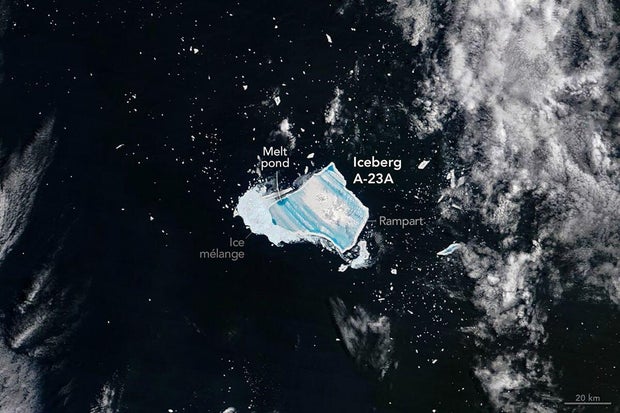
The satellite image suggests that A23a also “has sprung a leak,” NASA said, as the weight of water accumulated on top of the iceberg broke through the ice.
Scientists say all signs indicate the so-called “megaberg” could be just days or weeks away from completely disintegrating as it moves along currents that push it toward even warmer waters. Warmer air temperatures this season could also accelerate the demise of A23a in an area that ice experts have called an iceberg “graveyard.”
“I certainly don’t expect A-23A to last through the southern summer,” Chris Shuman, a retired scientist at the University of Maryland in Baltimore County, said in a statement.
The blue and white linear patterns visible on A23a are likely related to striations, which are ridges that were carved out hundreds of years ago when the iceberg was part of the Antarctic bedrock, NASA said.
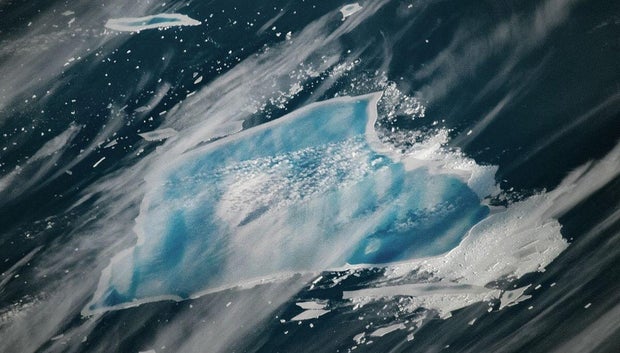
“The striations formed parallel to the direction of flow, eventually creating subtle ridges and valleys on the top of the iceberg that now direct the flow of meltwater,” said Walt Meier, senior research scientist at the National Snow and Ice Data Center.
When the iceberg broke off from Antarctica in 1986, it was about 4,000 square kilometers and housed a Soviet research station. It remained stagnant for over 30 years before finally breaking free in 2020; Its slow journey north was sometimes slowed by oceanic forces that stopped its movement.
In 2023, the British Antarctic Survey published a time-lapse satellite imagesshowing the movement of the iceberg. In January 2025, he was in a collision course with a remote penguin colony but fortunately it had no impact.
Last summer, several large chunks of ice broke off from A23a as it moved toward relatively warm summer conditions. According to current estimates from the US National Ice Center, as of early January 2026, the iceberg’s area was 1,182 square kilometers, still larger than New York City, but a fraction of its initial size.
“I’m incredibly grateful that we had the satellite resources that allowed us to track it and document its evolution so closely,” Shuman said. “The A-23A faces the same fate as other Antarctic icebergs, but its journey has been remarkably long and eventful. It’s hard to believe it won’t be with us for much longer.”
In:
- Antarctica
- POT