



Amnesty says US attack that killed migrants in Yemeni prison may be war crime
DUBAI, United Arab Emirates (AP) — A U.S. airstrike in April on a prison run by Yemen’s Houthi rebels that killed more than 60 detained African migrants should be investigated as a possible war crime, activists said Wednesday.
Amnesty International’s appeal renews scrutiny of the April 28 attack in Yemen’s Saada province. The attack came as part of an intense campaign of airstrikes under US President Donald Trump against rebels for disrupting shipping through the Red Sea corridor amid the war between Israel and Hamas.
The U.S. military’s Central Command has yet to offer any explanation for the attack on the prison, which had previously been attacked by a Saudi-led coalition also fighting the Houthis and known to be holding detained African immigrants trying to reach Saudi Arabia through the war zone.
“We take all reports of civilian harm seriously and are working to release the results of the Operation Rough Rider assessment soon,” said U.S. Navy Capt. Tim Hawkins, a spokesman for Central Command.
Dozens of dead
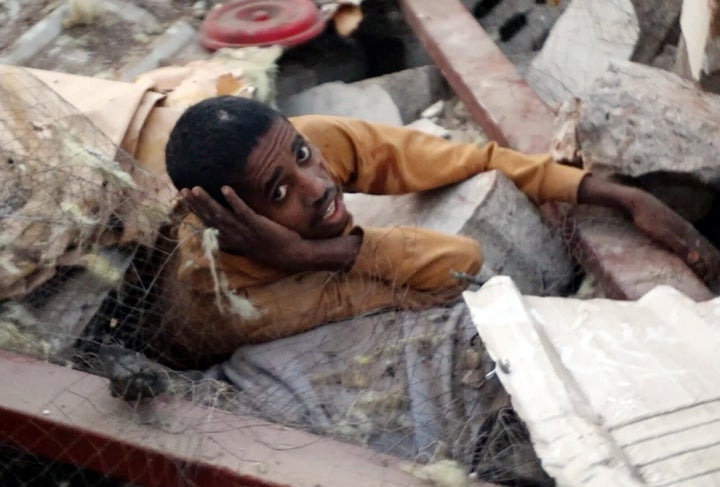
Houthi Media Center flyer via Getty Images
After the attack, the Houthis showed remains likely from two 250-pound GBU-39 small diameter precision-guided bombs used by the US military, Amnesty said. Survivors interviewed by Amnesty, all Ethiopian migrants detained while trying to reach Saudi Arabia, told the rights group that they did not see any Houthi fighters stationed inside the building.
Amnesty said the attack appeared to be an “indiscriminate attack” as it considered there was no clear military objective. International law prohibits attacking sites such as hospitals and prisons unless the structures are used to plan attacks or store weapons, and even then, every precaution must be taken to avoid harming civilians.
Amnesty said the Houthis recently put the death toll in the attack at 61, down from the 68 they initially reported. Gunshots could be heard in footage filmed after the airstrikes, and the Houthis said their guards fired warning shots at the time of the attacks.
The April attack was reminiscent of a similar attack by a Saudi-led coalition fighting the Houthis in 2022 on the same complex, which caused a collapse that killed 66 detainees and injured 113 others, a United Nations report later said. The Houthis shot dead 16 detainees who fled after the attack and wounded 50 others, the UN said.
The Houthis denied any wrongdoing in the April strike, but Amnesty noted that the rebels’ “continued repression against…activists, journalists, human rights defenders and aid workers” limited their ability to investigate. The Houthis are holding at least 59 United Nations staff and more aid group workers, and the rebels have seized electronics at U.N. offices in recent days. Iran-backed rebels, under economic pressure, have also been increasingly threatening Saudi Arabia in recent weeks.
“I actually didn’t think it was possible for the United States to carry out an airstrike on the same complex, which would cause a significant level of civilian damage,” said Kristine Beckerle, Amnesty’s deputy director for the Middle East and North Africa. “It kind of challenges the belief that the United States wouldn’t have known.”
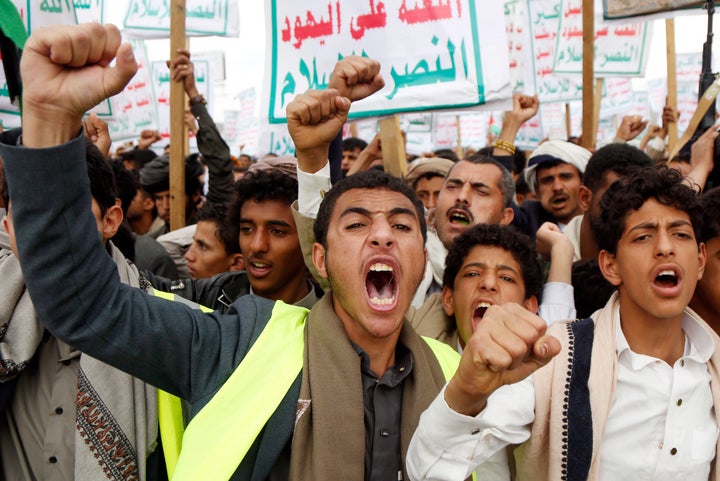
The US campaign is believed to have killed other civilians.
Mohammed Hamoud via Getty Images
The US airstrikes against the Houthis began in the wake of rebel attacks on shipping during US President Joe Biden’s administration. However, attacks increased dramatically during Trump’s Operation Rough Rider, hitting some 1,000 targets in Yemen.
Those attacks hit power plants, mobile phone infrastructure and military targets in Yemen. However, activists say the attacks also killed civilians, particularly an April attack on an oil depot that killed more than 70 people.
Airwars, a U.K.-based group that studies air war casualties, believes Operation Rough Rider targeted at least 224 civilians during the week-long campaign, nearly the same number of civilians killed during more than 20 years of U.S. strikes in the country.
US Army Gen. Michael Kurilla, former CENTCOM commander, promised that details about civilian casualties in the Yemen campaign would “absolutely” be made public during congressional testimony in June, although that has not yet happened.
Forget the dance hallsHelp build anewsroom
Your supportFuelsOur Mission
Your supportFuelsOur Mission
Become a News themezone Member
When power gathers under gilded roofs, true journalism remains outside, asking the questions that matter. Join the News themezone membership and keep independent reporting strong for everyone.
We remain committed to bringing you the unwavering, fact-based journalism everyone deserves.
Thank you again for your support along the way. We are truly grateful for readers like you! Your early support helped get us here and strengthened our newsroom, keeping us strong in uncertain times. As we continue, we need your help more than ever. We hope you will join us once again.
We remain committed to bringing you the unwavering, fact-based journalism everyone deserves.
Thank you again for your support along the way. We are truly grateful for readers like you! Your early support helped get us here and strengthened our newsroom, keeping us strong in uncertain times. As we continue, we need your help more than ever. We hope you will join us once again.
News themezone Support
Are you already a member? Sign in to hide these messages.
“One of the things that was relatively devastating is that again we’re talking about people who left Ethiopia to travel to Yemen because they were trying to get to the Gulf” to earn money for their families back home, Beckerle said. “They have to get their family to send them money to Yemen to deal with the effects of the injury.”