



Children discover mysterious ancient skeleton sitting next to playground in France
/News/News
Add News themezone on Google
Children at a primary school in eastern France this week found a strange new attraction next to their playground: a skeleton sitting upright, peeking out of the top of a circular well.
It is just the latest in a series of bodies discovered in the city of Dijon that were mysteriously buried in a sitting position and facing west.
Scientists are trying to discover why the ancient and little-understood Gaulish people chose to bury some of their dead in this unusual way, and whether the men were still alive at the time.
The last skeleton, remarkably well preserved, was found next to the Josephine Baker primary school, in the heart of Dijon.
Like four others unearthed nearby earlier this month, it lies upright at the bottom of a meter-wide pit.
The skeleton’s hands rest on his lap. Like the others, he has his back to the eastern wall and faces west.
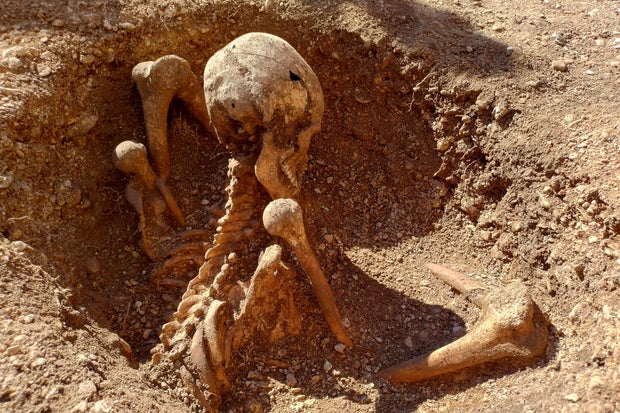
Last year, 13 other Gallic skeletons were discovered about 20 meters away at the same site, according to the French National Institute for Preventive Archaeological Research (INRAP). The bodies are believed to date from around 300 to 200 BC
At the time, INRAP said some of the skeletons had “unhealed marks of violence, undoubtedly indicative of intentional killing.”
“One of them received two blows to the skull with a sharp object (sword?),” the institute wrote.
Over the past three decades, archaeological excavations have revealed that Dijon was once a special place for the Gauls, an enigmatic Celtic group perhaps best known from the popular French comic book “Asterix and Obelix.”
The Gauls first emerged in approximately the 5th century BC. C. and spread through areas of what is now France, Belgium, Switzerland and further east.
Little is known about their culture beyond the writings of others. These may be partial, as recorded by the Roman emperor Julius Caesar, who conquered Gaul in 50 BC.
Reward or punishment?
Including earlier discoveries in 1992, around twenty tombs with seated Gauls have been discovered in a small area in the city center of Dijon.
This is more than a quarter of the 75 seated Gaul graves identified worldwide. Other sites have been found in France, Switzerland and the United Kingdom.
Regis Labeaune, a researcher at the French archaeological institute INRAP, said the latest bodies were “particularly impressive discoveries.”
“Taking into account the number and quality of these discoveries, we can say that there was an important French settlement in Dijon,” he told News.
However, there is much that is still unknown. Was this strange burial a punishment for people who had done wrong… or a reward for the powerful?
Could they have sacrificed these people to their gods in the hope of a better harvest? Or buried by enemy soldiers to deter other Gauls from fighting?
Another mystery is whether they were buried alive.
“This sitting position is atypical,” INRAP archaeoanthropologist Annamaria Latron told Le Monde. “We are more accustomed to burials of individuals reclining, generally face up, with their lower limbs extended and not bent like that.”
Except for a bracelet dating the settlement to the Gallic era, no personal items or ornaments were found among the Dijon bodies.
They were all men, measuring between 1.62 and 1.82 meters tall, except for one boy discovered in 1992.
Their teeth were very well preserved over the years, “probably because they didn’t know anything about sugar,” Latron said.
“Their bones show traces of osteoarthritis, suggesting intense physical activity,” particularly in the legs, he said.
“A very frustrating profession”
So why were they buried in this strange way?
“We don’t have a preferred hypothesis,” Latron stressed.
“We are missing the surface layer, which was on top of the graves,” he said.
“Being an archaeologist can be a very frustrating profession,” he added with a smile.
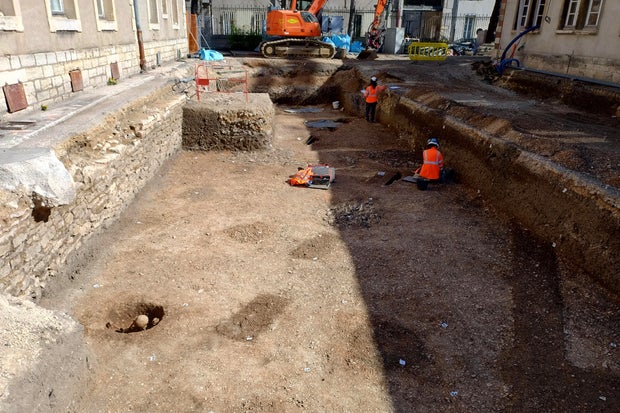
In the 1990s, the bodies of 28 dogs, five sheep and two pigs were found near the site. The corpses appear to date from the end of the French period and “seem to correspond to sacrificial practices,” according to INRAP.
Remnants of the Gauls still remain in the modern French language, including words for homeland and paganism, said INRAP president Dominique García.
He called for more attention to be paid to the Gauls, given that two-thirds of “French prefectures have Gallic origins, according to archaeology.”
In:
- Archaeologist
- France