



Cosmic butterfly seen in stunning new image captured by telescope in Chile
/News/AP
Add News themezone on Google
A telescope in Chile has captured a stunning new image of a grand and elegant cosmic butterfly.
The National Science Foundation’s NoirLab released the image on Wednesday. The glowing “wings” seem to burst out of the image. Although the bipolar nebula is called the Butterfly Nebula, Insect Nebula or Caldwell 69, its official name is NGC 6302.
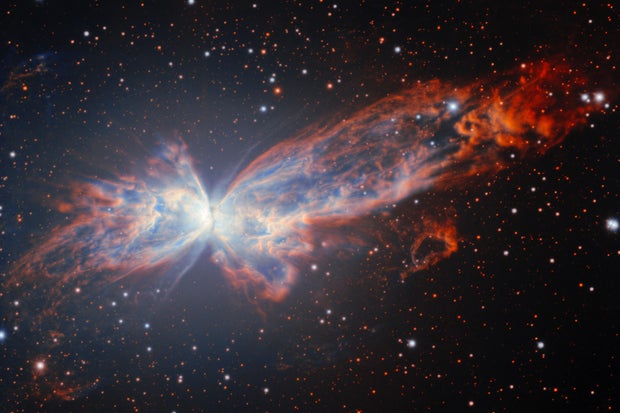
Taken last month by the Gemini South telescope (half of the Gemini International Observatory on Cerro Pachón, a mountain in central Chile), the aptly named Butterfly Nebula is located between 2,500 and 3,800 light-years away, in the constellation Scorpio. A single light year is equivalent to 6 trillion miles.
At the heart of this bipolar nebula is a white dwarf star that long ago abandoned its outer layers of gas. The discarded gas forms butterfly-like wings that flutter from the aging star, whose heat causes the gas to glow.
Students in Chile chose this astronomical objective to celebrate the 25 years of operation of the Gemini International Observatory.
“This picturesque object was chosen as the target for the 8.1 meter target. [26.5-foot] telescope by students in Chile as part of the Gemini First Light Anniversary Image Contest,” NoirLab wrote on its website. “The contest involved students at the host locations of the Gemini telescopes to celebrate the legacy that the International Gemini Observatory has built since its completion, marked by the First Light of Gemini South in November 2000.”
It is not known exactly when NGC 6302 was discovered, says NoirLab, but credit is often given to a 1907 study by American astronomer Edward E. Barnard. The Scottish astronomer James Dunlop may also have discovered it in 1826.
In:
- Chili
- Science
- Space