



Crane falls on moving train in Thailand, killing dozens in fiery derailment
/News/AP
Add News themezone on Google
bangkok — A construction crane fell on a moving passenger train, causing a derailment that killed at least 30 people Wednesday in northeastern Thailand, authorities said. Another 64 people were injured and rescue teams were still searching the wreckage and providing first aid.
The derailment occurred as part of an ambitious high-speed rail project that will eventually connect China to much of Southeast Asia.
Anuphong Suksomnit, governor of Nakhon Ratchasima province, where the accident occurred, said four passengers of the 171 believed to have been aboard the train were still missing. Search teams were still searching through the rubble about eight hours after the morning crash.
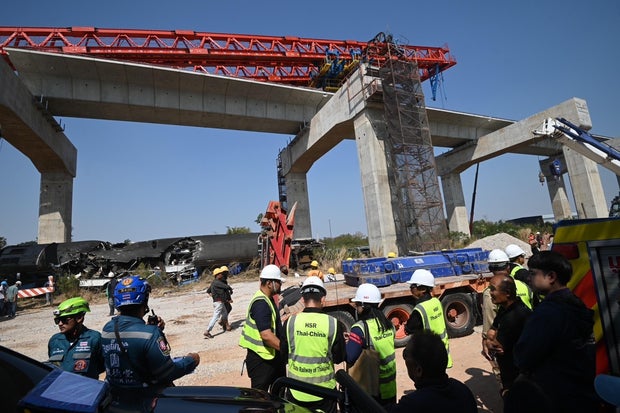
The crane, which was being used to build an elevated portion of the railway, fell while the train was traveling from Bangkok to Ubon Ratchathani province, according to the public relations office of Nakhon Ratchasima province, where the accident occurred about 143 miles northeast of Bangkok.
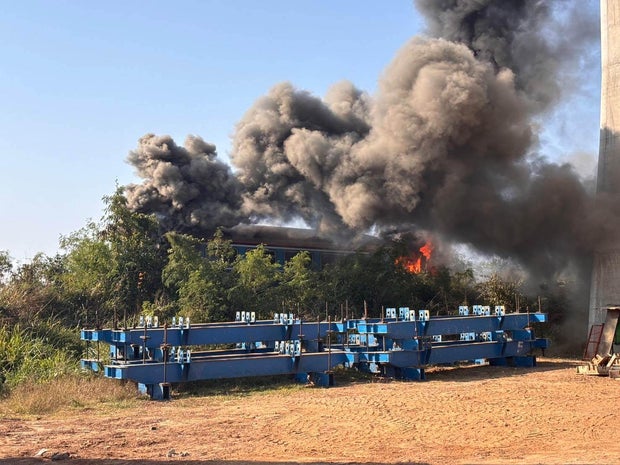
Photos published in Thai media showed plumes of white and then dark smoke above the site and construction equipment hanging between two concrete support pillars.
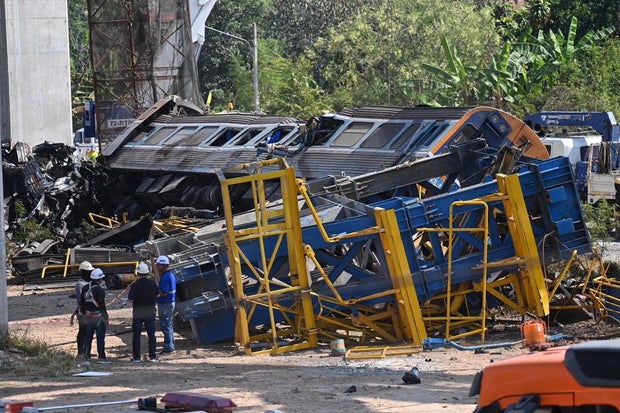
Rescuers were on top of overturned railway carriages, some with large holes in their sides, video from public broadcaster ThaiPBS showed. What appeared to be sections of the crane were scattered along the road.
Thai media reported that the train had three carriages, with the last two carriages being the most damaged.
Transport Minister Piphat Ratchakitprakan said 195 people were on board the train. He said he ordered an investigation.
Mitr Intrpanya, 54, a resident of the area, told the French news agency News that he “heard a loud noise, as if something was sliding from above, followed by two explosions. When I went to see what had happened, I found the crane on top of a passenger train with three cars. The metal of the crane seemed to hit the center of the second car, breaking it in half.”
In August 2024, a railway tunnel on the planned route, also in Nakhon Ratchasima, collapsed, killing three workers. Days of heavy rain are believed to have been a factor in the collapse.
The elevated segment that collapsed is part of the Thai-Chinese high-speed rail project linking Bangkok, Thailand’s capital, with the northeastern province of Nong Khai, on the border with Laos. The two-stage railway project has a total cost of more than 520 billion baht ($16.8 billion) and is associated with an ambitious plan to connect China with Southeast Asia under Beijing’s Belt and Road Initiative.
Anan Phonimdaeng, acting governor of the State Railways of Thailand, said the project contractor is Italian-Thai Development, and a Chinese company is responsible for design and construction supervision.
He said authorities will examine the responsibilities of both parties and the Railway Department plans to take legal action against the contractor as a first step. Damage to the train was estimated at more than 100 million baht ($3.2 million), while the construction equipment suffered limited damage, Anan said.
A statement posted on the company’s website expressed condolences to the victims and said the company would take responsibility for paying compensation to the families of the dead and hospitalization expenses for the injured.
Anger intensifies
The new accident caused outrage in Thailand because the main contractor for the first stage of the route between Bangkok and Nakhon Ratchasima, Italian-Thai Development, was also directly responsible for construction on the section where the accident occurred.
The company, also known as Italthai, was also the main contractor for the state audit building in Bangkok, the Thai capital, which collapsed during construction in March during an earthquake in neighboring Myanmar.
About 100 people died in the collapse, which was the only major structure in Thailand to suffer such serious damage. Dozens of executives have been charged in connection with the disaster, but none have been tried yet.
The participation of Chinese companies in both projects has also attracted attention, as well as the participation of Italthai and Chinese companies in the construction of several highway extensions in Bangkok and its surroundings, where several accidents occurred, some fatal.
Prime Minister Anutin Charnvirakul, who was home minister when the State Audit building collapsed, said the Comptroller General Department and the Transport Ministry are responsible for blacklisting contractors, and that laws could not be changed in the short time he was home minister to expedite the matter.
In Beijing, Chinese Foreign Ministry spokesman Mao Ning said the government was aware of reports about the accident and had expressed its condolences.
“The Chinese government attaches great importance to the safety of projects and personnel, and we are also learning about the situation,” he said. “Currently, it appears that the corresponding section is being built by a Thai company and the cause of the accident is still under investigation.”
In:
- Thailand
- Porcelain