



Crypto Industry’s Plan to Sink Hostile Democrats Backfires
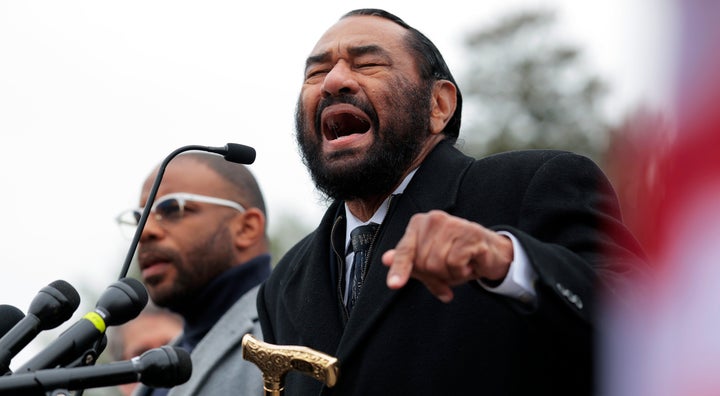
WASHINGTON – Rep. Al Green (D-Texas) survived more than $1 million in spending against him by the cryptocurrency industry in his Democratic primary earlier this month. Green said he now feels “liberated.”
“Today I am going to address the issue that has caused a lot of consternation in this Congress, an issue that many people would say would be reckless to address because of the consequences,” Green said in a speech on the House floor Thursday. “Why is the cryptocurrency industry spending mega-millions of dollars to control Congress?”
Most Democrats have spent the months since the 2024 election trying to avoid angering the crypto industry, especially after it set an example for former Rep. Katie Porter (D-Calif.) and Sen. Sherrod Brown (D-Ohio) by spending millions of dollars on ads attacking them before they lost their races. But the recent Democratic primaries may have sown the seeds of an eventual Democratic backlash.
Surprisingly, Green managed to advance to his runoff against freshman Rep. Christian Menefee despite the crypto intervention. And heavy cryptocurrency spending in a pair of elections in Illinois not only failed to defeat candidates there, but also infuriated the state’s elected officials.
“What they’re doing by trying to disrupt and buy an election by coming in and spending $10 million at the last minute, all they did was turn voters against them,” Sen. Tammy Duckworth (D-Ill.) told News themezone. “All it did was make me think twice about what they’re willing to do to promote the industry and reduce the barriers around them. And if anything, they hurt their cause with what they did in Chicago, in Illinois.”
Molly White, writer and researcher who directs a website that tracks crypto campaign spendingsaid there were only limited complaints about cryptocurrencies in 2024, the first campaign cycle in which the industry really flexed its political muscle.
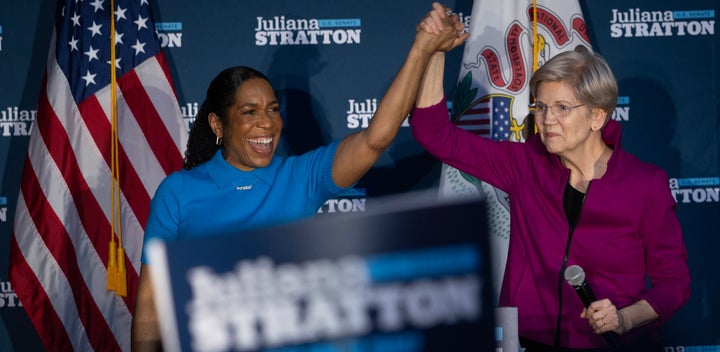
“This season, we are seeing much more explicit condemnation of Super PAC spending on both cryptocurrency and AI,” White said, pointing to statements by Democratic candidates Juliana Stratton and La Shawn Ford in Illinois. “I think it’s probably the start of a trend, and one that could be resonating with voters, because we saw some pretty strong pushback from the crypto industry’s favorite candidates in Illinois, with limited exceptions.”
Scott Olson via Getty Images
There, the leading cryptocurrency-funded super PAC, Fairshake, spent $10 million attacking Stratton, the state’s lieutenant governor, in the Democratic Senate primary, angry over state-level legislation regulating the industry. He also spent $2.5 million attacking Ford, a state senator running for Congress. Both candidates won anyway. (The group successfully defeated state Sen. Robert Peters in his House race.)
Fairshake declined to comment for this story.
The relative success of Ford and Stratton has some Democrats reconsidering their approach to an industry they feared actively alienating after Porter’s 2024 loss.
Porter, an acolyte of crypto industry foe Sen. Elizabeth Warren, is now running for governor. Last summer, he met with the co-founder of crypto company Ripple and received a donation of $39,200. the executive he later told Politico He found Porter’s “willingness to learn and participate” refreshing.
Many progressives were making similar calculations as an election season approached in which the artificial intelligence industry and AIPAC similarly threaten to spend millions of dollars on television ads attacking their enemies.
“You can only withstand so many incoming attacks, and sometimes you have to be smart about choosing your enemies,” said one progressive campaign strategist who advised his clients to avoid angering the industry and requested anonymity to speak candidly about strategy. “Say what you want about the crypto industry, they haven’t helped cover up a genocide for the last three years.”
The strategist clearly noted that most candidates also cannot count on financial support to respond to crypto ads like Stratton would: Illinois Governor JB Pritzker donated $5 million to a super PAC supporting her.
There has also been some confusion over how the crypto industry chooses its targets. Evanston Mayor Daniel Biss, a Democrat who won on Tuesday and is now headed to Congress, earned an “A” grade on the Stand With Crypto website, reportedly based on his responses to the questionnaire. But the Warren-backed progressive said he would not be an ally of the industry in Congress.
“I believe that financial regulation with both traditional financial institutions and these new and dangerous cryptocurrencies is critical to the well-being of the nation,” he said in an interview with News themezone before the election. “I can’t speak to their qualification process, but I can say they won’t have a friend if I’m elected.”
The spending comes even as values of Bitcoin and other “digital assets” have plummeted in recent months, collectively falling from more than $4 trillion last fall to just over $2 trillion.
And for all the industry’s success in creating and electing winners in the 2024 election cycle, they haven’t had much success in pushing legislation forward.
Congress passed a bill that essentially gives the government’s blessing to stablecoins, a type of cryptographic token pegged to the value of the dollar, but a more ambitious bill, giving the industry the lenient regulation of its dreams, has stalled. Republicans are waiting for banks and crypto companies to resolve their differences over a proposal to allow stablecoins to pay interest-like returns.
Meanwhile, Democrats have been silent on what is known as “market structure” legislation. It seems unlikely that as many Senate Democrats will be willing to vote for the larger bill as they voted for the stablecoin bill, which was dogged by complaints about President Donald Trump’s brazen use of digital assets to enrich his family, a corrupt spectacle that is it only becomes more obvious.
Heather Diehl via Getty Images
In an interview with News themezone, Green said he was proud to have received an “F” grade from the Support cryptocurrencies website, which, before the election, had counted against him his votes against pro-cryptocurrency legislation and the skeptical comments he had made during the House Financial Services Committee hearings.
“This is an F I’m going to talk about for the rest of my life, because I think what I’ve been doing is appropriate,” Green said. “But apparently the crypto industry doesn’t want any regulation at all, or if they have it, as little as possible, or regulation they deem appropriate, without input from people like me in Congress.”
Green said a source told him that his opponent, Menefee, had a victory party planned for the night of the Texas primary earlier this month. Now the winner will have to wait for a second round in May.
Menefee said he does not own cryptocurrency and did not ask for industry help for his campaign. He said he supports sensible regulations and rooting out scams, and suggested that the blockchain technology underlying crypto tokens could have useful real-world applications, such as preserving the accuracy of mortgage deeds.
“I’m committed to having a thoughtful and substantive approach to technology that we know is not going anywhere. We can’t bury our heads in the sand. People are using it. Young people are using it at a very high rate,” Menefee told News themezone.
The runoff is less a referendum on cryptocurrencies than a question of whether it’s time to “pass the torch” to a younger generation, Menefee said. (Green is 79 and Menefee is 37.)
As for Green’s claim that he had scheduled a victory party on primary night, Menefee said his campaign had the same kind of viewing party that every campaign has.
“He’s been in Congress for 20 years and he came in second,” Menefee said. “If the congressman had been so tough on our communities, if he had been doing the job, if he had stood up to Donald Trump, if he had kept his communities, if he had made them better, he wouldn’t have come in second place.”