



Cyberatack interrupts systems, cause delays in the main European airports
/ News/ AP
A cyber attack aimed at check-in systems and boarding has interrupted air traffic and has caused delays in several of the main airports in Europe, authorities said on Saturday, although the initial impact seemed to be limited.
The interruptions to the initially reported electronic systems in Brussels, the Brandenburg airports in Berlin and Heathrow in London meant that only manual check-in and embarkation were possible. Many other European airports said their operations were not affected.
“There was a cyber attack on Friday, September 19 against the service provider for registration and shipping systems that affect several European airports, including Brussels airport,” Brussels airport said in a statement, initially informing a “great impact” on flight schedules.
Airports said the problem focused on a check-in and shipping systems provider, not airlines or airports themselves.
Collins Aerospace, whose systems help passengers to register, print shipping passes and bag tags and dispatch their luggage from a kiosk, cited a “cyber interruption” to their Muse Software (multiple systems environment) in “selected airports.”
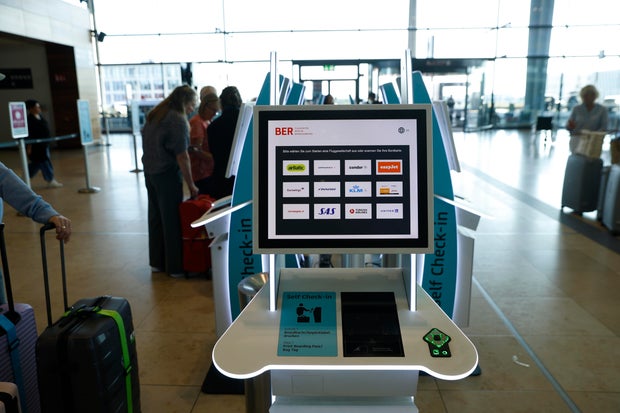
‘A very intelligent cyber attack’
It was not clear immediately who could be behind cyber attack, but experts said it could be hackers, criminal organizations or state actors.
Travel analyst Paul Charles said he was “surprised and shocked” by the attack that has affected one of the world’s main defense and aviation companies.
“It is deeply worrying that a company of that stature that normally has such resistant systems has been affected,” he said.
“This is a very intelligent cyber attack because it has affected a series of airlines and airports at the same time, not only an airport or an airline, but they have gotten into the central system that allows airlines to effectively verify many of their passengers in different desks in different airports in Europe,” he told Sky News.
As the day progressed, the consequences seemed to be contained.
Brussels airport spokesman Ihsane Chioua Lekhli told the VTM station that in the middle of the morning, nine flights had been canceled, four were redirected to another airport and 15 delays of an hour or more. She said it was not clear immediately how long the interruptions could last.
Axel Schmidt, head of communications at Brandenburg airport, said that late in the morning, “we have no canceled flight due to this specific reason, but that could change.” Berlin airport said the operators had cut the connections to the affected systems.
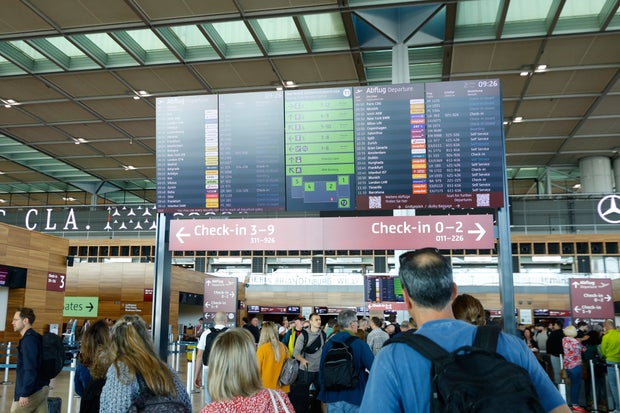
Heathrow, the most busy airport in Europe, said the interruption has been “minimal” without flight cancellations directly linked to the problems that afflict Collins. A spokesman would not provide details about how many flights have been delayed as a result of cyber attack.
Airports advised travelers to verify the status of their flight and apologize for any inconvenience.
Frustration in the counters
Some passengers expressed discomfort due to the lack of personnel. With many, if not most, verifying individually, airlines have reduced the number of people operating in traditional registration counters.
Maria Casey, who was going to a two -week backpack holiday in Thailand with Etihad Airways, said he had to spend three hours in the luggage record at Heathrow terminal 4.
“They had to write our luggage eyelashes by hand,” he said. “Only two desks were treated, for what we take away.”
Collins, a aviation and defense technology company that is a subsidiary of RTX Corp., previously Raytheon Technologies, said he was “actively working to solve the problem and restore complete functionality to our clients as quickly as possible.”
“The impact is limited to the client’s electronic check-in and the fall of luggage and can be mitigated with manual registration operations,” he said in a statement.
Airline industry vulnerable to the use of third -party platforms
Even so, experts said the attack pointed to vulnerabilities, which hackers are increasingly trying to exploit.
Charlotte Wilson, head of company of the Czech Point cybersecurity firm, said the aviation industry has become an “increasingly attractive objective” for cybercriminals due to their great dependence on shared digital systems.
“These attacks often cross the supply chain, exploiting third -party platforms that use multiple airlines and airports at the same time,” he said. “When a supplier looks compromised, the domino effect can be immediate and high range, causing a generalized interruption between the borders.”
The experts said it was too soon to say who could be behind the attack, and that they were trying to read some clues.
“It looks almost more to vandalism than extortion, according to the information we have,” said James Davenport, a professor of information technology at the University of Bath in England. “I think new significant details would have to arise to change this opinion.”
- Cybercrime
- Cyberata
- Belgium
- Traffic
- Germany
- London