



Iran says there is a ‘clearer path forward’ towards nuclear deal with US after talks in Geneva under Trump’s shadow
/News themezone
Add News themezone on Google
American and Iranian negotiators met in Geneva on Tuesday for high-stakes talks, with President Trump’s threat to launch a new attack on the Islamic Republic if a deal cannot be reached on its nuclear program looming large in the discussions. Iran’s initial reaction to the meetings was positive, but there was no immediate readout from the US delegation.
The negotiations, mediated by Oman, focused on Tehran’s nuclear program, but Israel’s leader has pressed Trump to include limitations on Iranconventional ballistic missiles in any new agreement. Trump told Israeli Prime Minister Benjamin Netanyahu in December that if a deal could not be reached with Iran, the The United States would support Israeli attacks over Iran’s ballistic missile program, according to two sources familiar with the matter.
That threat of possible military action is backed by a significant US military presence in the waters around Iran, with an aircraft carrier attack group already in the area and another on the way.
In a speech in Tehran on Tuesday as talks began, Iranian Supreme Leader Ayatollah Ali Khamenei was characteristically dismissive of the American military threat, saying: “A warship is certainly a dangerous weapon, but even more dangerous is the weapon capable of sinking it.”
Speaking Monday night to reporters on Air Force One, Trump said he would be involved in the negotiations “indirectly.” He said Iran was “typically a very tough negotiator” but said he believes the regime wants to reach a deal.
“I don’t think they want the consequences of not reaching an agreement,” he said.
The US delegation in Geneva is led by Trump’s special envoy, Steve Witkoff, and his son-in-law, Jared Kushner. The Iranian team is headed by Foreign Minister Abbas Araghchi.
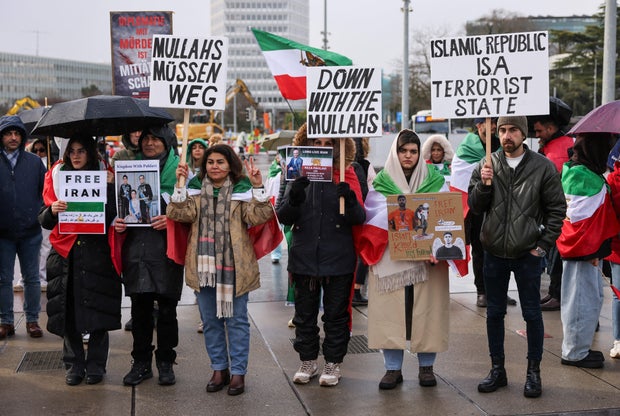
Iran says ‘path has begun’ towards deal after ‘more constructive’ talks
Aragachi said after Tuesday’s meetings that they were held indirectly, like the previous round a couple of weeks ago, with Omani officials traveling between the Iranian and American delegations.
“Compared to the previous one, the discussions were completely serious and the atmosphere more constructive,” he said, according to Iranian state television channel IRIB. “A number of ideas were presented and seriously considered. In the end, we were able to reach general agreement on a set of guiding principles, and from now on we will proceed on the basis of those principles and move towards drafting the text of a possible agreement. This does not mean that we can quickly reach a final agreement, but at least the path has begun.”
There was no confirmed timetable for this round of talks, but Tuesday’s discussions ended after several hours.
“We hope that this process can be completed as soon as possible and we are willing to devote sufficient time to it,” Aragachi said, according to IRIB. “When it comes to drafting the text, the work becomes more detailed and complex. In my opinion, good progress has been made compared to the previous session and we now have a clearer path ahead, which I consider positive.”
He said that “no specific date has been set” for the next meetings, but that “it was agreed that both sides will work on drafts of a possible agreement, then exchange those texts and then determine a date for the third round.”
What does Iran want?
Tehran is desperate for relief from damaging US economic sanctions. Iran was already constrained by a long list of international sanctions when President Trump, during his first term, unilaterally withdrew the United States from the 2015 international nuclear deal negotiated by his predecessor Barack Obama.
After doing so, Trump hit Iran with even more draconian economic punishment, and the sanctions have left the country’s finances in ruins, with sky-high inflation and a devaluation of the local currency making basic needs difficult to afford even for the relatively well-off.
Sanctions-induced economic suffering sparked an eruption of anger in early January, sparking an unprecedented wave of protests. violent and unprecedented repression in response.
Iranian authorities arrested thousands of people during the protests and have continued to threaten anyone deemed to have supported the unrest. But to avoid another mass uprising, the Islamic Republic’s leaders know the best option would be to lift sanctions so Iranians can afford food and fuel again.
However, what you are not willing to do to make that happen is crucial. Iranian officials have insisted on preserving the country’s right to enrich uranium for a civil nuclear program.
In a social media post, Araghchi said he was in Geneva “with real ideas to achieve a fair and equitable agreement. What is not on the table: submission before threats.”
Iran has expressed its willingness to negotiate over its nuclear enrichment program, and Araghchi met before the talks in Geneva with Rafael Grossi, head of the United Nations’ International Atomic Energy Agency (IAEA).
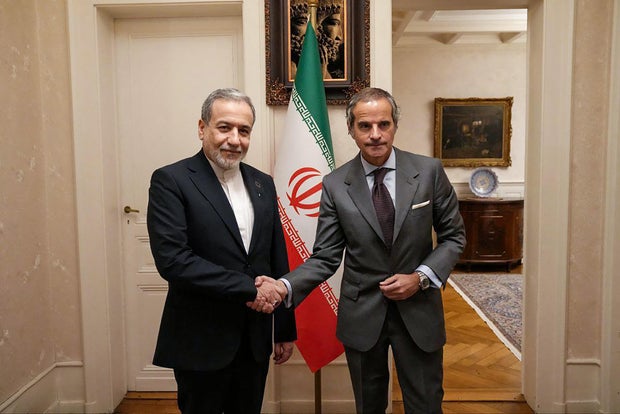
The IAEA was tasked with monitoring Iran’s adherence to the last nuclear deal, which slowly disintegrated after Trump withdrew the United States from the deal in 2018.
What does the United States want?
The US delegation is likely to push for demands designed to limit Tehran’s nuclear capabilities, including the possible reduction or elimination of Iran’s stockpile of enriched uranium and a new IAEA monitoring plan.
But the Trump administration has regularly consulted with Israel on the matter, and Netanyahu has been adamant that any new deal with Iran must include restrictions on ballistic missiles and Iran’s funding of proxy forces in the region. Israel also says Iran should not have any domestic nuclear enrichment capabilities.
It is unclear to what extent those demands will influence discussions in Geneva this week.
U.S. Secretary of State Marco Rubio said Monday there was hope for a diplomatic breakthrough, adding that President Trump “always prefers peaceful, negotiated outcomes over things.”
What preceded the conversations?
This round of negotiations comes after years of diplomatic false starts and a dramatic flare-up in June 2025, when the United States joined a 12-day Israeli war against Iran by carrying out Attacks on Iran’s nuclear facilities. Trump and Defense Secretary Pete Hegseth have claimed those strikes destroyed Iran’s nuclear program, but the extent of the damage has been questioned.
Before the June war, Iran had cited the United States’ withdrawal from the previous nuclear deal as it stepped up its enrichment program. had It began to enrich uranium up to 60% purity.a short and technical step away from weapons-grade levels, according to the IAEA, which said Iran was the only country in the world enriching at that level and not armed with the bomb.
The IAEA has been calling on Iran for months to improve transparency and cooperation with its inspectors, who continue to try to monitor its enrichment program.
Trump described as “very good” a first round of indirect talks held in Oman earlier this month, in which the Arab nation’s foreign minister spoke separately with Iranian and American negotiators, while Araghchi called the meeting a “good start.”
In:
- War
- Iran
- Israel
- nuclear weapons
- donald trump
- Ayatollah Ali Khamenei
- Middle East