



Lightning on Mars? Scientists believe that
/News/AP
Add News themezone on Google
Scientists have detected what they believe is lightning Mars eavesdropping on the swirl of wind recorded by NASA’s Perseverance rover.
The crackling of electrical discharges was captured by a microphone on the rover, a French-led team reported Wednesday.
Researchers documented 55 cases of “mini lightning” over two Martian years, mostly during dust storms and dust devils. Almost all occurred on the suns or windiest days on Mars, during dust storms and dust devils.
Just a few centimeters in size, the electrical arcs occurred within 6 feet of the microphone perched atop the rover’s tall mast, part of a system to examine Martian rocks through cameras and lasers. Sparks from electrical discharges, similar to static electricity here on Earth, are clearly audible amid the noisy gusts of wind and dust particles hitting the microphone.
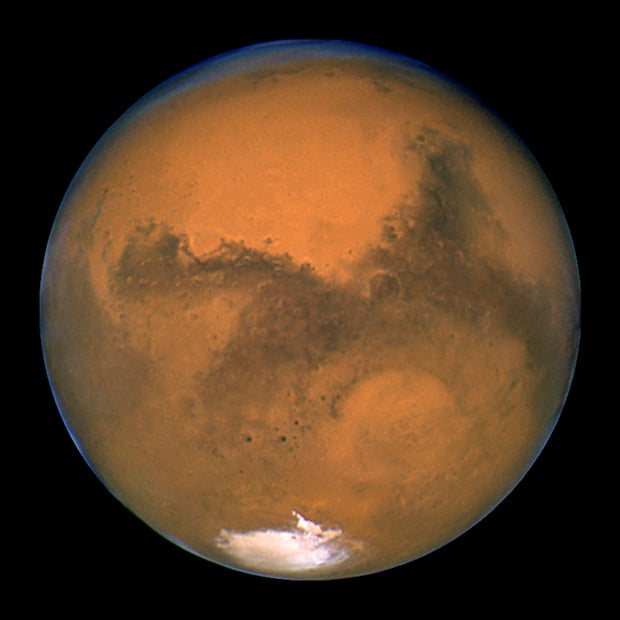
Scientists have been looking for electrical activity and lightning on Mars for half a century, said the study’s lead author, Baptiste Chide, of the Institute for Research in Astrophysics and Planetology in Toulouse.
“It opens up a whole new field of research for Mars science,” Chide said, citing the possible chemical effects of electrical discharges. “It’s like finding the missing piece of the puzzle.”
The evidence is strong and persuasive, but it is based on a single instrument that was intended to record the rover hitting rocks with lasers, not rays, said Daniel Mitchard of Cardiff University, who was not involved in the study. What’s more, he noted in an article accompanying the study in the journal Nature, the electric discharges were heard, not seen.
“It’s really a chance discovery to hear something else happening nearby, and everything points to it being a Martian lightning bolt,” Mitchard said in an email. But until new instruments are sent to verify the findings, “I think there will still be a debate by some scientists about whether this really was lightning,” he said.
“Like a storm on Earth, but barely visible to the naked eye”
Lightning strikes have already been confirmed on Jupiter and Saturn, and Mars has long been suspected of having them as well.
To find it, Chide and his team analyzed 28 hours of Perseverance recordings, documenting episodes of “mini lightning” based on acoustic and electrical signals.
Electrical discharges generated by fast-moving dust devils lasted only a few seconds, while those generated by dust storms lasted up to 30 minutes.
“It’s like a storm on Earth, but barely visible to the naked eye and with many weak hits,” Chide said in an email. He noted that the thin Martian atmosphere, rich in carbon dioxide, absorbs much of the sound, making some of the impacts barely perceptible.
According to Chide, Mars’ atmosphere is more prone than Earth’s to electrical discharges and sparks through contact between grains of dust and sand.
“Current evidence suggests that it is extremely unlikely that the first person to walk on Mars could, while placing a flag on the surface, be struck by lightning,” Mitchard wrote in Nature. But “small, frequent static discharges could be problematic for sensitive equipment.”
These are not the first sounds from Mars transmitted by Perseverance. Earthlings have heard the rover’s wheels crunching on the Martian surface and the whirring of the blades of its helicopter companion, Ingenuity, which no longer flies.
Perseverance has been scouring a dry river delta on Mars since 2021, collecting rock samples for possible signs of ancient microscopic life. NASA plans to return these core samples to Earth for laboratory analysis, but delivery is on hold indefinitely while the space agency looks for cheaper options.
Blue Origin’s NASA Blue and Gold satellites on their way to study Mars
Earlier this month, Blue Origin Release its second heavy-lift New Glenn rocket that put two small NASA satellites on a long circular path toward Mars. The satellites aim to learn more about how the sun has slowly chipped away at the red planet’s once thick atmosphere.
The NASA-sponsored payload, managed by the University of California, Berkeley Space Sciences Laboratory, is composed of two small, low-budget satellites known as Blue and Gold that form the heart of the ESCAPADE mission: Escape, Plasma Acceleration and Dynamics Explorers. Launch windows to Mars typically open every two years when Earth and the Red Planet reach favorable positions in their orbits to allow direct flights using current rockets. The next such window will open in 2026.
The ESCAPADE probes, which will pass within 600 miles of Earth in November 2027, will perform speed-increasing gravity-assisted flybys, augmented by onboard propulsion, to eventually head to Mars. In total, the twin spacecraft will spend a full year in that initial bean-shaped orbit past the Moon and back, and another 10 months in transit to Mars. The probes will not reach the red planet until September 2027.
While the ESCAPADE mission is modest compared to more sophisticated Mars rovers and orbiters, the probes are designed to answer key questions about the evolution of the Martian atmosphere.
Mars once had a global magnetic field like Earth’s, but its molten core, which powered that field, largely froze over long ago, leaving only isolated, jagged remnants of that once-protective field in magnetized deposits.
Without a protective global field like Earth’s, the Martian atmosphere faces a constant barrage of high-speed electrons and protons ejected from the sun and from dense clouds of charged particles arising from powerful solar storms.
William Harwood contributed to this report.
In:
- Mars Rover Perseverance
- Mars
- Science
- POT