



NATO allies say Hegseth
/News/AP
Add News themezone on Google
Brussels — European allies in NATO on Thursday brushed aside concerns that the United States has stepped back from its leadership role as the world’s largest security organization, leaving them and Canada to do most of Europe’s defense.
US Defense Secretary Pete Hegseth did not attend Thursday’s defense ministers’ meeting at NATO headquarters in Brussels. His absence occurred after Secretary of State Marco Rubio he skipped the last meeting of NATO foreign ministers in December.
It is rare for members of a U.S. administration to miss a meeting of the organization’s top decision-making body, the North Atlantic Council, at ministerial level, let alone two meetings in a row.
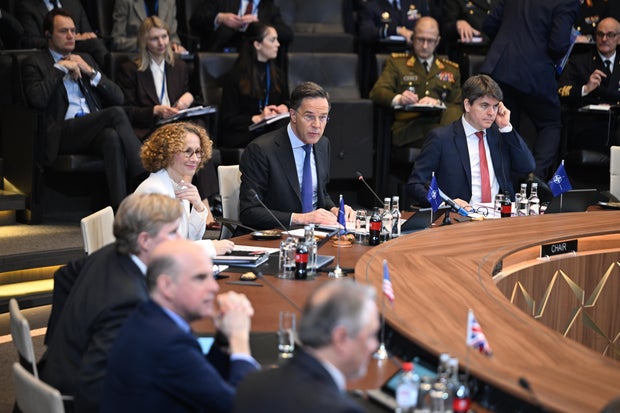
US Deputy Secretary of Defense Elbridge Colby was sent in Hegseth’s place.
Hegseth “misses a good party”, but Europeans downplay his absence
“Unfortunately for him, he is missing out on a good party,” Icelandic Foreign Minister Þorgerður Katrín Gunnarsdóttir told reporters. “Of course, it’s always better for ministers to attend here, but I wouldn’t call it a bad sign.”
“I am not disappointed,” said German Defense Minister Boris Pistorius. “Each of us has a full agenda. And once the American Defense Minister is here and once he is not, it is his decision and his duties that he has to fulfill.”
When asked what the purpose of NATO was in its infancy in 1949, NATO’s first secretary general, British general and diplomat Lord Hastings Ismay, was said to have responded: “To keep the Americans in, the Russians out, and the Germans down.”
Now Germany is taking a step forward. After Russia invaded Ukraine Four years ago, it pledged to spend $118 billion to modernize its military in the coming years.
A big part of NATO Secretary General Mark Rutte’s job is to keep the Americans in.
“You have to take care of the whole world. This is the United States,” Rutte told reporters before chairing the meeting. “I totally accept it, I agree with it.”
“They have always consistently called for Europe to do more, for Canada to do more and to do more of the defense of NATO territory, of course in conjunction with the United States,” he said.
That means more European spending on conventional weapons and defense, while the United States guarantees NATO’s nuclear deterrent.
But doubts persist and surprises from the Trump administration cannot be ruled out. Allies still wonder if there will be more US troops will be withdrawn from Europe.
US role in NATO shrinks under Trump
“What is most important to me is the no-surprises policy agreed between the NATO secretary general and the United States,” said Dutch Defense Minister Ruben Brekelmans.
At least publicly, the Trump administration is doing much less in NATO. A year ago, Hegseth warned that America’s security priorities lie elsewhere and that Europe would have to take care of itself and Ukraine in its battle against Russia’s full-scale invasion.
Supplies of American weapons and money that were sent to Ukraine by the previous administration of former President Joe Biden have dried up under the Trump administration. European allies and Canada are obliged to buy weapons from the United States to donate them now.
Western supporters of Ukraine also gathered at NATO on Thursday to drum up more military support. A plan proudly championed by the Pentagon during the Biden administration, the Ukraine Defense Contact Group is now chaired by the United Kingdom and Germany.
UK Defense Secretary John Healey announced that Britain would provide “an additional half a billion pounds ($682 million) in urgent air defense to Ukraine. This means Britain is a force for good in the world, building a new deal for European security within NATO.”
Sweden also intends to finance the purchase of more American weapons. The Netherlands will send more flight simulators to help Ukrainian fighter pilots train to fly F-16 aircraft.
Which nations will boost NATO’s Arctic Sentry mission?
The only “deliverable” from Thursday’s meeting was the formal announcement that NATO would launch Arctic Sentryhis response to US security concerns in the high north and an attempt to dissuade Trump from attempting to seize Green Earth.
It is apparently aimed at countering the activities or influence of Russia and China in the Arctic region.
But Arctic Sentry is essentially a rebranding exercise. National drills already underway in the region, such as those led by Denmark and Norway, will be under the NATO umbrella and overseen by the organization’s military chief. It is not a long-term NATO operation or mission.
Denmark, France and Germany will participate in the “military activities” that will take place under the Arctic Sentry, but have not said how.
Denmark’s Defense Minister Troels Lund Poulsen called the mission “very good news for us,” saying Thursday that the country “has made two packages for the Arctic with money for new Arctic ships, maritime patrol aircraft and strengthened satellite capacity. On top of that, we have signed an agreement to acquire additional F-35 fighter jets that can be used to solve tasks in the Arctic and the North Atlantic. So we are fulfilling our responsibility.” — and will only improve further under the auspices of NATO efforts.”
Finland and Sweden are also likely to take part, and Belgium is considering what role it could play.
“As a NATO ally, Sweden has a responsibility to contribute to the security of the entire Alliance territory. The Arctic region is becoming increasingly important from a strategic perspective. Our participation in Arctic Sentry demonstrates that we are a loyal and active ally that takes responsibility for our common security,” Prime Minister Ulf Kristersson said in a statement on Thursday.
It is not yet clear what role, if any, the United States will take.
A spokesperson for U.S. Air Force Gen. Alexus Grynkewich, NATO’s Supreme Allied Commander in Europe, told News themezone earlier this month that the new Arctic mission was being planned, calling it an “enhanced surveillance activity to further strengthen NATO’s posture in the Arctic and High North.”
The spokesperson told News themezone that planning had “barely begun, but details will be provided in due course.”
“It can’t just be more on the part of the United States,” US Ambassador to NATO Matthew Whitaker said before Thursday’s meeting. “We need capable, prepared and strong allies who can contribute assets to all these areas of our collective security.”
Mr. Trump has renewed threats last month to annex Greenland — a semi-autonomous territory of NATO ally Denmark — have deeply shaken the rest of the alliance. NATO’s primary role is to defend the territory of its 32 ember states, not undermine it.
European allies and Canada hope that Arctic Sentry and ongoing talks between the Trump administration, Denmark and Greenland will allow NATO to put the dispute behind it and focus on Europe’s real security priority: Russia’s war against Ukraine.
Belgian Defense Minister Theo Francken said the Arctic security deal at least means “we will stop having some food fights in the Atlantic.”
“I think the Greenland saga was not NATO’s best moment (in) the last 76 years,” he told reporters. “It was a crisis that was not necessary.”
In:
- War
- Ukraine
- donald trump
- Russia
- Porcelain
- Pete Hegseth
- European Union
- NATO