



Police raid in Brazil leaves at least 119 dead, sparks protests and reports of executions and beheadings
/News/AP
A massive police raid against a drug gang embedded in poor neighborhoods of Rio de Janeiro that left at least 119 people dead sparked protests over excessive use of force on Wednesday and calls for Rio’s governor to resign.
Families of the dead denounced what they described as police executions, while the state government praised a successful operation against a powerful criminal group that has taken over large areas of the city.
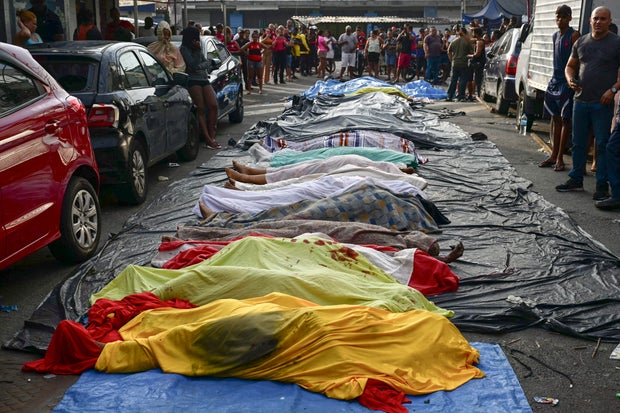
Dozens of favela residents gathered in front of the state government headquarters shouting “murderers!” and waving Brazilian flags stained with red paint, a day after Rio’s deadliest raid and hours after families and residents laid out dozens of bodies on a street in one of the targeted communities to show the magnitude of the operation.
BBC News verified several videos showing dozens of bodies arranged in a row in a market area of Rio, in the northern district of Penha.
Questions quickly arose about the death count and the condition of the bodies, with reports of disfigurements and stab wounds. Brazil’s Supreme Court, prosecutors and lawmakers asked Rio state governor Claudio Castro to provide detailed information about the operation.
“This was a massacre,” said Barbara Barbosa, a domestic worker in the Penha favela complex, one of two large communities targeted by the police operation. He said his son was killed in a previous operation in Penha.
“Do we have a death sentence? Stop killing us,” said activist Rute Sales, 56. Many residents of Penha, in the poor area of northern Rio, arrived by motorcycle to the imposing Guanabara Palace.
The death toll of 115 suspects and four police officers was an increase from what authorities originally said were 60 suspects killed in Tuesday’s raid by about 2,500 police and soldiers in the Penha and Complexo de Alemao favelas.
Felipe Curi, Rio state police secretary, said at a news conference that bodies of other suspects were found in a wooded area where he said they had been wearing camouflage while fighting with security forces. He said local residents had removed clothing and equipment from the bodies, in what would be investigated as tampering with evidence.
“These individuals were in the forest, equipped with camouflage clothing, vests and weapons. Now many of them appeared in underwear or shorts, without equipment, as if they had entered through a portal and changed their clothes,” Curi said.
Earlier on Wednesday, in the Penha neighborhood, residents surrounded many of the bodies – collected in trucks and displayed in a main square – and shouted “massacre” and “justice” before forensic authorities arrived to recover the remains.
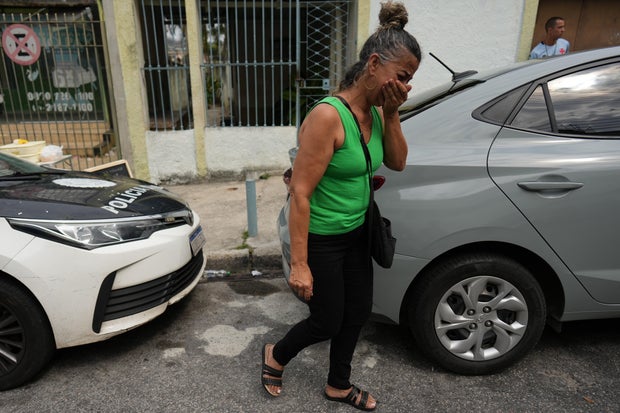
“They can take them to jail, why kill them like that? Many of them were alive and asking for help,” said resident Elisangela Silva Santos, 50, during the rally in Penha. “Yes, they are traffickers, but they are humans.”
“They slit my son’s throat”
A day after the police operation paralyzed the city, residents of the Complexo da Penha favela recovered dozens of bodies in a forest on the outskirts, including one decapitated, according to News journalists.
“They cut my son’s throat, cut his throat and hung his head from a tree as if it were a trophy,” said Raquel Tomás, the mother of the 19-year-old who was found decapitated.
“They executed my son without giving him a chance to defend himself. He was murdered,” she told News, her voice shaking.
“Everyone deserves a second chance. During an operation, the police must do their job, arrest suspects, but not execute them,” Tomas added.
Lawyer Albino Pereira Neto, who represents three families who lost relatives, told News that some of the bodies had “burn marks” and that several of those killed were tied up.
Some were “murdered in cold blood,” he said.
“We saw people executed”
The number of suspects arrested was 113, compared to the 81 cited previously, Curi said. The state government said about 90 rifles and more than a ton of drugs were seized.
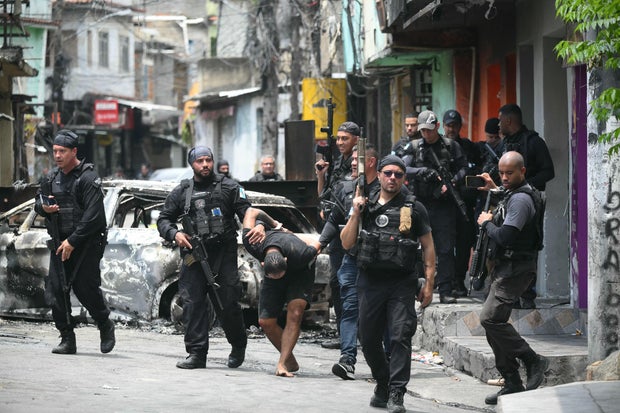
Police and soldiers had launched the raid in helicopters, armored vehicles and on foot, targeting the Red Command gang. They sparked shootings and other retaliation by gang members, leading to scenes of chaos across the city on Tuesday. Schools in affected areas closed, a local university canceled classes and roads were blocked with buses used as barricades.
Rafael Soares, a journalist covering crime in Rio, told BBC News Brazil that the Red Command had been on the offensive in Rio in recent years, reclaiming territory it had lost to its rivals, the First Capital Command.
Many shops remained closed Wednesday morning in Penha, where local activist Raull Santiago said he was part of a team that found about 15 bodies before dawn.
“We saw people executed: shot in the back, shot in the head, stabbed, people tied up. This level of brutality, the hatred that spreads, there is no other way to describe it other than as a massacre,” Santiago said.
Supreme Court Judge Alexandre de Moraes ordered Castro to provide information about the police operation and scheduled a hearing with the state governor and the heads of the military and civil police next Monday in Rio.
The Senate human rights committee said it was asking the Rio state government for clarification. Meanwhile, prosecutors in Rio asked Castro to provide detailed information about the operation and evidence that there were no less damaging means to achieve his objectives.
And the federal prosecutor’s office asked the Medical Examiner’s Institute to ensure that autopsy reports contained complete descriptions and photographic and radiographic documentation of all injuries.
Castro said Tuesday that Rio was at war against “narcoterrorism,” a term echoed by the Trump administration in its campaign against drug smuggling in Latin America.
On Wednesday, Castro called the operation a “success,” in addition to the death of the four police officers.
The Rio state government said the slain suspects had resisted police.
Rio has been the scene of deadly police raids for decades. In March 2005, some 29 people were murdered in the Baixada Fluminense region of Rio, while in May 2021, 28 were murdered in the Jacarezinho favela.
But the scale and lethality of Tuesday’s operation is unprecedented. Non-governmental organizations and the UN human rights body quickly expressed concern about the high number of reported deaths and called for investigations.
“We fully understand the challenges of having to deal with violent and well-organized groups like the Red Command,” said UN Human Rights spokesperson Marta Hurtado.
But Brazil must “break this cycle of extreme brutality and ensure that police operations meet international standards on the use of force,” he said, adding that the body was calling for comprehensive police reform.
Late Wednesday, President Luiz Inácio Lula da Silva said in X that he had ordered the Minister of Justice and the director general of the Federal Police to meet with Castro in Rio.
Brazil cannot accept that organized crime “continues to destroy families, oppress residents and spread drugs and violence in cities,” he said.
The stated objectives of the operation were to capture leaders and limit the territorial expansion of the Red Command gang, which has increased its control over the favelas in recent years.
Gang members allegedly attacked police with at least one drone. The Rio de Janeiro state government shared an X-rated video of what appeared to show a drone firing a projectile from the sky.
“Bomb-dropping drones are now a trend used by heavily armed criminal groups,” Carlos Solar of the Royal United Services Institute told the BBC.
Rio “alone in this war”
Governor Castro, of the conservative Liberal Party, said Tuesday that Rio was “alone in this war.” He said the federal government should provide more support to combat crime, in a blow to Lula’s leftist administration.
His comments were questioned by the Justice Ministry, which said it had responded to requests from the Rio state government to deploy national forces to the state, renewing their presence 11 times.
Gleisi Hoffmann, the Lula administration’s liaison to parliament, agreed that more coordinated action was needed, but pointed to a recent crackdown on money laundering as an example of the federal government’s action against organized crime.
Justice Minister Ricardo Lewandowski said it was clearly an extremely bloody and violent operation.
“We should reflect on whether these types of actions are compatible with the democratic rule of law that governs us all,” he told reporters on Wednesday.
Criminal gangs have expanded their presence throughout Brazil in recent years, including in the Amazon rainforest.
Roberto Uchôa, of the Brazilian Public Security Forum think tank, said criminal gangs have grown stronger despite these types of operations, suggesting they are inefficient.
“Killing more than 100 people like this will not help slow down the expansion of the Red Command. The dead will soon be replaced,” said Uchôa.
France-Presse Agency contributed to this report.
In:
- Brazil
- drug bust