



Pope Leo brings message of peace to Lebanon after leaving Türkiye
/News/AP
Add News themezone on Google
Pope Leo XIV concluded his visit to Turkey on Sunday before heading to Lebanon, where he sought to bring a message of hope to its long-suffering people and strengthen a crucial Christian community in the Middle East. He preached similar messages of peace and unity, within his own Catholic community and more broadly during his previous stops in Türkiye.
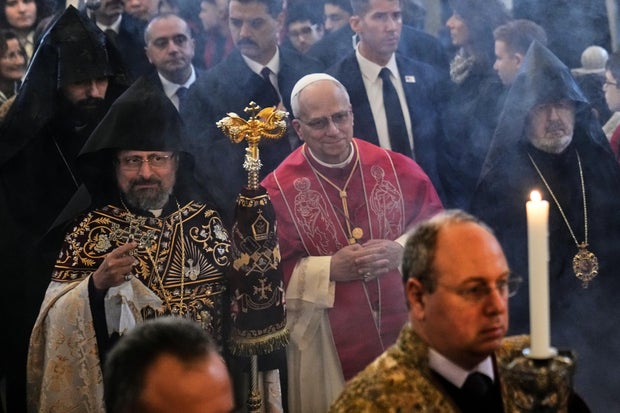
Leon had two key appointments in Istanbul before flying to Beirut: a prayer at the Armenian Apostolic Cathedral and a divine liturgy with Ecumenical Patriarch Bartholomew, the spiritual leader of the world’s Orthodox Christians, whose invitation to commemorate an important Christian anniversary was the impetus for Leon’s visit.
Leo processioned into the Armenian cathedral in a cloud of incense while a choir sang. He praised the “brave Christian witness of the Armenian people throughout history, often in tragic circumstances.” It was a reference to the massacre of Armenians by the Ottoman Turks in World War I.
Pope Francis called the massacre “genocide,” angering Turkey, which denies a genocide occurred. Leo was more diplomatic in his words on Turkish soil.
During his stay in Türkiye, the Pope also visited the city of Istanbul. Blue Mosquea historic Ottoman-era structure that has become a popular site for tourists.
“The Pope visited the Mosque in silence, with a spirit of reflection and listening, with deep respect for the place and the faith of those who were gathered there in prayer,” the Holy See press office said in a statement. He was accompanied by the Turkish Minister of Culture and Tourism, Mehmet Nuri Ersoy, the Provincial Mufti of Istanbul, Emrullah Tuncel, and the Grand Imam of the Sultan Ahmed Mosque (the Blue Mosque), Kurra Hafız Fatih Kaya.
In the second stage of his first papal trip, León will visit Lebanon at a precarious time for the small Mediterranean country after years of successive crises. He is fulfilling a promise from Pope Francis, who had wanted to visit him for years, but couldn’t because his health worsened.
Francis often quoted Saint John Paul II, who in 1989 said that Lebanon was more than just a country. It was a “message”, a message of brotherhood and coexistence. Under Lebanon’s power-sharing system, the country’s president is always a Maronite Christian, the prime minister a Sunni Muslim, and the speaker of parliament a Shia.
Lebanon, a Muslim-majority country where about a third of the population is Christian, has always been a priority for the Vatican, a stronghold for Christians throughout the region. After years of conflict, Christian communities dating back to the time of the Apostles have dwindled.
Leo was expected to try to encourage Lebanese who believe their leaders have failed them and encourage Lebanese Christians to stay or, if they have already moved abroad, to return home.
“The Holy Father comes at a very difficult time for Lebanon and for our region,” said Bishop George, archbishop of the Melkite Greek Catholic Archeparchy of Beirut. The Lebanese are worried about the future, he said, and still fear a possible return to all-out war with Israel.
“In this difficult time, the Pope’s visit is a sign of hope. It shows that Lebanon is not forgotten,” he told reporters before the visit.
In 2019, the country’s currency and banking system collapsed and many Lebanese saw their savings evaporate. The financial crisis caused shortages of electricity, fuel and medicines.
Another disaster struck in 2020, when hundreds of tons of ammonium nitrate improperly stored in Beirut’s port detonated in an explosion that devastated surrounding neighborhoods, killing 218 people, injuring thousands more and causing billions of dollars in damage.
The highlight of Leo’s visit to Lebanon will come on his last day, December 2, when he will spend time in silent prayer at the site of the explosion on August 4, 2020 and meet with some of its victims.
Lebanese citizens were enraged by the explosion, which appeared to be the result of government negligence coupled with the economic crisis. But the investigation has repeatedly stalled and, five years later, no officials have been convicted.
There are hopes among the Lebanese that Leo will hold Lebanon’s political class accountable and insist that there can be no peace without truth and justice.
Another important moment will come when Leo meets with young Lebanese. It is hoped that he will give them words of encouragement, amid decades of flight abroad, while also acknowledging their disillusionment with the failures of previous generations.
After the Hamas-led attack on southern Israel on October 7, 2023, which sparked war in Gaza, the Lebanese militant group Hezbollah entered a low-level conflict with Israel that escalated into a full-blown war in September 2024, killing more than 4,000 people in Lebanon and causing widespread destruction.
Despite a US-brokered ceasefire that nominally ended the conflict two months later, Israel continues to launch almost daily airstrikes that it says are aimed at preventing Hezbollah from rebuilding.
The pope “is coming to bless us and for the sake of peace,” said Farah Saadeh, a Beirut resident walking along the city’s waterfront. “We have to wait and see what will happen after he leaves, and hope that nothing will happen after he leaves.”
Before Leo’s arrival, Hezbollah urged the Pope to express his “rejection of the injustice and aggression” to which the country is being subjected. It was a reference to the Israeli attacks. The group also urged its followers to line up along the path the papal convoy will take from the airport to the presidential palace to pay their respects.
Hezbollah, a primarily Shiite group, has allied itself with several Christian political groups in the country, including the Free Patriotic Movement and the Marada Movement.
However, the Christian party with the largest parliamentary bloc, the Lebanese Forces, opposes Hezbollah and has criticized the group for leading the country into war with Israel.
In neighboring Syria, hundreds of thousands of Christians fled during the country’s 14-year civil war.
The former autocratic country President Bashar Assad was overthrown in an offensive led by Islamist insurgents last December. Since then, there have been outbreaks of sectarian violence and some attacks against religious minorities, including a suicide attack on a church in Damascus in June.
While the new government has condemned attacks on minorities, many accuse it of turning a blind eye or being unable to control allied armed groups.
A delegation of about 300 Syrian Christians, led by a Melkite Greek Catholic priest, would travel to Lebanon to join a meeting between Leo and youth groups and pray at a public mass on Beirut’s waterfront.
“We need someone like the Pope to come and give us hope as Christians” at a time of “fear of an unknown future,” said Dima Awwad, 24, one of the members of the delegation. “We hope that the Pope comes to visit Syria as he visited Lebanon, to reassure people and feel that we are present as Eastern Christians and that we should be in this place.”
In:
- Religion
- Turkey
- Lebanon
- Middle East
- Pope Leo XIV
- Beirut
- Catholic church