



Satellite images reveal
/News/News
Satellite images suggest mass killings are likely to continue in and around Sudan’s El-Fasher, Yale researchers said, as Germany’s top diplomat on Saturday described the situation there as “apocalyptic.”
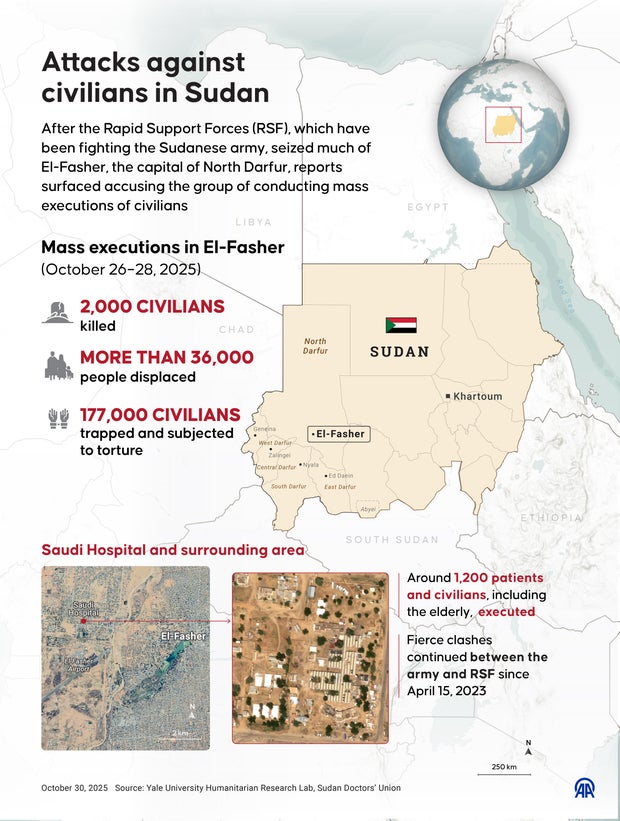
At war with the regular army since April 2023, the Rapid Support Forces seized El-Fasher on Sunday, driving the military from its last stronghold in the western Darfur region after a grueling 18-month siege.
Since the fall of the city, reports have emerged of summary executions, sexual violence, attacks on aid workers, looting and kidnappings, while communications remain largely cut off.
El Fasher survivors who reached the nearby town of Tawila told News of mass killings, children shot in front of their parents and civilians beaten and robbed as they fled.
Hayat, a mother of five who fled the city, said that “the young people who were traveling with us were detained” along the way by paramilitaries and “we don’t know what happened to them.”
Yale University’s Humanitarian Research Laboratory said new satellite images from Friday showed “no large-scale movement,” giving them reason to believe that much of the population could be “dead, captured or in hiding.”
– Humanitarian Research Laboratory (HRL) at YSPH (@HRL_YaleSPH) November 1, 2025
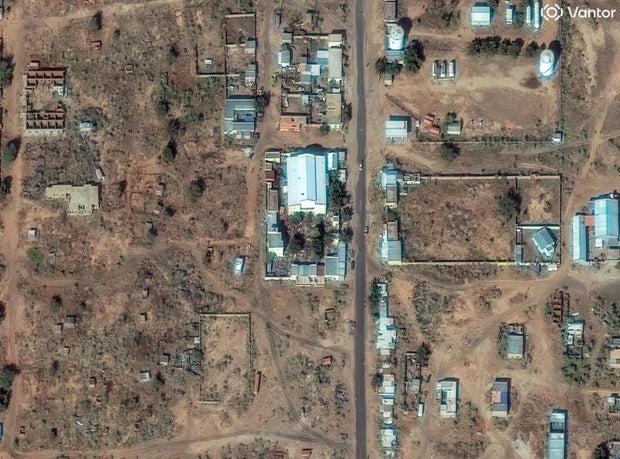
The lab identified at least 31 groups of objects consistent with human bodies between Monday and Friday, in neighborhoods, university grounds and military sites.
“The indicators that mass killings are continuing are clearly visible,” the lab said.
The lab also analyzed satellite images showing RSF vehicles in the Daraja Oula neighborhood in recent days.
“Yale HRL interprets the activity visible in satellite images on October 27 and 28 as reflecting high-speed killings and evictions of people in that neighborhood,” the lab writes. “By October 31, 2025, the change in activity may reflect that few people are left alive.”
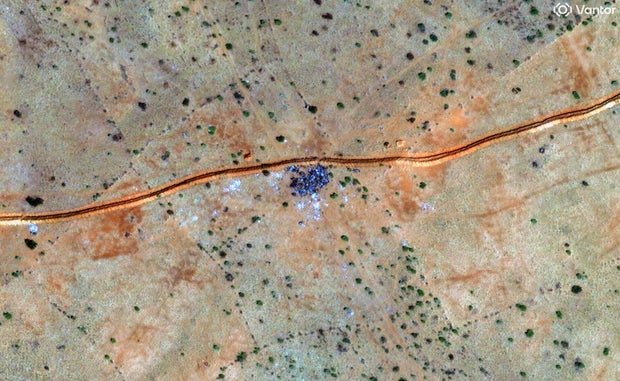
He laboratory said previously that there was “evidence of hand-to-hand combat” in El-Fasher, and that the activity “may be consistent with reports that RSF has taken prisoners in and around the [army] aerodrome.”
The UN says more than 65,000 people have fled El-Fasher, but tens of thousands remain trapped. Around 260,000 people were in the city before the final RSF assault.
At a conference in Bahrain on Saturday, German Foreign Minister Johann Wadephul said Sudan was “an absolutely apocalyptic situation, the biggest humanitarian crisis in the world.”
He added that RSF “is committed to protecting civilians and will be held accountable for these actions.”
“Really horrible”
At the same event, British Foreign Secretary Yvette Cooper also described the reported abuses as “truly horrifying.”
“Atrocities, mass executions, famine and the devastating use of rape as a weapon of war, while women and children bear the brunt of the greatest humanitarian crisis of the 21st century,” she said.
Unverified images posted on social media appeared to show RSF fighters walking among dead bodies and wounded civilians as fighters celebrated inside El-Fasher last Sunday.
The RSF said on Thursday it had arrested several fighters accused of abuses during the capture of El-Fasher, and the head of the paramilitary group, Mohamed Hamdan Daglo, promised to be held accountable to “anyone who made a mistake.”
However, UN humanitarian chief Tom Fletcher questioned RSF’s commitment to investigating these atrocities.
Both the RSF (descendants of the Janjaweed militias accused of genocide in Darfur two decades ago) and the army have faced accusations of war crimes over the course of the conflict.
The United States has previously determined that RSF committed genocide in Darfur.
The RSF has received weapons and drones from the United Arab Emirates, according to UN reports, although Abu Dhabi has denied giving support to the paramilitary group.
Meanwhile, the military has enjoyed support from Egypt, Saudi Arabia, Iran and Türkiye.
The capture of El-Fasher gives the RSF full control over Darfur’s five state capitals, effectively dividing Sudan along an east-west axis, while the army controls the north, east and center.
UN officials have warned that violence is spreading to the neighboring region of Kordofan, and reports have emerged of “large-scale atrocities perpetrated” by the RSF.
Sudanese civil society The war broke out in April 2023.when a power-sharing agreement between army commanders and the RSF collapsed over plans to combine their forces. Fighting has continued since then and both sides have been accused of alleged war crimes as fighting fuels what the UN considers the world’s largest humanitarian crisis.
In:
- Sudan