



Thailand and Cambodia sign new ceasefire agreement after weeks of fighting
/News/AP
Add News themezone on Google
Thailand and Cambodia signed a ceasefire agreement on Saturday after weeks of deadly fighting along its border over competing territorial claims.
The long border conflict between neighbors revived this monthbreaking an earlier truce and killing at least 47 people, according to official counts. About a million people have also been displaced.
The agreement came into force at noon local time and calls for the cessation of military movements and violation of airspace for military purposes.
Only Thailand has carried out airstrikes, hitting sites in Cambodia as recently as Saturday morning, according to Cambodia’s Defense Ministry.
The agreement also requires Thailand, after the ceasefire has been in place for 72 hours, to repatriate 18 Cambodian soldiers it has held prisoner since previous fighting in July. His release has been one of the main demands of the Cambodian side.
Within hours of the signing, Thailand’s Foreign Ministry protested to Cambodia that a Thai soldier had suffered permanent disability when he stepped on an antipersonnel landmine it claimed had been placed by Cambodian forces.
Defense Ministers met at the border to sign the agreement
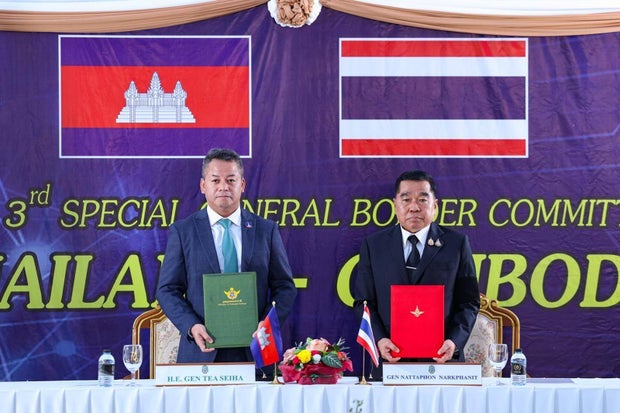
The agreement was signed by the defense ministers of both countries, Tea Seiha of Cambodia and Nattaphon Narkphanit of Thailand, at a border checkpoint. This followed three days of lower-level talks held by military officials.
It states that the parties are committed to an earlier ceasefire that ended five days of fighting in July and to follow-up agreements.
The original July ceasefire was negotiated by Malaysia and driven by pressure from US President Donald Trumpwhich threatened to withdraw trade privileges unless Thailand and Cambodia agreed. It was formalized in more detail in October at a regional meeting in Malaysia that Trump attended.
Despite those agreements, the countries waged a bitter propaganda war and minor cross-border violence continued, escalating into intense widespread fighting in early December.
Civilians were the most affected by the fighting
Thailand has lost 26 soldiers and one civilian as a direct result of combat since Dec. 7, according to officials. Thailand has also reported 44 civilian deaths.
Cambodia has not released an official figure on military casualties, but says 30 civilians have been killed and 90 wounded. Hundreds of thousands of people have been evacuated on both sides of the border.
“Today’s ceasefire also paves the way for displaced people living in border areas to return to their homes, work in the fields and even allow their children to return to schools and resume their studies,” Cambodian Defense Minister Tea Seiha told reporters after the signing.
Each side blamed the other for starting the fighting and claimed to be acting in self-defense.

The agreement also requires both sides to adhere to international agreements against the deployment of landmines, a major concern for Thailand.
Thai soldiers along the border have been injured in at least 10 incidents this year by what Thailand says are newly laid Cambodian mines. Cambodia says the mines are remnants of decades of civil war that ended in the late 1990s.
Following the latest casualty on Saturday, Thailand’s Foreign Ministry said the new agreement “includes key provisions on joint humanitarian demining operations to ensure the safety of military personnel and civilians in border areas as soon as possible.”
Another clause says the two sides “agree to refrain from spreading false information or fake news.”
The agreement calls for the resumption of previous measures to demarcate the border. The parties also agreed to cooperate in the repression of transnational crimes. This is primarily a reference to online scams perpetrated by organized crime that has defrauded victims around the world of billions of dollars each year. Cambodia is a hub for these types of criminal enterprises.
Malaysian leader praises deal
Malaysian Prime Minister Anwar Ibrahim, who was instrumental in bringing about the original ceasefire, said the new agreement “reflects a shared recognition that restraint is required, not least in the interests of civilians.”
Many clauses similar to those in Saturday’s agreement were included in the October ceasefire document, which were open to various interpretations and were generally only partially complied with. These included provisions regarding landmines and Cambodian prisoners.
The fragility of the new agreement was highlighted by Thai Defense Ministry spokesman Surasant Kongsiri in a press conference after the signing on Saturday. He said the safe return of civilians to their homes would indicate that the situation had stabilized enough to allow the repatriation of captured Cambodian soldiers.
“However, if the ceasefire does not materialize, this would indicate a lack of sincerity on Cambodia’s part to create a secure peace,” he said. “Therefore, the 72-hour ceasefire that begins today is not an act of trust or unconditional acceptance, but rather a time frame to tangibly demonstrate whether Cambodia can truly cease the use of weapons, provocations and threats in the area.”
In:
- Thailand
- Cease-fire
- Cambodia