



The European strategy of treating Trump like a real child didn’t work, now what?
WASHINGTON – After a full year of praising President Donald Trump as if he were a little boy who needs to be coaxed into eating his vegetables, only to have him threaten another NATO member anyway, the United States’ traditional European allies appear to be reconsidering that strategy.
“President Trump is acting like an international gangster,” Ed Davey, a member of the British Parliament, told his House of Commons colleagues on Tuesday. “He threatens to trample on an ally’s sovereignty, he threatens the complete end of NATO, and now he threatens to hit our country and seven European allies with outrageous and damaging tariffs unless he gets his hands on Greenland.”
Anders Vistisen, a Danish member of the European Parliament, was even more forceful, beginning his remarks at an official session in Brussels last week with: “Let me put this in words you can understand: Mr. President, go to hell.”
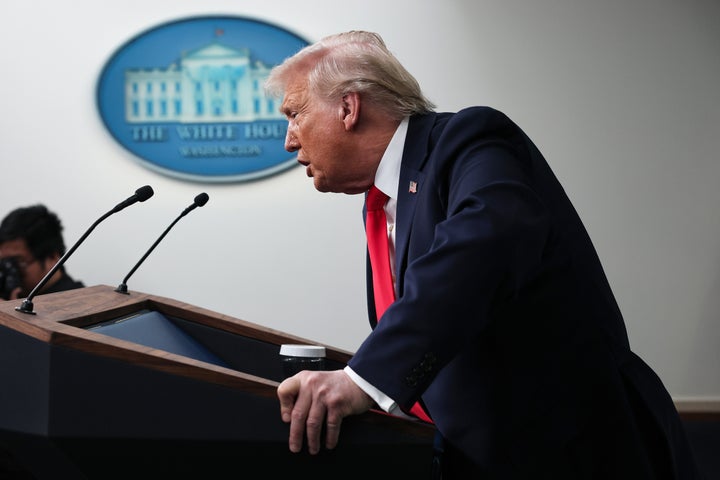
Win McNamee via Getty Images
Even officials at larger multinational organizations expressed frustration with Trump, who will deliver a speech at the World Economic Forum in Davos, Switzerland, on Wednesday.
“We will be pragmatic when we can and firm when we must be,” said Nadia Calvino, president of the European Investment Bank, a branch of the 27-member European Union.
The latest flashpoint came last weekend, when news broke that Trump had explicitly linked his willingness to seize Greenland (a semi-autonomous Danish territory) to the Norwegian Nobel Committee’s decision not to award him the peace prize last year.
“Considering that your country decided not to give me the Nobel Peace Prize for stopping 8 PLUS Wars, I no longer feel obligated to think only about Peace, although it will always be predominant, but can now think about what is good and appropriate for the United States,” Trump wrote to Norway’s prime minister, repeating his frequent lie about having stopped eight wars. “The world is not safe unless we have complete and total control of Greenland.”
The U.S. State Department then distributed the letter to other nations participating in a joint military exercise in Greenland in response to Trump’s threat to use force to take it. On Tuesday, those nations (Denmark, Finland, France, Germany, Netherlands, Norway, Sweden and the United Kingdom) issued a joint statement:
“Tariff threats undermine transatlantic relations and risk a dangerous downward spiral. We will continue to be united and coordinated in our response. We are committed to defending our sovereignty.”
So far, however, there appears to be no clear consensus on how to address Trump’s threat. The United States has by far the largest military among NATO’s 32 members and, throughout its seven-decade history, has played a central role in coordinating equipment and training.
Some nations were never enamored of the exaggerated blandishments adopted by NATO Secretary General Mark Rutte early last year as a way to prevent Trump from breaking with NATO while supporting Ukraine’s efforts to defend itself from Russia’s continuing invasion.
“Many people in Europe thought Rutte’s approach to Trump was wrong,” said one European diplomat, on condition of anonymity.
Rutte, who began addressing Trump as “Dear Donald” and repeatedly praised him for his leadership, defended the approach after the US president voiced his support for the transatlantic alliance at last year’s summit in The Hague.
“I think it’s a matter of taste,” Rutte told reporters at the end of the meeting. “Doesn’t he deserve some praise?”
Rutte has continued that tactic even as Trump openly threatens Greenland.
“Mr. President, dear Donald, what you accomplished today in Syria is incredible. I will use my media engagements in Davos to highlight your work there, in Gaza, and in Ukraine. I am committed to finding a way forward in Greenland. I can’t wait to see it,” he wrote in a private text message that Trump later posted on his social media platform in the early hours of Tuesday.
The annual gathering in Davos of the world’s richest business leaders and government officials from the largest economies has generally focused on banking and investment issues. That tradition has been disrupted by Trump’s recent obsession with obtaining Greenland despite Denmark’s lack of interest in losing it and residents’ lack of interest in joining the United States.
When the eight European allies agreed to hold joint exercises in Greenland, an enraged Trump responded by announcing 10% tariffs against them. Those tariffs could be increased to 25% if they do not agree to hand over Greenland.
French President Emmanuel Macron addressed the gathering in Davos on Tuesday joking about Trump (“It is a moment of peace, stability and predictability”) before criticizing his efforts to replace the rule of law in international affairs with might-makes-right imperialism.
“It is also a change towards a world without rules. Where international law is trampled and where the only law that seems to matter is that of the strongest,” Macron said. “We prefer respect to thugs… And we prefer the rule of law to brutality.”
Canadian Prime Minister Mark Carney, whose party came to power at least in part because of Trump’s repeated comments about making Canada the 51st state, never offered much praise for Trump and continued that approach in Davos.
“Let me be direct. We are in the middle of a breakup, not a transition,” Carney said. “Recently, great powers have begun to use economic integration as a weapon and tariffs as leverage.”
It is unclear how Trump will respond to the criticism. He long disliked NATO and falsely claimed that the alliance had cheated the United States by not paying its dues. One of his national security advisers during his first term said Trump intended to withdraw from NATO in his second term.
Upon returning to office a year ago, Trump stopped sending American weapons to Ukraine and is now forcing NATO allies to buy American weapons to give to the beleaguered democracy.
In a lengthy appearance before reporters at the White House on Tuesday, Trump asserted that the dispute over Greenland would be resolved amicably, although he refused to rule out military force.
When asked how far he was willing to go to acquire the island, he replied, “You’ll find out.”