



The issue that generates more fights between the Democratic parties than any other
WASHINGTON – The Democratic Party is in the midst of fierce intraparty debates over everything from health care to immigration enforcement to the war in Gaza, but the issue that could generate more primary fights than any other has as much to do with how candidates fill their campaign coffers as the policy positions they occupy.
Divisions among candidates over whether to accept corporate PAC money are emerging in at least four major Democratic Senate primaries this year (in Michigan, Minnesota, Texas and Illinois) and in a series of U.S. House nomination fights. Candidates who reject the money, typically but not always progressives, argue that their opponents’ ability to take on President Donald Trump and fight special interests is inherently hamstrung by their decision to accept donations.
“If you take money from certain people, it’s not like that money doesn’t come with strings attached,” said Abdul El-Sayed, a progressive who is running for an open Michigan Senate seat, although he rejects money from corporate PACs. “I have no commitment to any company that can gain from what I say or do.”
Those who accept the money, however, are working to muddy the waters by pointing out other ways their opponents have benefited from corporate money, portraying their opponents as holier than thou.
The fights have turned what was once an issue that united Democrats (both progressives and moderates rejected corporate PAC money during the 2018 midterm blue wave) into another intraparty pressure point, one that progressives have been happy to emphasize. They argue that the issue is more important than ever, especially now that technology and other powerful industries are doing everything they can to win Trump’s approval.
“People are fed up with a system rigged in favor of price-gouging corporations and understand that the corrupting influence of money in politics is a key factor why politicians have failed to reduce costs like health care and housing,” said Sen. Elizabeth Warren (D-Mass.). “Turning down corporate PAC money is a powerfully important signal to voters that you’re a gutsy Democrat who will really fight special interests.”
Warren and other progressives have begun to point to the rejection of corporate PAC money as an important litmus test. Sen. Chris Murphy (D-Conn.), another member of the so-called “fight club” from liberal senators he specifically pointed it out as a reason to support the Senate candidacy of Lieutenant Governor Peggy Flanagan in Minnesota and progressive Maine Senate candidate Graham Platner.
Direct corporate donations to candidates are illegal under federal law, although corporations can donate to both super PACs and nonprofit organizations involved in political activities. Corporate PACs, which are often controlled by an employee of a company or trade association, typically accept donations from a company’s executives and shareholders and then distribute the cash to favored candidates.
Corporate PAC money accounts for about 5% of the cash donated to federal campaigns each cycle, but rejecting it has become an important symbolic move for many Democrats and a handful of Republicans who argue it is representative of a political system where corporations have far more influence than typical voters. Some candidates who reject it are unlikely to receive much of it in the first place.
Michigan is perhaps the state where divisions are most stark, as evidenced by arguments at a candidate forum hosted by the United Auto Workers on Wednesday. After a UAW member asked directly if the candidates were accepting corporate PAC money, both El-Sayed and state Sen. Mallory McMorrow said no.
Rep. Haley Stevens, the most moderate of the three candidates and the preferred candidate of Democratic leaders in Washington, makes no apologies for her willingness to accept corporate PAC donations. Instead, he focused on his desire to overturn the Supreme Court’s Citizens United decision.
“I’m not a millionaire and I don’t own any stocks,” Stevens said. “I’m running my campaign from the grassroots.”
McMorrow, who accepted corporate PAC money early in his career but now avoids it, gently criticized Stevens for not answering the question: “We need to know who our next senator will work for.”
El-Sayed, for his part, made sure to highlight his consistency: “I am the only person on this stage who has never received a dime of corporate PAC money and never will.”
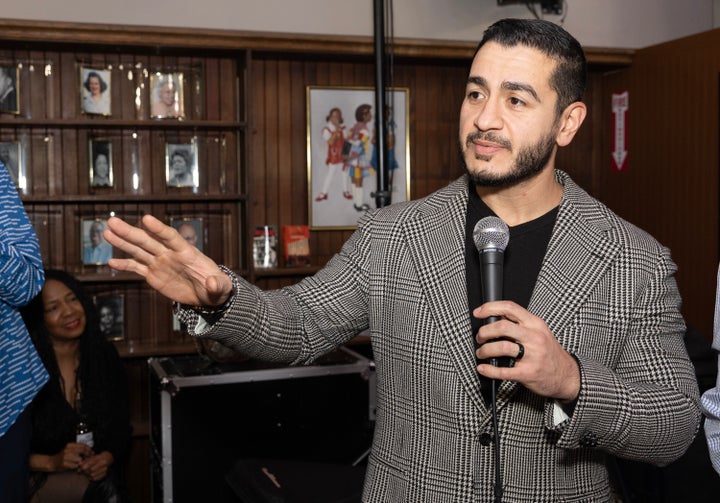
Monica Morgan via Getty Images
In an interview with News themezone before unveiling a plan last month focused on ensuring that municipalities benefit from the growing number of controversial data centers in Michigan, El-Sayed noted that his two opponents have accepted donations from PACs tied to utilities in the state that will benefit from increased electricity use.
State and federal campaign finance records show that PACs affiliated with three Michigan utilities donated $19,500 to McMorrow’s campaigns for state legislature and $58,500 to Stevens’ congressional campaigns.
“They say ‘follow the money,'” El-Sayed told News themezone.
McMorrow has said he accepted corporate PAC money early in his career because he thought it was necessary to win elections (he even once argued about it with progressives online in a now-deleted tweet), but he now rejects it because “corporate influence in federal politics is out of control.” Meanwhile, his campaign is ready to highlight how Stevens, who has amassed many union endorsements, has taken money from companies like Amazon and others with sketchy records on labor issues.
In Minnesota, the primary between Flanagan and Rep. Angie Craig has become a binary battle between progressives and moderates, with Flanagan eager to highlight the support Craig has received from the cryptocurrency and oil industries.
“You can’t shake your finger and say, ‘I’m going to hold [the cryptocurrency industry] “Responsible” and simultaneously have your other hand out and ask for a contribution to your campaign,” Flanagan said in an interview. “I think people have had enough and want people who are beholden to the voters and not to special corporate interests.”
But Craig has clearly pointed out that the Democratic Lieutenant Governors Association (which can legally accept direct donations from corporations) raised a lot of money from business interests while Flanagan chaired it.
“Since I first entered Congress I have fought to clean up Washington, from writing laws to prohibit members from trading stocks to fighting to end Citizens United, because our elected officials should be working on behalf of the people,” Craig said in a statement. “Meanwhile, Peggy Flanagan raised millions of corporate dollars as president of the DLGA, including from the pharmaceutical, tobacco, and oil and gas industries, and continues to lie about it.”
A similar fight has played out in Illinois, where Lt. Gov. Juliana Stratton has highlighted her refusal to accept corporate PAC money, in contrast to Rep. Raja Krishnamoorthi, a relative moderate and the frontrunner in the race.
In turn, Krishnamoorthi has criticized Stratton for benefiting from donations from both the DLGA and Gov. JB Pritzker, a billionaire who has endorsed her and spent millions on super PAC ads supporting her.
“Lieutenant Governor Stratton says she has a people-driven campaign,” Krishnamoorthi said at a debate in Chicago last week. “It’s driven by two people, and that’s wrong.”
In Texas, state Rep. James Talarico has highlighted his own refusal to accept corporate PAC donations in television ads. but has yet to launch attacks against Rep. Jasmine Crockett, who has accepted corporate PAC money throughout her career.
While it’s unprecedented for candidates to fight over corporate PAC donations in a primary (Rep. Alexandria Ocasio-Cortez highlighted former Rep. Joe Crowley’s corporate PAC donations in the lead up to her 2018 upset), the issue was largely one that united Democrats in recent years. Both progressive and moderate candidates, many of them encouraged by the campaign finance group End Citizens United, rejected corporate PAC money beginning in the 2018 cycle, when the party used an anti-corruption message to regain control of the House.
And many Democrats are still counting on it as a winning message in a general election, including 32 candidates running for seats picked by the Democratic Congressional Campaign Committee, as well as all the candidates in key opportunities for the party, such as No. 8 in Colorado, No. 2 in Nebraska and No. 1 in Arizona.
“We expect the 2026 midterm elections to look a lot like 2018,” said Tiffany Muller, the group’s president. “It’s a swing election – anti-government, anti-establishment, anti-status quo – and rejecting corporate PAC money is one of the clearest and most credible ways for candidates to differentiate themselves. Not only does it motivate the base, it also helps win over critical independent and undecided voters in the most competitive races. It’s good politics and good policy.”
But two Democratic operatives, who requested anonymity to speak candidly about divisions in the party, acknowledged that DCCC Chairwoman Susan DelBene, a former Microsoft executive and chairwoman of the moderate New Democrat caucus, was less enthusiastic than her predecessors about candidates who rejected corporate money. The DCCC did not respond to a request for comment.
Beyond the Senate primaries, progressives challenging Democratic House members in safe seats are also highlighting their rejection of corporate PAC money (even if there’s very little chance a corporate PAC will donate to a primary challenger with a safe blue seat to begin with), to argue that long-term incumbents are out of touch with politics today. Each of the candidates endorsed by the progressive group Justice Democrats this cycle has promised to reject corporate PAC money.
“Discontent with the corporate part of the Democratic Party is becoming broader,” said Usamah Andrabi, the group’s communications director. “Voters are realizing that a politician bought and sold by a corporate PAC is less likely to run afoul of the Trump administration.”