



The Pope visits Istanbul
/AP
Add News themezone on Google
Pope Leo XIV visited Istanbul’s Blue Mosque on Saturday on the second day of his trip to Turkey and highlighted the need for Christian unity in meetings and liturgies with the country’s Christian leaders.
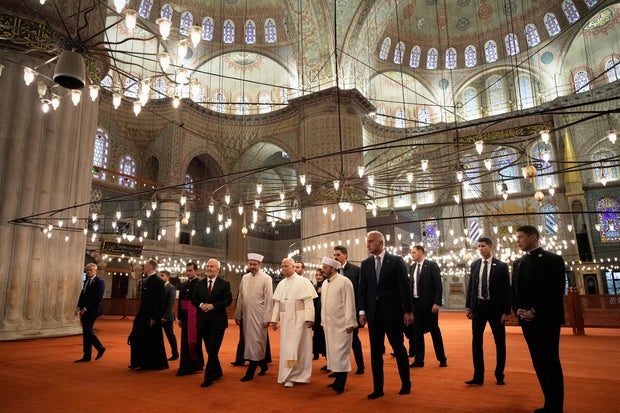
Leo was following in the footsteps of his recent predecessors, who made high-profile visits to the mosque in a gesture of respect to Türkiye’s Muslim majority. Leo did not pray at the mosque despite an imam’s invitation. Speaking to reporters after the visit, Asgin Tunca said he had told the Pope that the mosque was “the house of Allah.”
“It is not my house, nor yours, (it is the) house of Allah,” he said. He said he told Leo, “‘If you want, you can worship here,’ I said. But he said, ‘Okay.'”
“I wanted to see the mosque, I wanted to feel (the) atmosphere of the mosque, I think. And I was very happy,” he said.
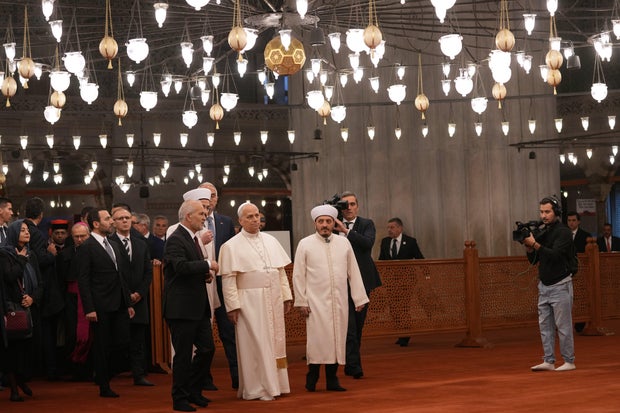
After the mosque visit, Leo met with Turkey’s Christian leaders at the Mor Ephrem Syrian Orthodox Church.
This is the Pope’s first trip abroad. He will also visit Lebanon.
Leo, the first American pope in history, is expected to speak in broader terms about peace in the Middle East.
Papal visits to the Blue Mosque often raise questions
Other visits have always raised questions about whether the Pope would pray at the Muslim place of worship or at least pause to gather his thoughts in meditative silence.
When Pope Benedict XVI visited Turkey in 2006, tensions were high because Benedict had offended many in the Muslim world a few months earlier with a speech in Regensburg, Germany, that was widely interpreted as linking Islam to violence.
The Vatican added a visit to the Blue Mosque at the last minute in an attempt to reach out to Muslims, and Benedict was warmly received. He observed a moment of silent prayer, his head bowed, as the imam prayed at his side, facing east.
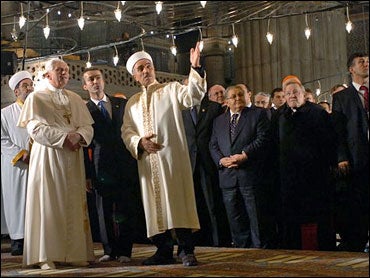
Benedict later thanked him “for this moment of prayer” for what was only the second time a pope had visited a mosque, after St. John Paul II visited one briefly in Syria in 2001.
There was no doubt in 2014 when Pope Francis visited the Blue Mosque: He stood for two minutes of silent prayer facing east, head bowed, eyes closed, and hands clasped in front of him. The Grand Mufti of Istanbul, Rahmi Yaran, later told the Pope: “May God accept it.”
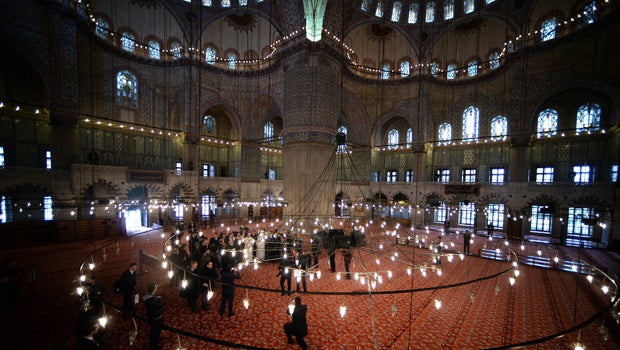
The Pope’s planned itinerary and Vatican spokesman had said before the trip that Leo would pause to pray as his predecessors had done at the imposing 17th-century mosque. But Leo limited himself to touring the mosque.
The Vatican had initially reported that the visit took place as planned. But he later revised the record to say he visited “in a spirit of contemplation and listening, with deep respect for the place and the faith of those who gather there in prayer.”
There were also other changes to the mosque visit.
The Vatican had initially said that the head of Diyanet’s religious affairs directorate would welcome Leo at the mosque. But the director, Safi Arpagus, was not there, and a Diyanet spokesman said Arpagus was not expected, noting that he met Leo upon his arrival in Ankara on Thursday.
The Vatican did not explain the discrepancy. Instead, Leo was received by the Turkish Minister of Culture and Tourism and several imams.
Pope Leo prays in the church of the leader of Orthodox Christians
Pope Leo XIV prayed at the patriarchal church in Istanbul of the spiritual leader of the world’s Orthodox Christians in another gesture of unity.
In the elaborate Church of St. George, Leo attended the doxology alongside Ecumenical Patriarch Bartholomew. The doxology is a short hymn of praise and glory to God that Christians sing.
Leo said he was sure that the “meeting will also help strengthen the bonds of our friendship.”
The Eastern and Western churches split in the Great Schism of 1054, a split precipitated largely by disagreements over the primacy of the Pope. Leo and the popes before him have promised to work to unite Christians again.
Bartholomew, for his part, highlighted the importance that León had in opening his pontificate with his visit to Türkiye.
The main reason for the visit was to commemorate the 1,700th anniversary of the Council of Nicaea, the unprecedented meeting of bishops that produced a creed, or proclamation of faith, still recited by millions of Christians today.
Hagia Sophia was left out of the itinerary
Previous popes have also visited the nearby Hagia Sophia landmark, once one of the most important historic cathedrals in Christianity and a designated world heritage site by the United Nations.
But Leo left that visit off his itinerary on his first trip as Pope. In July 2020, Türkiye converted Hagia Sophia from a museum to a mosque, a move that attracted Widespread international criticismeven from the Vatican.
After the mosque visit, Leo held a private meeting with Turkey’s Christian leaders at the Mor Ephrem Syrian Orthodox Church. In the afternoon, he was expected to pray with the spiritual leader of the world’s Orthodox Christians, Patriarch Bartholomew, at the Patriarchal Church of St. George.
There they had to sign a joint declaration. The Vatican said in its statements to the assembled patriarchs that Leo reminded them “that the division among Christians is an obstacle to their witness.”
He pointed to the next Holy Year that Christians will celebrate, in 2033, on the anniversary of the crucifixion of Christ, and invited them to go to Jerusalem on “a path that leads to full unity.”
Leo will end the day with a Catholic Mass at the Volkswagen Arena in Istanbul for the country’s Catholic community, which numbers 33,000 people in a country of more than 85 million people, the majority of whom are Sunni Muslims. Crowds of devout Catholics braved torrential rain and tight security for the event.
Maria Banasik waited for her friends at a cafe near the stadium, four hours before the scheduled mass, and said they were excited to be part of Leo’s first visit abroad.
“In the current world situation, his visit is of great importance,” said Banasik, a Polish citizen living in Ankara.
Airbus software update does not forgive the Pope
While Leo focused on strengthening relations with Orthodox Christians and Muslims, the trip organizers dealt with more mundane issues.
Leo’s ITA Airways Airbus A320neo was among those trapped in the global Airbus software updateordered by the European Union Aviation Safety Agency. The order came after an analysis found that computer code may have contributed to a sudden drop in altitude of a JetBlue plane last month.
Vatican spokesman Matteo Bruni said Saturday that ITA was working on the issue. He said the component needed to upgrade the plane was on its way to Istanbul along with the technician who would install it.
Leo is scheduled to fly from Istanbul to Beirut, Lebanon, on Sunday afternoon for the second leg of his maiden voyage as pope.
Lebanon increased security measures ahead of his visit. The Interior Ministry said in a statement on Saturday that trucks will be banned from entering the capital, Beirut, and the Mount Lebanon governorate from Sunday morning to Tuesday night. Trucks transporting food, water and fuel, as well as garbage trucks, will be excluded from the ban. Meanwhile, Defense Minister Michel Menassa issued an order prohibiting anyone from carrying weapons in the same areas starting midnight Saturday for three days.
In a statement on Saturday, the Lebanese militant group Hezbollah welcomed the pontiff’s trip to the crisis-hit nation, saying the group is committed to religious coexistence, democratic agreement and preserving its security in the country. Hezbollah is allied with several Christian groups in the country, including the Free Patriotic Movement and the Marada Movement.
In:
- Christianity
- Pope Francis
- Religion
- Vatican City
- Turkey
- Islam
- Pope Benedict XVI
- Pope Leo XIV
- Catholic church